
Russian Air Defense reported 249 drones shot down over Moscow ahead of the 2026 elections
 Dmitri Volkov
The Russian Air Defense Claimed 249 Drones Shot Down Over Moscow Ahead of the 2026 Elections
A figure that cannot be taken at face value
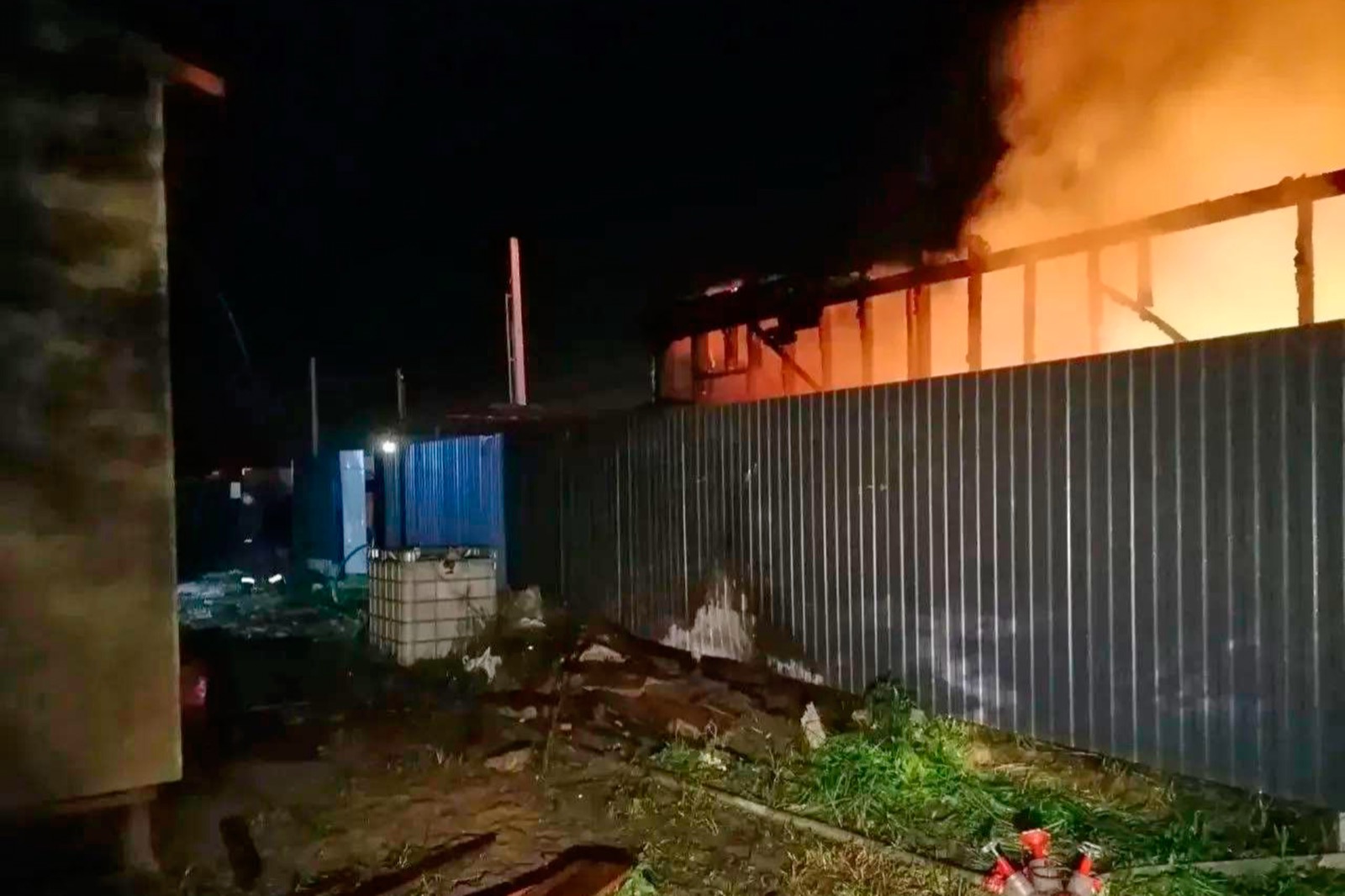
Archive image of the aftermath of a drone attack in the Moscow region. It is not directly related to the strike of September 19–20, 2026.
Russian regional authorities reported that 249 drones were destroyed over the Moscow region on the night of September 20. During the same period, Ukrainian sources spoke of an expanded geography of Russian strikes on Ukraine, while Poland raised its aviation as part of preventive measures. The figure of 249 is impressive, but in military analysis, it signifies not only the scale of the raid. It shows that the enemy is capable of saturating the defense system with multiple echelons of targets simultaneously, forcing Moscow to turn an ordinary night into an operation of national significance.
This figure remains a statement from the Russian side and has not received independent confirmation in full. As noted by Reuters, the Polish armed forces began preventive aviation operations on September 19 due to Russian strikes on Ukraine. The Kyiv Independent simultaneously reported a large drone attack on the Moscow region and the Russian authorities' statement about the destruction of 249 devices. The gap between the official "destroyed" and the actual impact is an old problem of Russian air defense statistics, dating back to the Soviet reporting system.
What the number 249 really indicates
The Russian layered defense around Moscow is not based on a single complex. It combines long-range systems from the S-400 family, shorter-range "Pantsir-S1" and "Tor-M2," radar posts, electronic warfare systems, and mobile units with firepower. Each element has its own area of responsibility and its own cost of error. A drone suppressed by electronic warfare may be reported as "neutralized," a device shot down by a missile as "destroyed," and one that crashes after losing control as a civil incident. Therefore, a single final figure conceals different outcomes and costs.
For the capital's defense, this problem is particularly unpleasant. A large low-speed drone does not require complex technology to create a disproportion between the cost of the attack and the cost of interception. If an expensive anti-aircraft missile is used against a single cheap device, the defense wins tactically but loses economically. If the unit waits for the target to enter the close zone, the risk of fire at an industrial site, damage to infrastructure, or panic among the population increases. This is the modern logic of drone warfare: it is not necessary to break through to the Kremlin; it is enough to force the enemy to constantly open new security lines.
The Russian command is likely trying to address this issue by expanding the detection network and shifting part of the burden to cheap means of destruction. However, this reveals an institutional weakness familiar from the campaign in Ukraine. The system, designed to repel a limited number of precision missiles, is poorly adapted to a prolonged flow of small targets. It may demonstrate a high interception rate in reports and still fail to prevent damage from several penetrated devices.
Election night and strategic communication
The attack coincided with the first parliamentary elections in Russia since the start of the full-scale war. This does not prove that the target of the Ukrainian operation was specifically the electoral infrastructure. However, the calendar changes the political significance of the raid. Russian authorities must simultaneously show the population control over the sky and explain why the air threat reached the central region. Hence, there is a natural motivation to inflate the number of downed targets: reporting becomes part of the regime's internal legitimization.
Kiev, for its part, seeks a different effect. Strikes on areas far from the front, oil infrastructure, and military sites demonstrate that Russian territory is not a safe rear. The Kyiv Independent points to the ongoing development of the Ukrainian campaign of deep strikes on oil facilities, logistics, military infrastructure, and arms production. Even if a specific raid causes limited physical damage, it forces Moscow to redistribute air defense from the front to internal areas and increase spending on the protection of facilities.
Why Poland raised its aviation
The Polish reaction is more significant than it may seem. The preventive raising of aviation does not mean NATO's entry into the war, but it indicates the normalization of the risk of Russian missiles and drones crossing into the alliance's borders. After several years of war, the eastern flank no longer views air incidents as exceptions. This turns the Russian strike campaign into a factor that affects the entire security architecture of Central Europe.
It is noteworthy that almost simultaneously, Washington approved a potential sale to Ukraine worth $2.7 billion for the modernization and development of air defense, as reported by Reuters. This is not an immediate supply of a ready-made "shield," but an investment in a long-term system: sensors, command, interoperability, training, and munitions. The Russian strategy of mass strikes thus accelerates precisely the process that Moscow would like to avoid — the transformation of Ukrainian air defense into a resilient multi-layered network linked to European defense infrastructure.
Forecast without victorious rhetoric
The current night does not prove either the collapse of Russian air defense or its complete effectiveness. It reveals a more uncomfortable reality: Russia can intercept a huge number of targets but cannot guarantee the absence of damage and cannot indefinitely increase defense without harming the front. Ukraine also did not achieve an automatic strategic breakthrough — drone attacks require constant production, intelligence, and route adjustments.
In the coming months, Moscow will likely strengthen anti-drone lines around the capital, expand restrictions on civil aviation, and use interception statistics as a political resource. Kiev will continue to seek cheap ways to overload Russian sensors and force the Kremlin to choose between protecting the front, the oil industry, and the symbolic center of the state. Russian air defense will survive, but its cost will rise faster than its ability to restore a sense of security. The drone war rarely ends with a single successful breakthrough; more often, it ends with even a well-protected capital gradually getting used to living in a besieged rear mode.
Russian air defense claimed the destruction of 249 drones over Moscow on September 20, 2026, amid heightened tensions and expanded strikes on Ukraine. This incident coincided with the first parliamentary elections since the onset of the full-scale war, prompting Poland to raise its aviation alert level. The reported number highlights the challenges faced by Russian air defense in managing multiple threats.
- Russian air defense claimed to have shot down 249 drones over Moscow on September 20, 2026.
- Ukrainian sources reported expanded Russian strikes on Ukraine during the same period.
- Poland raised its aviation alert level in response to the situation.
- The number of drones shot down reflects the challenges faced by Russian air defense systems.
- The attack coincided with the first parliamentary elections in Russia since the start of the full-scale war.