
Russian missiles and drones strike Kyiv on October 25, 2026 — negotiations give way to pressure again
 Dmitri Volkov
Russian missiles and drones strike Kyiv on October 25, 2026 — negotiations once again give way to pressure
Four intercepted missiles out of nine and fifty drones out of sixty-two — this is what the morning of October 25 looks like when you remove the usual rhetoric about the "high efficiency" of air defense. The Russian strike on Ukraine once again demonstrated not so much Moscow's ability to destroy individual targets, but rather its persistent strategy of exhausting urban air defense and political will. According to Ukrainian authorities and reports from AP, the attack resulted in at least four deaths and injuries to about two dozen people.
Composition of the strike and interception limits
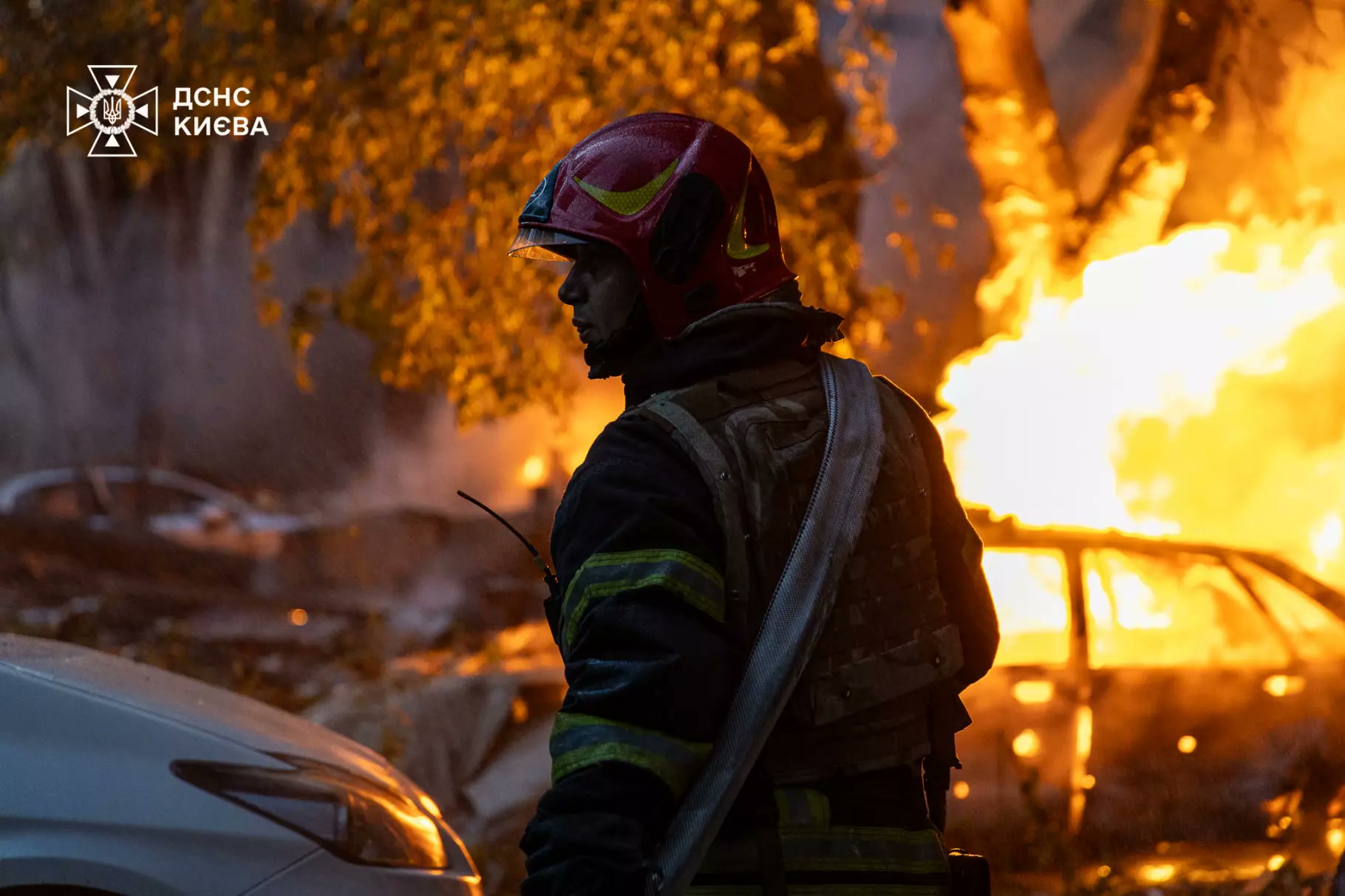
The Ukrainian Air Force reported nine ballistic missiles and sixty-two strike UAVs. Four missiles and fifty drones were reported as destroyed or suppressed. In the arithmetic of the official report, five missiles and twelve devices remain that reached the target area or required separate verification. This does not mean that each of them hit a target: some may have been suppressed by electronic warfare means, shot down later, or fell outside the intended point. But the ratio itself is important. The ballistic component still poses a qualitatively more difficult task for Kyiv than a mass raid of relatively cheap drones.
The Russian Ministry of Defense, for its part, reported intercepting 121 Ukrainian drones over Russian territory. These figures cannot be directly compared with Ukrainian data without independent verification; however, they demonstrate the symmetrical logic of the current air war: both sides measure success not only by destruction but also by the number of targets that force the opponent to expend expensive missiles, standby aircraft, and air defense units.
Why Moscow continues its strike campaign
In Russian military logic, a long-range strike is rarely a standalone operation. It must exert pressure on several levels simultaneously — on energy and transport, on governance and daily life, on Ukraine's Western partners. The current raid occurred against the backdrop of yet another American attempt to bring the parties back to discussions on a ceasefire. Therefore, it should be viewed not as a refutation of diplomacy but as its forceful accompaniment: Moscow demonstrates that negotiations do not negate the ability to raise the price of waiting.
A familiar mechanism from the late USSR is evident here. Military activity is used to expand the bargaining space, but not necessarily to achieve an immediate operational goal. The strike on Kyiv is intended to make the Ukrainian leadership consider the vulnerability of the rear, and Washington — to include air defense and arms supplies in any formula for a future agreement. This is the logic of coercion, not the logic of a lightning victory.
Drones as an economic tool of war
The main change in recent years is that the drone has become not just a munition but a means of overloading the entire defense system. Russia can launch large waves of devices, combining them with ballistic missiles and, according to reports from American media, reactive strike drones. Even if a significant portion of the targets is destroyed, the defender expends time, ammunition, and operator resources. The attacking side gains the opportunity to choose between an expensive destruction of a target and a cheap coercion of the opponent to maintain constant readiness.
But this approach has a downside. According to the Ukrainian Ministry of Defense as of October 24, just in the previous day, the Ukrainian side reported 1,855 destroyed Russian operational-tactical UAVs and 64 artillery systems. These estimates are military data from one side and require caution; however, even with this caveat, they show the scale of resource expenditure. The production problem for Russia is not whether it can assemble another batch of drones, but how long the industry can maintain the pace alongside the missile campaign and frontline needs.
Strategic effect for Russia and Ukraine
For Ukraine, the outcome is twofold. The level of drone interception remains high, but protection against ballistic means depends on a limited number of systems and munitions. Consequently, each new wave creates a distribution dilemma: to cover the capital, energy hubs, airfields, or troops at the front line. Without expanding multi-layered air defense, even successful nights do not eliminate structural vulnerability.
For Russia, the picture also does not appear to be an unconditional victory. Air strikes have not led to the cessation of Ukrainian resistance, and the Russian side simultaneously acknowledges its own vulnerability to long-range Ukrainian drones. A mutual exhaustion arises, in which Moscow has greater industrial mass, but Kyiv is incentivized to improve cheap penetration means and a distributed launch system. Thus, the war turns into a competition not of individual missile models but of production cycles, intelligence, and the ability to quickly restore air defense.
Negotiations are not halted by strikes, but strikes show under what conditions Moscow is willing to continue them.
Forecast
In the coming weeks, mixed raids should be expected to continue — ballistic missiles to breach the most protected areas, drones for saturation and reconnaissance, as well as mutual attacks on Russian territory. The Kremlin will use the intensity of strikes as an argument in negotiations while simultaneously avoiding costs that would require a full-scale air campaign. The Russian system is capable of sustaining such pressure as long as the industry replenishes expenditure faster than Ukrainian air defense receives new shipments. If this condition changes, today's model of coercion will quickly turn into an expensive demonstration of force for Moscow without a political result.
Sources
Russian forces launched an attack on Kyiv using nine ballistic missiles and sixty-two drones on October 25, 2026. Ukrainian authorities reported that four missiles and fifty drones were intercepted, resulting in at least four fatalities and approximately twenty injuries. This strike is part of a strategy to pressure Ukraine amid ongoing diplomatic efforts for a ceasefire.
- Four out of nine ballistic missiles were intercepted.
- Fifty out of sixty-two drones were reported intercepted.
- At least four people were killed and around twenty injured in the attack.
- The attack is part of a broader strategy to exhaust Ukrainian air defenses.
- Russia's Ministry of Defense claimed to have intercepted 121 Ukrainian drones.