
Russia's ballistic missiles consume a month's production stock in July 2026
 Dmitri Volkov
Russia's Ballistic Missiles Consume Monthly Production Stock in July 2026
In July, Russia launched more ballistic missiles at Ukraine than it is estimated to be able to produce in a month, according to open-source assessments. This arithmetic is more unpleasant than any political commentary: if the rate of fire exceeds the rate of industrial replenishment, it is not a demonstration of endless power, but rather the consumption of a pre-accumulated stockpile. On July 19, ISW indicated that Russian forces had already used more ballistic missiles by mid-month than Russia likely produces monthly. A few days later, Ukrainian reports showed another side of the same picture: on the night of July 25, the strike group consisted not of dozens of ballistic items, but of two X-59/69 missiles and 157 drones of various types, of which Ukrainian air defense and electronic warfare systems shot down or neutralized 127.
July's Bet on Ballistics
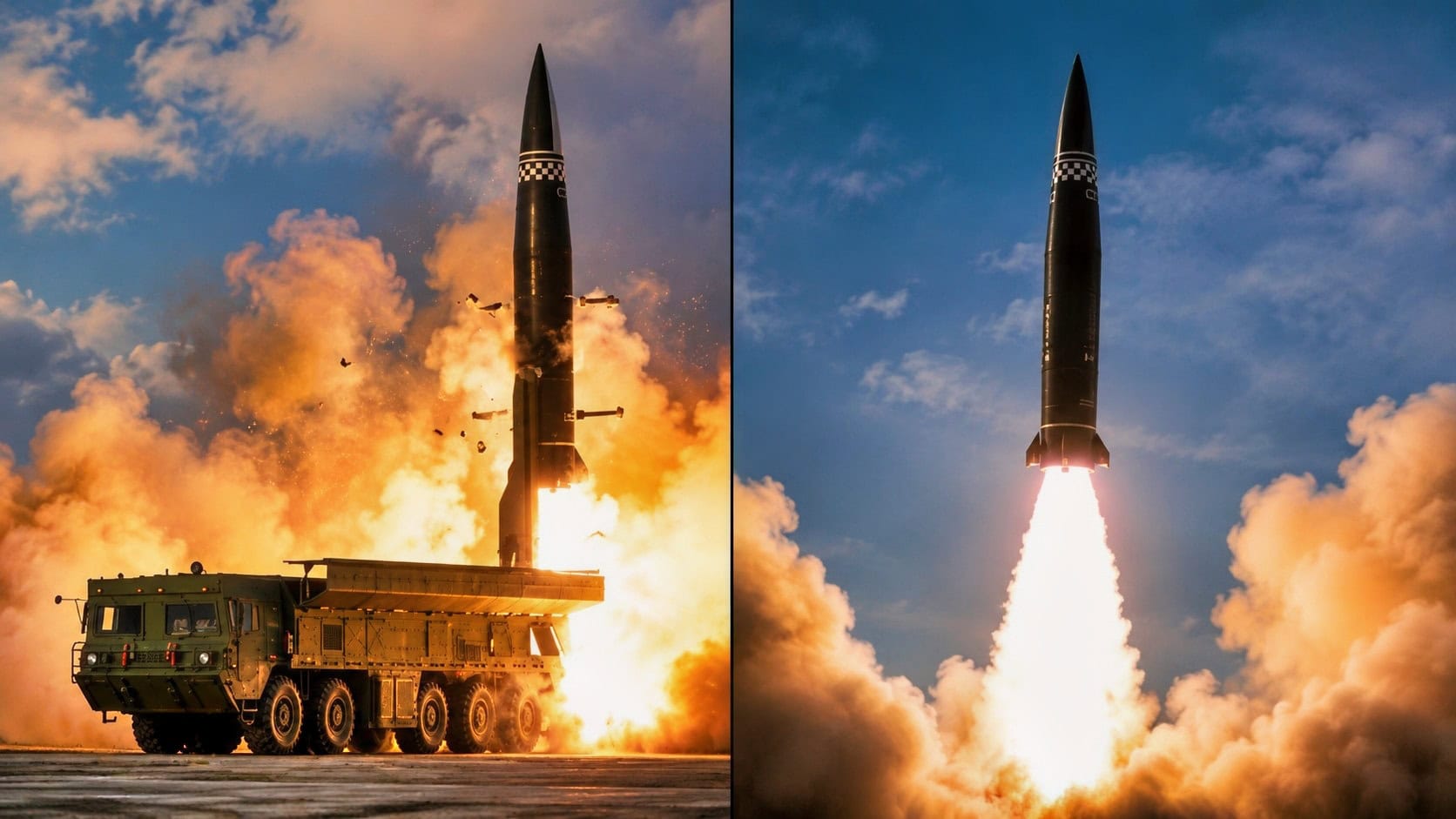
The most telling episode was the night of July 19, when, according to a GlobalSecurity report citing Ukrainian and analytical sources, Russia used 125 drones, 25 ballistic missiles, 10 Zircon hypersonic missiles, and six other types of missiles against Kyiv. Even if part of the Ukrainian classification requires caution, the order of magnitude is important: this was not the usual terror of cities with Shahed drones, but an attempt to overload the defense with expensive, fast, and hard-to-intercept means of destruction. In Soviet military doctrine, a massed missile strike was a tool for operational paralysis, not a daily artillery substitute. However, Russian practice in 2026 increasingly uses ballistics as an expensive form of coercion when there is no decisive breakthrough on the front.
The difference between the Iskander-M, the North Korean KN-23, and the naval Zircon is enormous for an engineer, but for strategic accounting, it boils down to two parameters: how many items can be produced and how many launch cycles can be sustained without a drop in readiness. The Iskander-M carries a warhead of about 480 kilograms and has a range of up to 500 kilometers in the export-restricted logic of Russian statements; the KN-23 is close to the family of quasi-ballistic missiles and is important for Moscow not for its quality, but because it expands the stockpile through Pyongyang. The Zircon, if its use is indeed confirmed, remains a product of a narrower and more expensive class. When these categories are mixed in one strike night, it looks impressive on screen, but poorly for military economic planning.
Why Drones Are Again Becoming the Mainstay
Data from July 24-25 show a return to a more familiar strike structure. The Ukrainian Air Force reported two X-59/69 missiles and 157 strike and decoy drones, including Shahed, Gerbera, Italmas, Bandero, and Parody, launched from the directions of Oryol, Kursk, Bryansk, Millerovo, Primorsko-Akhtarsk, occupied Donetsk, Gvardeyskoye, and Chayuda in Crimea. President Volodymyr Zelensky separately mentioned two missiles and nearly 160 drones. This is no longer a July ballistic barrage against Kyiv, but a more industrially economical saturation scheme: cheap devices, decoy targets, routes from different azimuths, hoping to exhaust Ukrainian mobile fire groups and air defense missiles.
This transition does not mean that missiles will run out tomorrow. That would be too convenient and likely incorrect an explanation. The Russian defense industry knows how to live with shortages, cannibalize civilian supply chains, procure components through third countries, and dilute quality for quantity. But there is a boundary between production for replenishment and production for increasing tempo. If ballistic launches in July indeed exceeded monthly output, then each subsequent large barrage must be paid for either by stockpiles, or by reducing future reserves, or by imports, which themselves depend on the political stability of North Korea and channels for circumventing sanctions.
The Front Does Not Confirm Strategic Effect
On the ground, this expensive air campaign has not yet provided Russia with the operation for which it is theoretically worth spending ballistic missiles. The Ukrainian General Staff reported on July 25 about 230 combat engagements in a day, with the most intense area remaining Pokrovsk, where Ukrainian forces repelled 37 attacks. The same report mentions 85 Russian airstrikes, 275 guided aerial bombs, 9,846 kamikaze drones, and 3,438 shellings. The scale is monstrous, but it highlights the problem: the Russian army has created almost continuous pressure, yet has not turned it into an operational breakthrough. This resembles the late Soviet disease of high consumption norms, where the system measures its own power in tons of ammunition rather than achieved operational objectives.
The Ukrainian side is simultaneously moving the war deeper into Russian rear areas. On July 24-25, strikes were reported against an enterprise in the Kirov region, oil refining in Tyumen, logistics in Yekaterinburg, a fuel and lubricants warehouse in Rostov-on-Don, and targets in the Caspian Sea related to the transportation of military cargo from Iran. ISW assessed the Ukrainian strikes on logistics and warehouses at Wildberries as a burden on an already stretched Russian air defense. Here, an asymmetry arises: Moscow spends expensive missiles for psychological and infrastructural pressure, while Kyiv tries to force Russia to disperse its Pantsirs, calculations, electronic warfare, and management attention across a vast territory.
What This Means for Russian Doctrine
Russian military thought traditionally loves the word ratio. The ratio of forces, means, tempos, reserves. In July 2026, the main ratio looks like this: ballistics are needed by the Kremlin to demonstrate the inevitability of a strike, but mass is provided by drones. A missile penetrates, a drone exhausts. A missile sounds politically significant, a drone is economically tolerable. Therefore, Russian strikes will likely oscillate between rare expensive salvos and almost daily drone swarms, where decoy targets are as important as warheads.
For the Russian army, the danger is not that the stockpile suddenly runs out. The danger is that the command begins to confuse the ability to inflict pain with the ability to change the course of the campaign.
My forecast is cautious: Russia will retain the ability to periodically conduct large ballistic strikes against Ukraine until the end of 2026, especially if North Korean supplies continue. But each such strike will increasingly resemble a managed expenditure of scarce capital rather than a sign of industrial confidence. If Ukrainian long-range strikes continue to pressure energy, logistics, and defense enterprises, Russia's bet on ballistics will become not a strategy for victory, but an expensive way to conceal the lack of an operational solution on the front.
In July 2026, Russian forces launched over 25 ballistic missiles and 125 drones against Ukraine, exceeding their monthly production capacity. Despite the extensive use of these weapons, the operations have not achieved a decisive breakthrough on the front lines. Ukrainian forces reported successful interceptions of many of these attacks, while also conducting strikes on Russian logistics and military targets.
- Russia launched more ballistic missiles than it can produce in a month.
- On July 19, Russia used 125 drones and 25 ballistic missiles against Kyiv.
- Ukrainian forces reported significant interceptions of Russian drones and missiles.
- Russian military operations have not resulted in a decisive breakthrough on the front.
- Ukrainian strikes targeted Russian logistics and military infrastructure.