
Russia's Large-Scale Attack on Ukrainian Military Industrial Facilities, Zelensky Calls on Allies for More Air Defense Missiles
[Global Times correspondent in Russia, Xiao Xinxin, Global Times special correspondent Wang Yi] From the evening of the 29th to the early morning of the 30th local time, Russia launched large-scale strikes on multiple locations in Ukraine, resulting in at least 8 deaths and 30 injuries. The day before, U.S. President Trump revealed to the media that during his meeting with visiting Ukrainian President Zelensky, he expressed hope to "end this war." Zelensky emphasized after the meeting that Trump "agreed to advance" the issue of granting Ukraine a production license for "Patriot" interceptors.
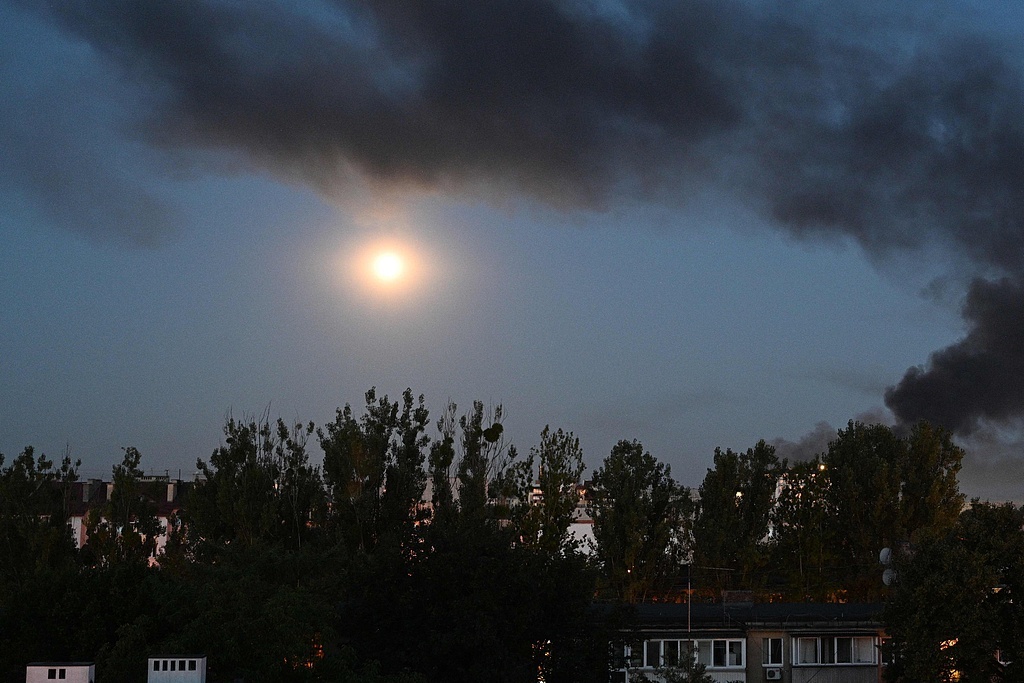
Russian military launches large-scale airstrikes
According to a report from RIA Novosti on the 30th, the Russian Ministry of Defense announced that from the evening of the 29th to the early morning of the 30th, the Russian armed forces used land-based, sea-based, and air-based precision long-range weapons and attack drones to carry out large-scale strikes on Ukraine. The announcement stated that the Russian military targeted military airports, military industrial enterprises, military communication and logistics centers located in Kyiv, Lviv, and other areas. The Russian side claimed that these facilities were involved in the production, storage, and transportation of various missile guidance systems and drones, and provided support for the operation of air defense monitoring systems. The announcement also mentioned that the Russian military attacked several cargo ships transporting weapons and military equipment to Ukraine.
The Kyiv Independent reported on the 30th that the large-scale strikes by the Russian military resulted in at least 8 deaths and 30 injuries within Ukraine. Before the attacks, Zelensky warned that Russia might launch a new round of large-scale airstrikes and called on allies to provide more air defense missiles as soon as possible.
Reuters reported on the 30th that the range of the Russian military's attacks extended as far as the western Ukrainian city of Lviv, during which "an incident occurred involving a violation of Polish airspace," prompting Poland to urgently deploy fighter jets and early warning aircraft, while ground air defense systems and radar systems were also put on alert to prevent the airstrikes from affecting Polish airspace.
Did Trump agree to Ukraine's core demands?
According to a report by CBS News on the 29th, Trump stated during an interview with reporters at the White House that he told Zelensky he hoped to "end this war." He also said, "I get along well with both Russian and Ukrainian leaders. Last month, 25,000 people died in the Russia-Ukraine war. This is unacceptable, so we must end it all."
On the evening of the 28th local time, Zelensky held a closed-door meeting with Trump at the White House. After the meeting, Trump simply wrote on social media, "The meeting went very well." Zelensky stated on social media, "We discussed the production license for 'Patriot' interceptors and some other ideas that could be helpful." Before the meeting, he expressed that obtaining the "Patriot" was a top priority.
According to a report by Axios on the 29th, Zelensky told the media that Trump had "agreed to advance" the issue of granting Ukraine a production license for "Patriot" interceptors during their meeting. However, Zelensky stated that even if they received U.S. approval, it would take 1 to 5 years to achieve mass production, so he hoped that before winter arrives, the U.S. could provide 300 "Patriot" interceptors to defend against Russian attacks on Ukraine's energy infrastructure.
According to a report by the Ukrainian National News Agency on the 29th, the head of the Ukrainian President's Office, Budanov, stated that the U.S. and Ukraine have reached an agreement to accelerate the peace negotiation process. Former U.S. Assistant Secretary of State Fried told the Kyiv Post on the 30th that the discussions between the U.S. and Ukrainian leaders were serious and focused on pragmatic cooperation. He noted that Trump's increasingly friendly attitude towards Ukraine is not just a change in diplomatic tone; it reflects Washington's growing recognition that a Russian victory is far from certain. Fried mentioned that during Zelensky's visit to the U.S., the U.S. Senate passed a procedural vote on a bill aimed at sanctioning Russia.
"Substantial results are few"
However, the Kyiv Independent reported on the 30th that sources revealed that the meeting between Zelensky and Trump took place in the "enthusiastic atmosphere" described by Ukrainian officials, but the substantial results brought to Kyiv were few. One Ukrainian official told the Kyiv Independent before the meeting, "Our core demand is 'Patriot' interceptors; the question is whether they will provide these missiles."
"The meeting between the U.S. and Ukrainian leaders failed to bring breakthrough results for Ukraine." According to a report by the Russian newspaper Parliamentary Gazette on the 29th, Russian political scientist and U.S. expert Dudakov stated that Zelensky failed to convince Trump that the Ukrainian military had achieved so-called "turning point progress" in combat, and the Ukrainian delegation also failed to forcefully push for proposals regarding a ceasefire in the air and at sea between Russia and Ukraine, nor did they secure new military funding allocations.
The Kyiv Independent believes that the only tangible outcome of this visit is the U.S. reaffirming that the two main envoys responsible for Russia-Ukraine affairs, Witkoff and Kushner, will visit Kyiv. A U.S. official cautiously stated that this trip could take place within the next two weeks. However, it remains uncertain whether this visit will actually happen. If it does occur, it would mark the first visit to Ukraine by these two envoys since taking over the current peace process.
Russian forces launched large-scale airstrikes on military facilities in Ukraine from the evening of the 29th to the early morning of the 30th, resulting in at least 8 deaths and 30 injuries. The strikes targeted military airports and defense industries in Kyiv and Lviv. President Zelensky urged allies to provide more air defense missiles in response to the attacks.
- Russian forces conducted large-scale airstrikes on military facilities in Ukraine.
- At least 8 people were killed and 30 injured in the attacks.
- The strikes targeted military airports, defense industries, and logistics centers in Kyiv and Lviv.
- Ukrainian President Zelensky called for more air defense missiles from allies.
- The attacks included strikes on vessels transporting weapons to Ukraine.