
Russia's Shahed Drones Are Testing NATO's Air Defenses in 2026
 Alexandra Reeves
Russia's Shahed Drones Are Testing NATO's Air Defenses in 2026
Russia does not need to deliberately attack NATO to test the alliance. It only needs to keep flying drones toward the edge of allied airspace and let everyone argue about intent. That is the uncomfortable lesson from the latest Ukraine-Russia drone exchange.
On September 18, Ukraine launched a large drone barrage toward Moscow while Russia opened its first parliamentary election since the full-scale invasion. Al Jazeera reported that Moscow Mayor Sergei Sobyanin said more than 350 Ukrainian drones had been directed toward the capital, with 64 destroyed as they approached the city. Kyiv also reported strikes on the Yaroslavl oil refinery and a Russian military airfield in Rostov. Russia, meanwhile, continued attacks on Ukrainian infrastructure, including a strike near Kyiv that injured five people, three of them children.
The headline number is dramatic. The strategic point is more important: the drone war is no longer only a contest over factories, fuel and front-line logistics. It is becoming a daily political and air-defence stress test for two states, with NATO sitting uncomfortably close to the flight path.
The Shahed Is Cheap Enough to Create Expensive Decisions
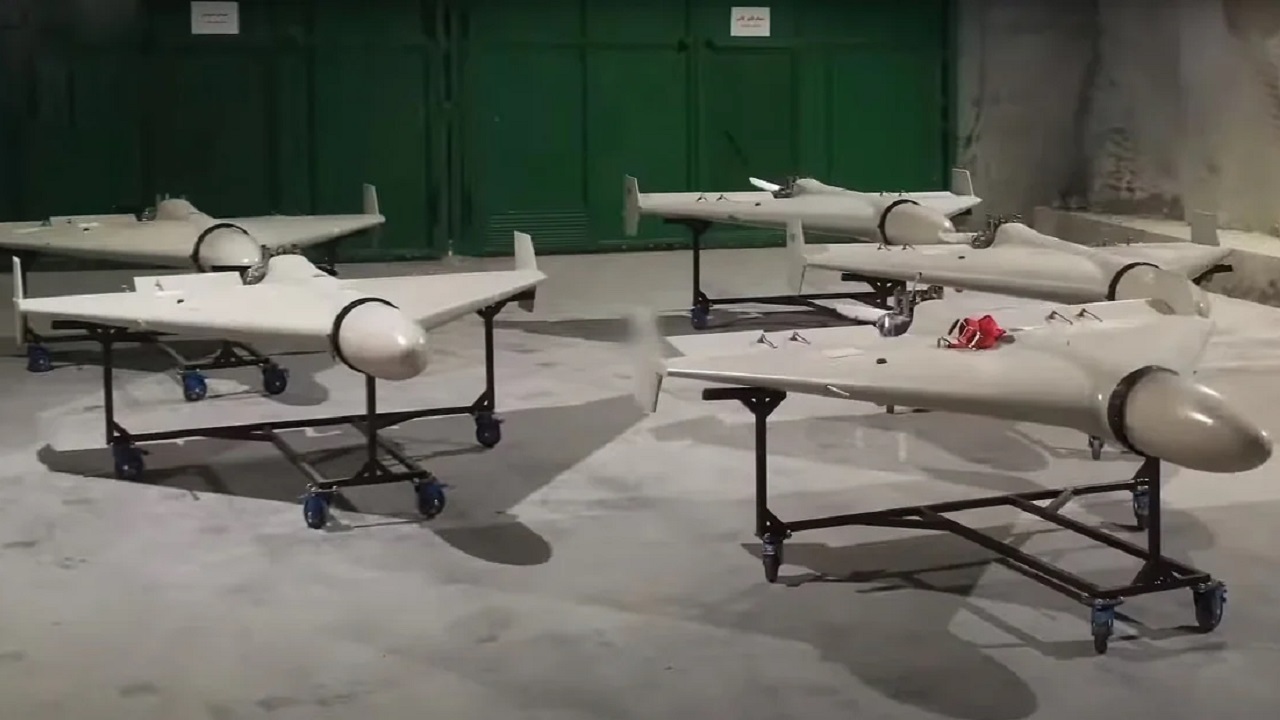
The Shahed-136, known in Russian service as the Geran-2, is not a high-end aircraft. It is a propeller-driven, one-way attack drone with a relatively small radar and infrared signature, a long range commonly assessed at roughly 1,000 to 2,000 kilometres depending on the configuration, and a warhead in the tens of kilograms. Its power is industrial rather than technological. Russia can launch many of them, combine them with faster missiles, and force defenders to spend more on detection and interception than the attacker spends on the airframe.
That exchange rate matters. A modern surface-to-air missile can cost hundreds of thousands or millions of dollars. A Shahed-class system is far cheaper. Ukraine has improvised with mobile fire teams, electronic warfare, machine guns and short-range missiles, but protecting every city, refinery, railway hub and power station remains impossible. The same arithmetic is now visible on the Russian side. A reported 350-drone approach toward Moscow is not proof that all those aircraft penetrated the city. It is proof that a defender can be made to mobilise a national air-defence network simply by creating enough tracks at once.
Ambiguity Is Becoming a Russian Weapon
The more worrying development for NATO is not one drone crossing a border. It is the accumulation of ambiguous incidents. The Institute for the Study of War reported on September 17 that Lithuanian President Gitanas Nauseda believed Russia might be allowing drones to deviate into Baltic airspace deliberately, using uncertainty to punish states supporting Ukraine. Poland has also warned that Russia could conduct attacks against Ukraine supporters while presenting them as accidental.
That is a cheap form of coercion. If a drone enters allied airspace, NATO must decide whether it was lost, jammed, spoofed, deliberately redirected or testing a response time. Each explanation points to a different action. Shoot it down and the alliance risks escalation. Ignore it and Moscow learns that ambiguity buys access. Publicly accuse Russia without hard evidence and NATO exposes the political gap between its eastern members and governments that want to keep escalation under control.
Everyone in Brussels likes to talk about deterrence as if it were a statement. Drones turn deterrence into a stopwatch. How quickly can an allied radar detect a low-flying object? Which national commander can authorise a shoot-down? Are the rules identical in Lithuania, Poland and Romania? Can NATO distinguish a Russian decoy from a civilian aircraft before the object reaches a populated area?
Ukraine Is Also Learning to Attack the System
Ukraine is not simply absorbing Russian drone strikes. ISW assessed that Ukrainian intermediate-range strikes against Russian logistics in occupied Luhansk had degraded fuel supplies and strained the generators that power Russian electronic-warfare systems. The same assessment described Ukrainian strikes against Russian aircraft and helicopters at Rostov-Central airfield, part of a wider effort to weaken Russian strike and air-defence capacity.
This is a smarter target set than chasing individual drones. Air campaigns are sustained by fuel, launch sites, maintenance crews, data links and electronic-warfare screens. Ukraine is trying to break that chain while using massed drones to impose costs deep inside Russia. The objective is not merely to destroy a refinery or embarrass the Kremlin during an election. It is to make Russian air defence defend too many things at once.
There is a political logic as well. The Kremlin can keep an air war distant from most Russians only while it remains geographically abstract. Drone alerts over Moscow, attacks on oil infrastructure and disruption around transport hubs turn the war into a domestic fact. That does not guarantee public opposition. In an election in which antiwar parties were excluded, it may instead produce conformity and anger. But it narrows the Kremlin's room to claim that the conflict is entirely controlled.
What NATO Should Watch Next
NATO should stop treating each border incident as a separate public-relations problem. The alliance needs a shared operational picture for drone incursions, common rules for rapid interception and a larger supply of low-cost counter-drone weapons. Expensive interceptors still have a role, especially against missiles and aircraft, but they cannot be the default answer to every Shahed-class target.
- First: track whether Russian drones continue to approach or enter Baltic and Polish airspace during periods of intense Ukrainian strikes.
- Second: measure whether Russia is pairing drone incursions with jamming, cyber activity or disinformation about accidental navigation errors.
- Third: watch the cost exchange. If NATO answers cheap drones with scarce high-end missiles, Moscow will have found a sustainable way to drain allied magazines.
The immediate event is a reported 350-drone barrage and a new round of Russian strikes. The deeper development is a contest over who can impose uncertainty on the other side at lower cost. Ukraine is trying to make Russia feel the war. Russia is testing whether NATO will defend its airspace before an attack is unambiguously hostile.
The next serious escalation may not begin with a missile aimed at Warsaw. It may begin with a drone that nobody wants to call an attack. That is exactly why NATO cannot afford to wait for perfect certainty.
Sources
Al Jazeera, Ukraine fires drone barrage as Russia launches elections, September 18, 2026. Institute for the Study of War, Russian Offensive Campaign Assessment, September 17, 2026. The Guardian, Ukraine coverage and September 18 reporting.
On September 18, 2026, Ukraine launched a significant drone barrage toward Moscow, involving 350 drones, while Russia continued its military operations against Ukraine. The Shahed-136 drones are being used to test NATO's air defenses, creating ambiguity and challenging the alliance's response protocols. This situation highlights the evolving nature of drone warfare and its implications for regional security.
- Russia tested NATO air defenses with drone incursions.
- 350 Ukrainian drones were directed toward Moscow.
- Ukraine launched strikes on Russian military targets in Rostov.
- Russia continued attacks on Ukrainian infrastructure.
- Ambiguity in drone incursions poses a challenge for NATO.