
Russia’s state arms giant claims a new drone-missile class
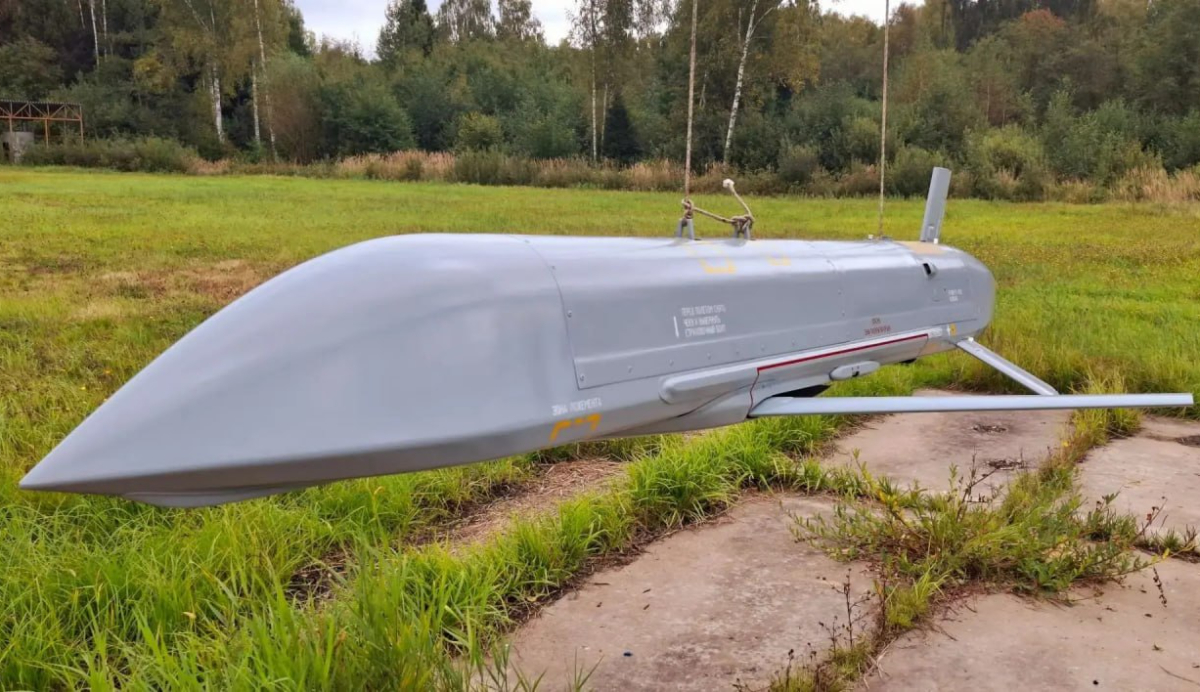
Russia’s state defense conglomerate Rostec says three of its newest jet-powered strike drones, the S-71M, S-71K and Dan-T, can now do the job of cruise missiles at a fraction of the cost, and that all three are already being used against Ukraine.
Rostec made the claims in comments to the Russian Defense Ministry newspaper Krasnaya Zvezda published on Sept. 30, describing the weapons as a new category that sits between attack drones and missiles. The company did not give prices, production numbers or performance figures for any of the three, and its claims about accuracy and combat results could not be independently verified.
“In fact, a classic cruise missile is already a fixed-wing unmanned aerial vehicle. However, not every UAV of this type is a cruise missile. Nevertheless, in the new S-71M, S-71K and Dan-T, this line is being erased,” Rostec said in its statement.
The company said the drones have the accuracy, maneuverability and range of cruise missiles while being significantly cheaper than conventional missiles, and that the gap between the two kinds of weapon will keep shrinking as drone production matures. Rostec said it expects the new jet-powered drones to become a standard weapon for Russian frontline aviation in the near future, alongside the glide-bomb kits that Russian jets have dropped on Ukrainian front lines in large numbers since 2023.
The S-71M and S-71K are designed to be launched from fifth-generation fighters, including the Su-57, Rostec told the state news agency TASS. Both are sized to fit inside the Su-57’s internal weapons bay, which lets the jet carry them without spoiling its radar-evading shape, and Russia’s arms exporter Rosoboronexport displayed them next to a Su-57E at the El Alamein International Airshow in Egypt in September.
Ukraine’s military intelligence has examined debris from both. It says the S-71K, known as Kovyor, carries a 250-kg (550-pound) OFAB-250-270 high-explosive bomb as its warhead and lacks terminal guidance, and that the S-71M, called Monokhrom, contains an NVIDIA Jetson Orin computing module, a small U.S.-made computer built to run artificial intelligence software on board, Militarnyi reported. Some published reports have swapped the two designations, so details tied to each name should be treated with caution.
Rostec told TASS that the smaller Dan-T has been confirmed in hundreds of launches against Ukrainian targets and can be fired from aircraft and helicopters, including foreign-made ones, which suggests the company is aiming it at export buyers. Accounts of where the Dan-T comes from differ: some analysts describe it as the export name for the S8000 Banderol, a small jet-powered cruise missile built by Russian drone maker Kronshtadt, while Ukrainian experts have described it as a strike version of the Dan-M jet target drone that Russia used for air defense training.
Ukrainian estimates put the Dan-T’s range at roughly 500 km (310 miles) with a 135-kg (298-pound) warhead, The New Voice of Ukraine reported, citing Ukrainian intelligence officials who said Moscow wants the weapon built entirely from Russian components.
That goal follows Ukrainian findings about the Banderol, which first appeared over Ukraine in spring 2025 and is launched mainly from Su-30/34 combat aircraft, Orion drones and Mi-28 attack helicopters, often from occupied Crimea toward the Odesa region. Ukraine’s military intelligence says the Banderol contains a Chinese-made jet engine, a Japanese battery and mostly U.S.-made electronics, Euronews reported.
Cheap jet-powered weapons that fly like missiles force Ukraine to spend scarce and expensive air defense interceptors on targets that cost Russia far less to build, the same logic behind Russia’s mass use of Shahed-type drones.
Rostec placed the new drones in a wider family of guided weapons that includes the Iskander ballistic missile system, Tornado-S rocket launchers with guided rockets, Krasnopol guided artillery shells and the Kalashnikov Group’s KUB loitering munitions.
Content preview only. Full article available at source. View Full Article
Rostec announced that its new jet-powered strike drones, the S-71M, S-71K, and Dan-T, are being used against Ukraine and can perform the role of cruise missiles at a lower cost. The S-71K is equipped with a high-explosive bomb, while the Dan-T has been launched in numerous attacks. Rostec anticipates these drones will become standard in Russian aviation alongside existing glide-bomb kits.
- Rostec claims S-71M, S-71K, and Dan-T drones can replace cruise missiles at lower costs.
- The S-71K carries a 250-kg high-explosive bomb and lacks terminal guidance.
- The Dan-T has been confirmed in hundreds of launches against Ukrainian targets.
- Rostec expects these drones to become standard for Russian frontline aviation.
- The S-71M contains an NVIDIA computing module for AI operations.