
Russia's Threat to Europe's Arms Factories Could Test NATO's Article 5
 Alexandra Reeves
Russia's Threat to Europe's Arms Factories Could Test NATO's Article 5
Europe is finally building the weapons Ukraine has been asking for. Moscow is now being warned that hitting those factories could trigger a NATO military response. That sounds like deterrence. It may also be the clearest sign yet that Europe has built an industrial target before it has built a political consensus on how to protect it.
The Warning Is New, but the Vulnerability Is Not
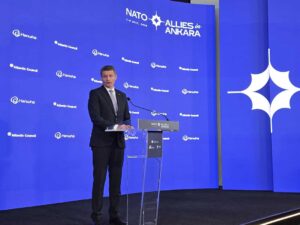
On October 1, EU Defence Commissioner Andrius Kubilius said a Russian strike on a European arms factory could amount to an attack covered by NATO's Article 5. Politico Europe and the Kyiv Post both reported the warning. The political message was deliberately blunt: Moscow should not assume that a plant producing weapons for Ukraine is an easy target simply because it sits outside Ukraine.
The problem is that Article 5 is not an automatic war button. The treaty says an armed attack on one ally is treated as an attack on all, but each member decides what action it considers necessary. That distinction matters. A missile through a production hall in Germany, Poland or the Czech Republic would create immediate pressure for a response. It would not, by itself, tell thirty-two governments what that response must be.
That ambiguity has traditionally been useful. It gives NATO room to manage escalation. In this case, it may give Russia room to gamble.
Why Factories Are Becoming Front-Line Targets
Europe's defence industrial expansion is changing the geography of the Ukraine war. Rheinmetall plants, missile-production lines, ammunition facilities and maintenance hubs are no longer merely economic assets. They are part of the supply chain that keeps Ukrainian artillery, air defence and armoured vehicles in the fight.
Those facilities do not need to be destroyed to be militarily useful targets. A fire in a power substation, a cyberattack against industrial control systems, sabotage of rail access or an attack on a specialist supplier could delay output for months. Modern weapons production is less like an isolated factory and more like a network: one missing component can stop an entire assembly line.
That is the uncomfortable technical reality behind the political language. Europe can increase nominal production capacity and still remain fragile if it depends on a few suppliers, a small number of test ranges or vulnerable transport corridors. A factory that produces 155mm artillery shells is valuable. The machine tools, energetic materials, electronics and quality-control systems behind it may be even harder to replace.
Hybrid Pressure Comes Before the Missile
Ukraine's military intelligence service warned on October 2 that Russia is preparing hybrid operations in EU and NATO countries and has identified potential targets. The warning was reported by United24 Media and several Ukrainian outlets. Separately, Politico Europe described a failed attack in Leipzig as evidence of a broader Russian campaign.
The reporting should be treated carefully. Intelligence warnings are not proof that every suspected operation will occur, and public accounts rarely provide enough evidence to establish responsibility beyond doubt. But the pattern is strategically coherent. Sabotage, arson, cyber intrusion, disinformation and covert recruitment all offer Moscow ways to impose costs without crossing the bright line of an overt military attack.
That is exactly where NATO is least comfortable. A missile strike is visible and attributable. A warehouse fire may be blamed on negligence. A cyberattack may pass through criminal infrastructure. A disrupted rail line can look like an accident. The attacker gets strategic effect while the alliance debates evidence.
Article 5 Is Only Credible If the Response Is Prepared
European officials are right to draw a line around defence production. But a public warning has value only if it is backed by practical measures. That means hardening factories, dispersing critical production, protecting energy supplies and rehearsing continuity plans with local authorities. It also means deciding in advance how NATO would respond to sabotage that kills nobody but stops a key production line for six months.
Air defence is part of that calculation. A Patriot or SAMP/T battery can protect a high-value site from ballistic and cruise missiles, but those systems are scarce and expensive. They cannot cover every factory, subcontractor and rail junction. Shorter-range systems, counter-drone measures, passive protection and rapid repair teams are less glamorous, but they may determine whether an attack causes a temporary interruption or a strategic failure.
There is also an intelligence problem. NATO must connect national police investigations, counterintelligence services and military assessments quickly enough to establish attribution. If every incident remains a national matter until the evidence is perfect, Russia will enjoy the initiative. The alliance needs a threshold for collective consultation that sits below the threshold for war.
Europe's Strategic Choice
The broader lesson is not that Russia is about to attack a European arms plant. The evidence available today does not justify that prediction. The lesson is that Europe's rearmament has created a new contest over risk. Governments want the industrial benefits of supporting Ukraine, but they are discovering that production capacity is also a security liability.
Washington has spent years telling European allies to spend more. Europe is now spending more, and the next question is less comfortable: who protects the factories? The answer cannot be “the market,” because a commercial insurer cannot deter a state. It cannot be “Article 5” as a slogan, because slogans do not repair a burned power transformer or replace a sabotaged machine tool.
Russia's advantage is not only its missiles. It is the ability to exploit hesitation inside an alliance that must prove both resolve and restraint at the same time. Europe should therefore assume that the first test may arrive below the level of open war: a fire, a cyber outage, a compromised shipment, or a campaign designed to make workers and voters fear the cost of helping Ukraine.
Article 5 can deter a deliberate strike only if Moscow believes NATO has already decided what follows. The real warning from Europe's arms factories is that the alliance is still writing that decision after the production lines have gone live.
Sources: Politico Europe, October 1–2, 2026; Kyiv Post, October 1–2, 2026; United24 Media, October 2, 2026; Ukrainian Pravda, October 1, 2026; NATO public statements reported by Anadolu Agency, September 30, 2026.
EU Defence Commissioner Andrius Kubilius warned that a Russian strike on European arms factories could trigger NATO's Article 5 response. Reports indicate that Russia is preparing hybrid operations targeting EU and NATO countries, with factories becoming critical front-line assets in the Ukraine conflict. The situation highlights the need for NATO to establish clear responses to potential sabotage and attacks on defense production facilities.
- EU Defence Commissioner warned that a Russian strike on arms factories could trigger NATO's Article 5 response.
- Russia is preparing hybrid operations targeting EU and NATO countries.
- Factories are becoming front-line targets in the Ukraine war due to their role in supplying military aid.