
Rutte's 0.25 Percent Plan for Ukraine Aid Reveals Europe's NATO Burden-Sharing Deficit
 Dr. Klaus Weber
Rutte's 0.25 Percent Plan for Ukraine Aid Reveals Europe's NATO Burden-Sharing Deficit
0.25 percent of gross domestic product sounds like a technical footnote. However, in the NATO debate in Helsingborg, it has become a political litmus test. Mark Rutte has proposed to the Allies to tie military support for Ukraine in the long term to a fixed share of economic output. According to calculations referenced in several reports, such a formula could mobilize annual amounts in the double-digit billion range; some media even mention around 143 billion US dollars if all NATO countries paid according to the same rule. However, the sum alone is not decisive. What is crucial is that Rutte wants to transform voluntary ad-hoc packages into a quasi-institutional burden-sharing arrangement.
This is where the conflict lies. Rutte admitted on May 21 in Sweden that his proposal would not achieve unanimity. Thus, the plan is politically blocked in its original form, but analytically it is all the more revealing. It shows that the Alliance has not only a munitions problem, a production problem, or an American troop problem. It has a distribution problem that has so far been obscured by well-sounding summit declarations.
Helsingborg as Pre-Negotiation for Ankara
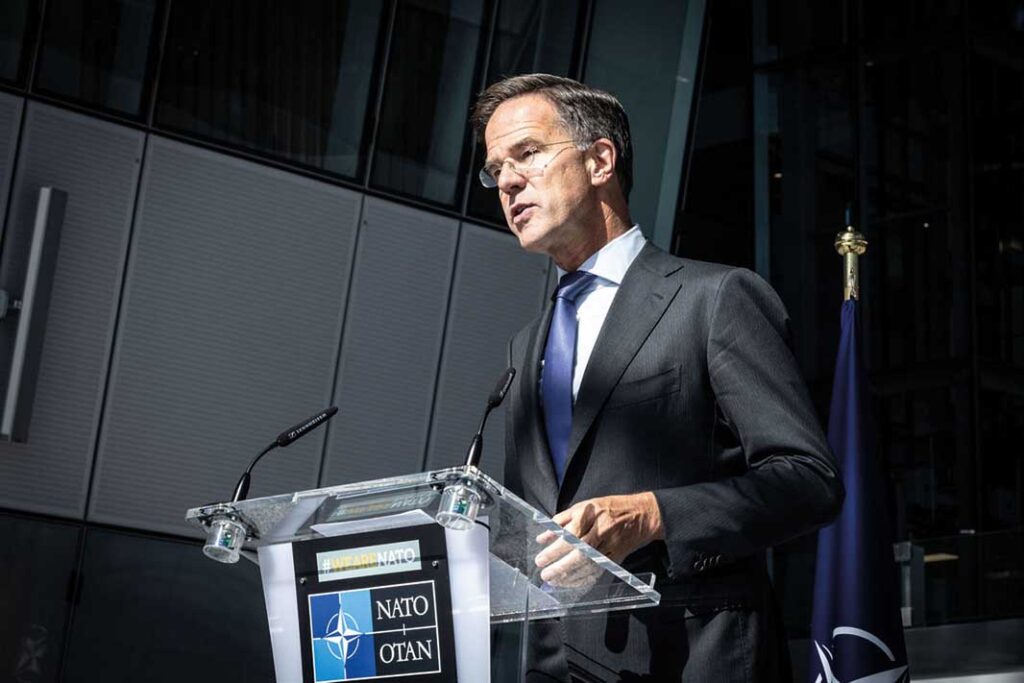
The NATO foreign ministers met on May 21 and 22, 2026, in Helsingborg to prepare for the summit in Ankara in July. According to the NATO transcript, Rutte named three priorities: higher defense investments, faster industrial production, and sustained support for Ukraine. He reminded that the Allies had accepted the goal of 5 percent of GDP for defense and security-related spending by 2035 in The Hague in 2025. At the same time, he emphasized that European Allies and Canada had increased their defense investments by 20 percent in 2025.
These figures are important because they shift the rhetorical comfort zone of European politics. As long as the debate revolves only around the 5 percent target, almost any government can talk about long-term paths, special funds, infrastructure categories, and accounting rules. The 0.25 percent formula is more uncomfortable. It does not ask how much a state wants to spend on its own armed forces at some point. It asks how much it is concretely spending annually on the war that has already destroyed the European security order.
Why 0.25 Percent is Institutionally Dangerous
From a German perspective, the formula initially seems moderate. 0.25 percent of German GDP roughly corresponds to a low double-digit billion amount per year. Germany is already among the top absolute donors for its Ukraine aid. For smaller Nordic and Baltic states, the formula is even more of an acknowledgment of already practiced norms. Estonia's Foreign Minister Margus Tsahkna explicitly welcomed the proposal and pointed out that Tallinn has advocated this idea for years. The three Baltic states had already committed to a similar target figure in December 2025.
For France and the United Kingdom, the logic is less comfortable. Both countries see themselves as military leading powers in Europe, but their Ukraine aid follows different political and fiscal patterns. Paris traditionally argues with qualitative contributions, nuclear deterrence, and strategic autonomy. London refers to its role in the Ramstein format, training, intelligence, and long-range weapons. Both are not irrelevant. But a GDP formula reduces prestige to a verifiable metric. That is precisely why it is politically so explosive.
The objection to such percentage targets is valid: they measure money, not impact. Weber would add: they do not even measure money particularly well when accounting rules remain unclear. Military aid can come from stocks, new orders, national industrial programs, EU loans, or through mechanisms like PURL, which finance American equipment for Ukraine. Nevertheless, a percentage formula has an institutional advantage. It makes free-riding visible.
The Kiel Data and the Unequal Burden
The Ukraine Support Tracker from the Kiel Institute has been tracking state military, financial, and humanitarian aid since February 2022 and covers 41 countries as well as EU institutions. The latest data update from April 2026 extends to February 2026. Kiel repeatedly points out that European support is increasingly being borne by a few large and particularly committed donors, while EU instruments primarily take on financial stabilization.
This division of labor is functional but politically fragile. When Nordic and Baltic states, the Netherlands, Poland, Germany, and Canada contribute disproportionately, while other large economies remain more reserved, a fair alliance does not emerge, but rather a coalition of the willing payers. Rutte stated in Helsingborg that aid is not evenly distributed within NATO. This was not a moral remark but a strategic observation. Unevenly distributed aid is difficult to sustain in a prolonged war of attrition phase.
The EU is trying to partially alleviate this problem with SAFE and the 90 billion euro Ukraine loan. The Council finalized a loan package for 2026 and 2027 in April; SAFE, in turn, allows for joint procurements in which Ukraine can participate equally. But loans and procurement frameworks do not replace an annual military contribution logic. They are instruments, not a culture of obligation.
PURL Shows Transatlantic Residual Dependence
Rutte highlighted the Prioritised Ukraine Requirements List in Helsingborg. PURL delivers urgently needed American equipment that has an immediate effect on the battlefield, particularly air defense, missiles, and other scarce systems. This is militarily sensible. Institutionally, it is ambivalent. If Europe mobilizes more money but primarily procures US systems with it, it temporarily strengthens Ukraine while confirming its own industrial dependence in the long term.
This is especially true for air defense. Patriot, NASAMS components, interceptors, sensors, and fire control systems cannot simply be replaced by European programs. SAFE can prioritize European procurement and limit non-European components. However, if the need arises today and European manufacturing scales only tomorrow, the available American capacity always wins. Rutte's 0.25 percent proposal therefore does not solve the capacity problem. It only partially addresses the planning problem.
Germany's Role Between Payer and Architect
Berlin should not view this proposal as another budgetary imposition but as a test of its own Zeitenwende rhetoric. Germany cannot permanently present itself as a European anchor of stability while allowing the support logic to be renegotiated every year. The special fund has enabled procurements, but it has not created a European contribution order. The Bundeswehr remains materially under strain, the industry produces more slowly than the security policy situation demands, and Ukraine needs predictability rather than summit poetry.
A German approach would need to combine three elements: first, a multi-year Ukraine line in the federal budget; second, a clear separation between aid for Ukraine and replenishment of its own stocks; third, European coordination on which contributions count as genuine military support. Without this distinction, any quota will invite creative accounting.
The Real Decision
The 0.25 percent plan is unlikely to be adopted as a formal NATO target. Rutte has hinted at this himself. But the debate will remain because it poses an uncomfortable question: Should Ukraine aid continue to be a political event dependent on budget cycles, coalition crises, and summit pressure, or will it become part of the European security architecture?
Europe has become accustomed to formulating strategic autonomy as industrial policy and transatlantic solidarity as a procurement mechanism. Rutte's proposal forces both together. Anyone who wants to finance Ukraine annually must explain whether this money creates European production capacity or replaces American stocks. Anyone who rejects the formula must explain which more reliable institution should take its place.
The paradox is obvious: a rigid percentage does not make Europe a strategic power. But without a verifiable contribution logic, Europe's Ukraine policy remains a sum of national press releases. More money does not guarantee a better strategy. Yet without a robust financing rule, even the existing strategy will not be sustainable.
Sources
- NATO Press Conference by Secretary General Mark Rutte following the meeting of NATO Ministers of Foreign Affairs in Helsingborg, 22 May 2026.
- European Pravda, NATO allies discuss long-term military support for Ukraine at 0.25% of GDP, 22 May 2026.
- AFP via The Straits Times, Many NATO members not spending enough to support Ukraine, 21 May 2026.
- Kiel Institute Ukraine Support Tracker, April 2026 update.
- Council of the EU, SAFE and EU military support for Ukraine policy pages, April-May 2026.
Mark Rutte proposed a 0.25% GDP military support plan for Ukraine during NATO discussions in Helsingborg, Sweden, on May 21-22, 2026. The plan aims to establish a more institutionalized burden-sharing among NATO allies, although Rutte acknowledged it would not achieve consensus. The discussions highlighted the unequal distribution of military aid within NATO and set the stage for the upcoming Ankara summit.
- Mark Rutte proposed a 0.25% GDP military support plan for Ukraine.
- The proposal aims to create a more institutionalized burden-sharing among NATO allies.
- Rutte acknowledged that the proposal would not achieve consensus among allies.
- The NATO foreign ministers met in Helsingborg to prepare for the Ankara summit in July 2026.
- The report highlights the unequal distribution of military aid within NATO.