
Saudi Arabia intercepts a Houthi ballistic missile over Riyadh and tests Gulf defense in 2026
 Ahmed Al-Rashid
Saudi Arabia intercepts a Houthi ballistic missile over Riyadh and Gulf defense test in 2026
On October 25, 2026, the Saudi-led coalition announced the interception of a ballistic missile launched by the Houthi Ansar Allah group towards Riyadh, just one day after intercepting two other missiles that Saudi authorities said were headed towards Mecca and Medina. At the same time, Aden International Airport and the Coast Guard base in the city were targeted by ballistic missile attacks, while fighting continued around Taiz. These are not isolated incidents; they represent a return of the Yemeni war to a direct test of Saudi depth at a highly sensitive regional moment.
What actually happened
According to Al Jazeera, the coalition's command stated that its air defenses destroyed a ballistic missile launched towards the capital, while the Saudi Civil Defense Ministry reported debris falling after intercepting two missiles aimed at Mecca and Medina. The Houthi group denies targeting the two holy cities, claiming its targets were three airports, oil facilities, and an airbase. These accounts cannot be independently verified, but the continued closure of Riyadh Airport for two weeks followed by the announcement of the resumption of flights illustrates that operational impact is not measured solely by the number of missiles that hit a target.
In Yemen, authorities reported that two missiles struck Aden Airport, describing the attack as the fourth of its kind within the month. The government forces also announced conducting over 700 operations within 24 hours, killing around 300 Houthi fighters, figures that Al Jazeera could not verify. Militarily, the most significant aspect is the widening of the theater of engagement from the fronts of Taiz to airports and vital facilities, forcing Riyadh to distribute its resources between defending cities and protecting ports, energy, and borders.
The missile that did not reach does not mean sufficient defense
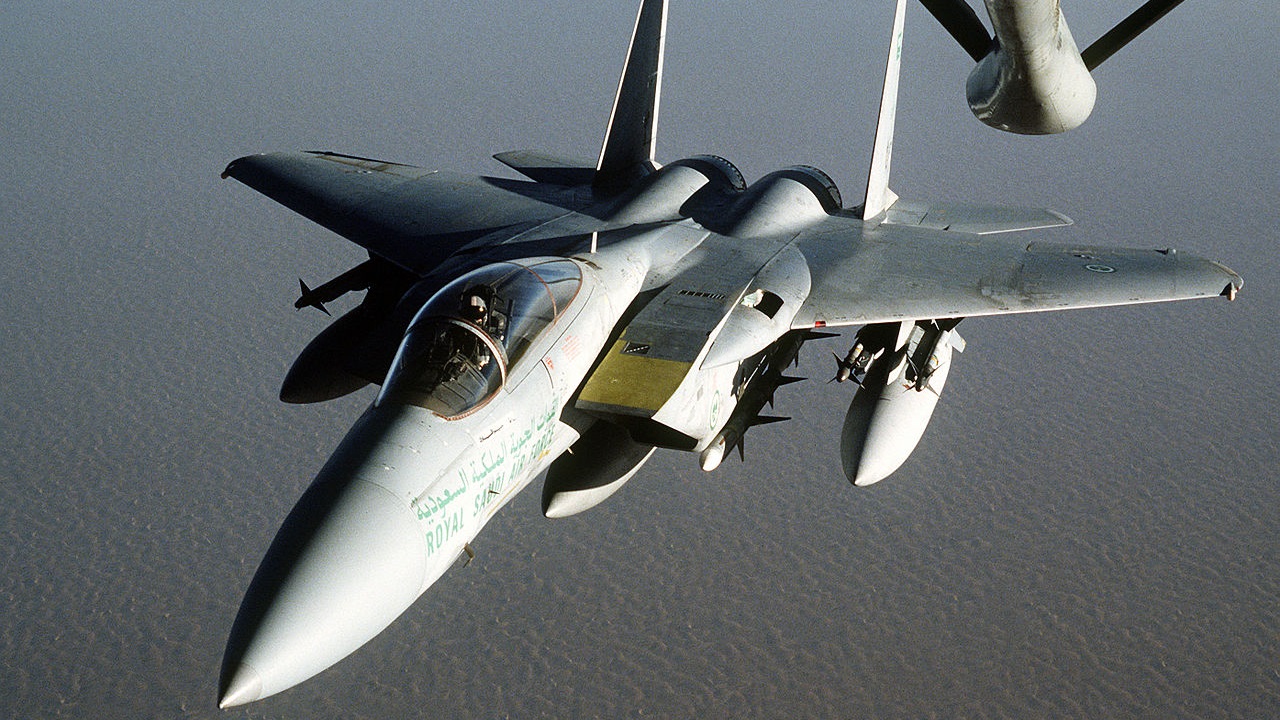
Practically, intercepting one missile is a tactical success, but it does not prove that Saudi Arabia possesses independent air defense. A true defense system is measured by the ability to detect an attack early, classify the target, prioritize engagement, then reload batteries and continue operating under the pressure of successive attacks. Saudi Arabia has F-15 aircraft, radar networks, Patriot batteries, and other systems, but the command chain, munitions, spare parts, and upgrades remain linked to varying degrees with the United States.
Here lies the old Gulf paradox. The state spends on the most expensive platform, but it cannot always guarantee a complete operational cycle without foreign support. The cheap Houthi missile does not need to outmatch the F-15; it is enough to force Riyadh to operate an expensive radar and interception battery, or to close an airport, delay a shipment, and sow doubt in the capital's security. The cost balance here tilts towards the attacker even when the defender succeeds in shooting down the missile.
The Mecca agreement faces the real test
On October 23, Pakistan announced its ratification of the defense agreement with Saudi Arabia and Turkey, a significant political development that came as Riyadh faces Houthi attacks and Washington warns its citizens against traveling to Saudi Arabia and the UAE. The agreement adds a political and military cover to the Saudi deterrence network, but it does not create an overnight unified Gulf warning network or a joint capability to intercept missiles.
The real value of the agreement will emerge in the details that official statements often avoid discussing. Can the three forces exchange radar data in real-time? Who has the launch decision? Are there shared interception stocks and alternative command centers? Can Turkey and Pakistan provide continuous coverage over thousands of kilometers, or will the agreement remain a political message to Iran and its proxies? Any military officer who has served in the region knows that alliances begin with signing, but they do not become a force until after training, communications, and a supply chain.
Saudi deterrence between American cover and declared independence
The escalation in Yemen coincided with American and Israeli discussions about the possibility of launching a new attack on Iran following the elections. This places Gulf states in a harsh dilemma. They need the American umbrella against ballistic missiles, but they do not want their territories and airports to become platforms for war with Tehran. At the same time, they cannot ignore that the Houthis are increasing pressure on Saudi Arabia at a moment when Washington is preoccupied with a larger front.
The Saudi response to the Riyadh missile, and the airstrikes attributed to the coalition in Sana'a and Hodeidah, may demonstrate the ability to respond, but they do not solve the sustainability problem. What is required is not only to shoot down the missile but to protect navigation, energy, and civil aviation while maintaining interception stock and human readiness for months. The Mecca agreement may expand political options, but it will not eliminate technical dependence on the United States, and purchasing more aircraft will not address the coordination gap between air defense, ground forces, and intelligence.
Conclusion
Saudi Arabia has proven capable of preventing a Houthi missile from reaching Riyadh, but it has not yet demonstrated that it can prevent a lower-cost adversary from disrupting the state's rhythm. This is the distance between possessing the weapon and possessing the capability. Riyadh will talk about new alliances, and Washington will discuss the deterrence umbrella, but the real test will remain on the second and third night of the attack, when some interception missiles run out and the decision needs a regional network that operates without waiting for the American phone call. In the Middle East, it is not enough to have a shield; the question is who holds its keys and when they can operate it.
Sources
- Al Jazeera, Report on Houthi attacks on Saudi Arabia and Aden, October 24, 2026.
- The National, Follow-up on the interception of a ballistic missile towards Riyadh, October 24, 2026.
- Anadolu Agency, Pakistan's announcement of ratification of the Mecca defense agreement, October 23, 2026.
- Middle East Eye, Analysis of Saudi developments and the trilateral agreement, October 24, 2026.
Saudi Arabia intercepted a Houthi ballistic missile targeting Riyadh on October 25, 2026, following the interception of two other missiles aimed at Mecca and Medina. Concurrently, Aden International Airport faced missile attacks, with ongoing military operations reported in Taiz. The conflict is intensifying, requiring Saudi Arabia to allocate resources for city defense and protection of critical infrastructure.
- Saudi Arabia intercepted a Houthi ballistic missile targeting Riyadh on October 25, 2026.
- Two other missiles were intercepted heading towards Mecca and Medina.
- Aden International Airport was attacked by ballistic missiles, marking the fourth such incident in a month.
- Yemeni authorities reported over 700 military operations and approximately 300 Houthi casualties in 24 hours.
- The conflict is expanding to include attacks on airports and vital installations.