
Saudi Arabia intercepts two ballistic missiles and drones on November 15, 2026, and a real test of Gulf defense.
 Ahmed Al-Rashid
Saudi Arabia Intercepts Two Ballistic Missiles and Drones on November 15, 2026: A Real Test for Gulf Defense
In the early hours of November 15, 2026, the Saudi-led coalition announced the interception of two ballistic missiles heading towards Riyadh, along with drones in the Eastern Province. Around the same time, Bahrain announced the interception of an Iranian drone, while Tehran claimed it hit an American radar in Bahrain. These are not separate news items; they form a single picture of a Gulf security system that has shifted from political warnings to daily interceptions.
Two Incidents Reveal the Expanding Threat Landscape
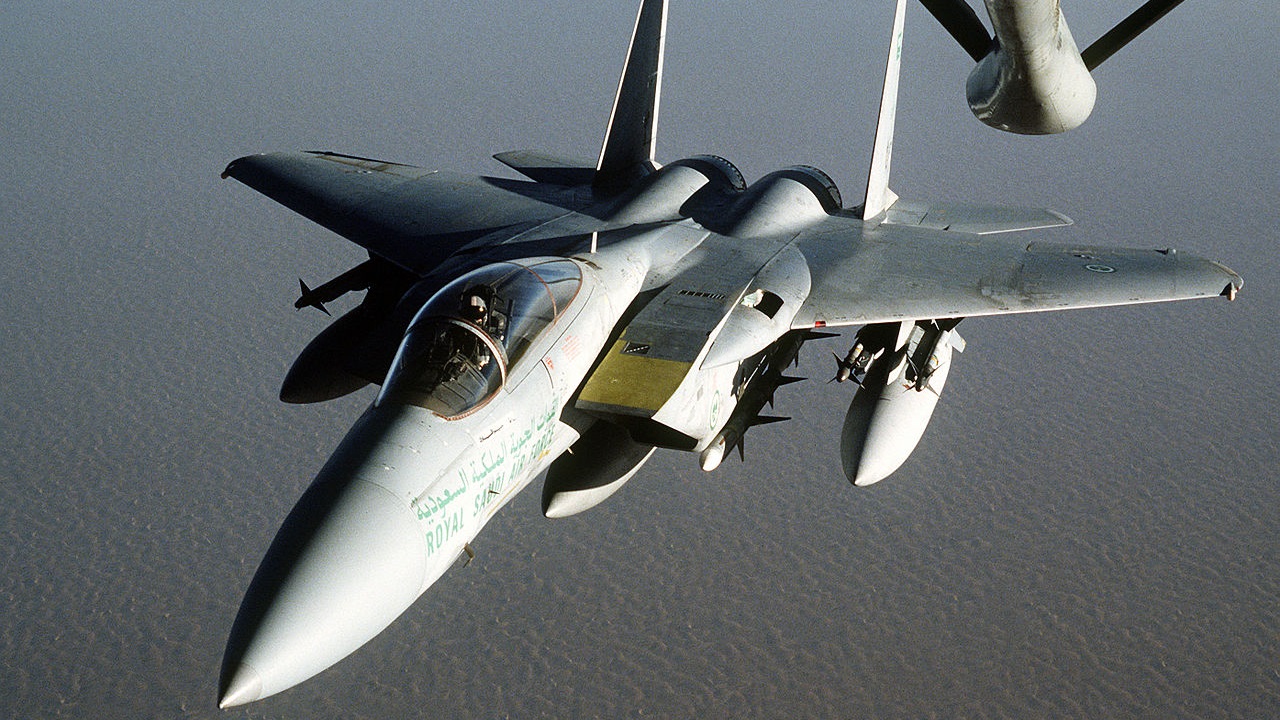
According to reports published by Reuters and Al Jazeera, the missiles and drones were attributed to the Houthis or to an Iran-aligned attack network. Operational details remain limited, and there is not enough in open sources to definitively ascertain the type of missile, launch site, or damage assessment. However, the trend is clear: Riyadh is no longer facing a single threat from the south. The ballistic trajectory pressures the capital, while drones expand the points of danger to oil and logistical facilities in the east, and the Bahrain incident adds a maritime and electronic dimension to the equation.
The military objective of these attacks does not always require hitting a sensitive facility. Forcing air defense to activate radars, mobilize Patriot batteries, temporarily close airspace, and raise insurance and transportation costs are all military and political outcomes in their own right. The intercepted missile may be costly for the attacker, but the interceptor missile, the system, the crew, and early warning consume far greater resources. This is where the sustainability test begins.
Successful Interception Does Not Equal Capability
Saudi Arabia possesses advanced air defense systems, including Patriot, and benefits from a broad American warning and support network. However, defensive capability is not measured by the number of batteries reflected in procurement data, but by the system's ability to operate continuously in a threat-saturated environment. As I always say, military capability is a triangle of equipment, training, and institutions. Saudi Arabia has made significant strides in equipment, but it still needs to demonstrate that training, command and control, and maintenance are improving at the same pace.
Ballistic missiles and drones do not pose the same problem. The missile tests warning time, interception altitude, PAC-3 inventory, and the operations center's ability to make decisions within minutes. Drones, on the other hand, test low-altitude radar, integration between air defense, the guard, and civilian facilities, and engagement costs. Using an expensive missile against a cheap drone may provide immediate protection, but it is not a model that can be repeated indefinitely.
Bahrain Reveals the Fragility of Dependence on the American Umbrella
The Bahrain incident is more significant than its apparent size. The island hosts the U.S. Fifth Fleet, and any Iranian claim of hitting an American radar aims to test the limits of deterrence, even if Washington denies a direct hit or announces the downing of drones. For Gulf states, the troubling message is that the presence of American forces does not eliminate the need for a swift national decision, nor does it prevent an adversary from turning bases and facilities into political pressure tools.
Practically, Riyadh and Manama cannot build a complete independent defense during an ongoing crisis, nor can they accept being mere recipients of protection. This is the old Gulf paradox in a new guise: purchasing the latest systems raises the level of protection, but it ties readiness to spare parts, software updates, training, and sensor data coming from the American ally. Independence that requires an external ignition key remains incomplete independence.
What to Monitor After the Interceptions
- Interceptor Missile Inventory: The recurrence of attacks will reveal whether Riyadh can maintain the pace of engagement without rapid depletion.
- Defense Distribution: Protecting Riyadh and eastern facilities simultaneously requires multi-layered defense, not just batteries concentrated around cities.
- Cheap Drones: Integrating guns, electronic systems, and small interceptor aircraft will become essential to reduce the cost of each engagement.
- Regional Command: The success of a single interception does not prove the existence of a unified Gulf network. Early warning exchange and joint command procedures between Saudi Arabia, Bahrain, and the rest of the Gulf Cooperation Council are required.
Gulf Deterrence Between Image and Capability
Riyadh will present the interceptions as evidence of its defense effectiveness, which is politically understandable. However, military assessment must ask a harder question: how many times can this be repeated, at what cost, and who will handle maintenance and decision-making when attacks coincide from the south, east, and sea? The Houthis or any Iran-linked entity do not need to penetrate every missile; it is enough for them to impose a costly and permanent defense on the Gulf and to prove that a single facility or radar can become the focal point of a crisis.
The events of November 15 demonstrated that Saudi Arabia is capable of neutralizing the threat, but it has yet to prove its ability to end the equation that produces it. While Gulf states seek decision-making independence, the effectiveness of their air umbrella remains tied to an American network that cannot be quickly replaced. In modern warfare, the question is not who has the shiniest weapon, but who can keep their eyes open and ammunition available on the third night of the attack.
Sources
- Reuters, November 15, 2026 report on the interception of missiles heading towards Riyadh and drones in the Eastern Province.
- Al Jazeera, November 15, 2026 report on the coalition's interception of missiles and drones attributed to the Houthis.
- Reuters and Haaretz, reports from November 13 and 14, 2026 about Iran's claim of targeting an American radar in Bahrain and the United States announcing the downing of drones.
Saudi Arabian forces intercepted two ballistic missiles targeting Riyadh and multiple drones in the Eastern Province on November 15, 2026. Concurrently, Bahrain intercepted an Iranian drone, indicating a growing threat from Houthi and Iranian-aligned forces. These incidents reflect a significant shift in Gulf security dynamics, necessitating enhanced regional defense cooperation.
- Saudi forces intercepted two ballistic missiles aimed at Riyadh on November 15, 2026.
- Bahrain intercepted an Iranian drone around the same time.
- The incidents indicate a shift in Gulf security dynamics with increased threats from Houthi and Iranian-aligned forces.
- The operational details remain limited, with no clear information on missile types or launch locations.
- The events highlight the need for improved regional defense coordination among Gulf states.