
Behind the Actions of Hundreds of PLA Vessels: The Type 055 Destroyer Transforms Naval Production Capacity into Constant Pressure in the Taiwan Strait
 Li Minghui
Behind the Actions of Hundreds of PLA Vessels, Type 055 Destroyers Turn Naval Capacity into Constant Pressure in the Taiwan Strait
In early November, a number that could easily be misrepresented by clickbait emerged around the Taiwan Strait: approximately 100 vessels from the Chinese Navy, Coast Guard, and auxiliary ships were active in multiple directions in the Western Pacific. France 24 cited information from Taiwan stating that on November 3, 49 PLA military aircraft were also detected, but by November 8 to 9, only 1 military aircraft and 8 Chinese vessels were recorded near Taiwan. In other words, this is not a maritime blockade that has already been implemented, but rather a large-scale display of military presence that can be rapidly intensified or reduced.
What concerns me more is not the "100 vessels" itself, but why the PLA is able to organize such a diverse array of ships in a short period of time. The answer lies partly in the shipbuilding capacity of the Chinese Navy and partly in the increasingly close task integration between the Navy, Coast Guard, and maritime auxiliary forces.
100 Vessels Does Not Equal 100 Main Battle Ships
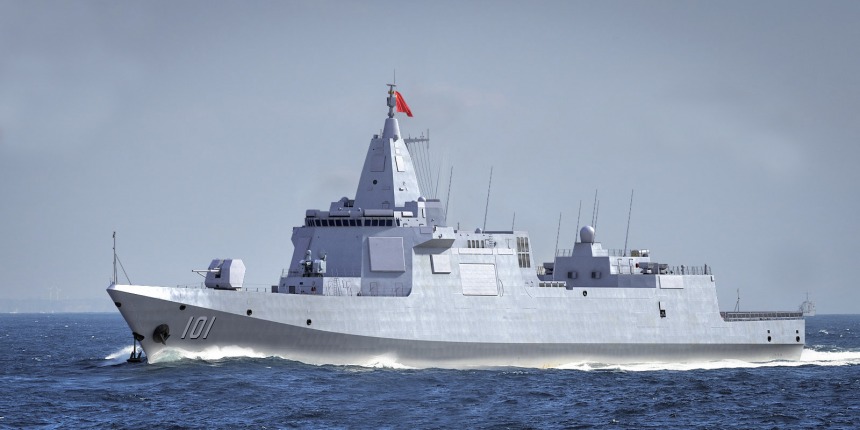
We must first break down the numbers. The scale of "hundreds of vessels" reported by France 24 includes naval ships, Coast Guard vessels, and even auxiliary fishing boats, which does not mean that the PLA deployed 100 Type 055 destroyers or frigates at once. The Type 055 is a 10,000-ton class area air defense and fleet command platform, with publicly available information typically stating that it has 112 vertical launch system cells, suitable for fleet air defense, long-range anti-ship strikes, and command node tasks; however, it cannot independently achieve large-scale maritime control.
What is truly valuable is the combination of "high-end nodes and low-end numbers." Main battle ships like the Type 055 and Type 052D provide sensors, missiles, and command capabilities, while Coast Guard vessels undertake law enforcement in gray areas and provide continuous presence, and auxiliary ships expand the area of presence, supplement logistics, and maritime situational awareness. In simple terms, this is a layered network rather than a neatly arranged fleet.
Shipbuilding Speed is Changing the Threshold for Action
Defense News reported in October, citing the Euronaval World Defense Shipbuilding Report, that the tonnage of combat vessels built by China from 2024 to 2025 will reach 636,208 tons, compared to 270,509 tons for the United States; China accounts for more than one-third of the global naval construction tonnage during the same period. The total tonnage of the Chinese Navy is still lower than that of the United States, but the speed of new ship additions has transformed the question of "whether forces can be continuously deployed" into "how many layers of forces can be prepared for deployment."
This also distinguishes current operations from past large-scale military exercises. Traditional exercises require advance announcements, concentration of forces, and clear objectives; now, normalized operations can mix a small number of high-value vessels, Coast Guard forces, and civilian auxiliary ships across different maritime areas, creating pressure while retaining de-escalation space. For Taiwan, the early warning system faces not a one-time peak but a long-term noise and signal that needs to be identified.
The Real Shortcomings Still Lie in Coordination and Sustainability
However, the number of vessels cannot be directly equated to blockade capability. Experts interviewed by France 24 pointed out that 8 vessels are insufficient to constitute a blockade, as civilian merchant ships can still enter and exit Taiwanese ports during peak periods. This assessment reminds us that the PLA's advantage currently resembles "rapidly building a maritime pressure network," rather than having a seamlessly operating blockade system at all times.
I believe the next step to observe is not the total number of vessels in news footage, but whether core platforms like the Type 055 can maintain stable coordination with Coast Guard, land-based air forces, and logistics vessels over consecutive days. If the answer is affirmative, the pressure in the Taiwan Strait will shift from large-scale exercises to a repeatable daily tool; if the answer is negative, the scale of hundreds of vessels may still only represent an expensive concentrated display.
Sources and Boundaries of Judgment
Main sources: France 24 "What we know about China's military exercises around Taiwan" (November 13, 2026); Institute for the Study of War "Dynamics between China and Taiwan" (November 13, 2026); Defense News "China built more than twice the naval tonnage of the US in 2024-25" (October 20, 2026). Publicly available information cannot confirm the complete composition of the hundred vessels, and some judgments regarding the role of the Type 055 formation in this article are based on publicly available equipment information.
Chinese naval and coast guard vessels are operating in the Western Pacific, demonstrating military presence rather than a blockade. Approximately 100 vessels were reported, including 055 and 052D destroyers, with activities noted around the Taiwan Strait in early November 2023. The Chinese Navy's shipbuilding capacity is increasing, allowing for sustained military pressure on Taiwan.
- Approximately 100 Chinese naval and coast guard vessels are active in the Western Pacific.
- On November 3, 49 Chinese military aircraft were reported near Taiwan.
- By November 8-9, only 1 military aircraft and 8 vessels were recorded near Taiwan.
- The Chinese Navy's shipbuilding capacity is rapidly increasing, with significant tonnage expected by 2024-2025.
- The operational strategy involves a mix of high-end and low-end naval assets to create sustained pressure on Taiwan.