
SH-60L and MH-60R Conduct Anti-Submarine Training in Sagami Bay in 2026, Verifying Japan-U.S. ASW Integration
 Tanaka Takashi
SH-60L and MH-60R Conduct Anti-Submarine Training in Sagami Bay in 2026, Verifying Japan-U.S. ASW Connection
The photo of two patrol helicopters flying side by side over Sagami Bay is not a flashy depiction of a fleet exercise. The joint training announced by the Ministry of Defense and the Maritime Staff Office on July 1 was an anti-submarine warfare training conducted on June 30 in Sagami Bay, with participation limited to one SH-60L from the Japan Maritime Self-Defense Force and one MH-60R from the U.S. Navy. It is a small-scale exercise. However, in my view, this smallness is the point of interest.
One Day of Anti-Submarine Training in Sagami Bay
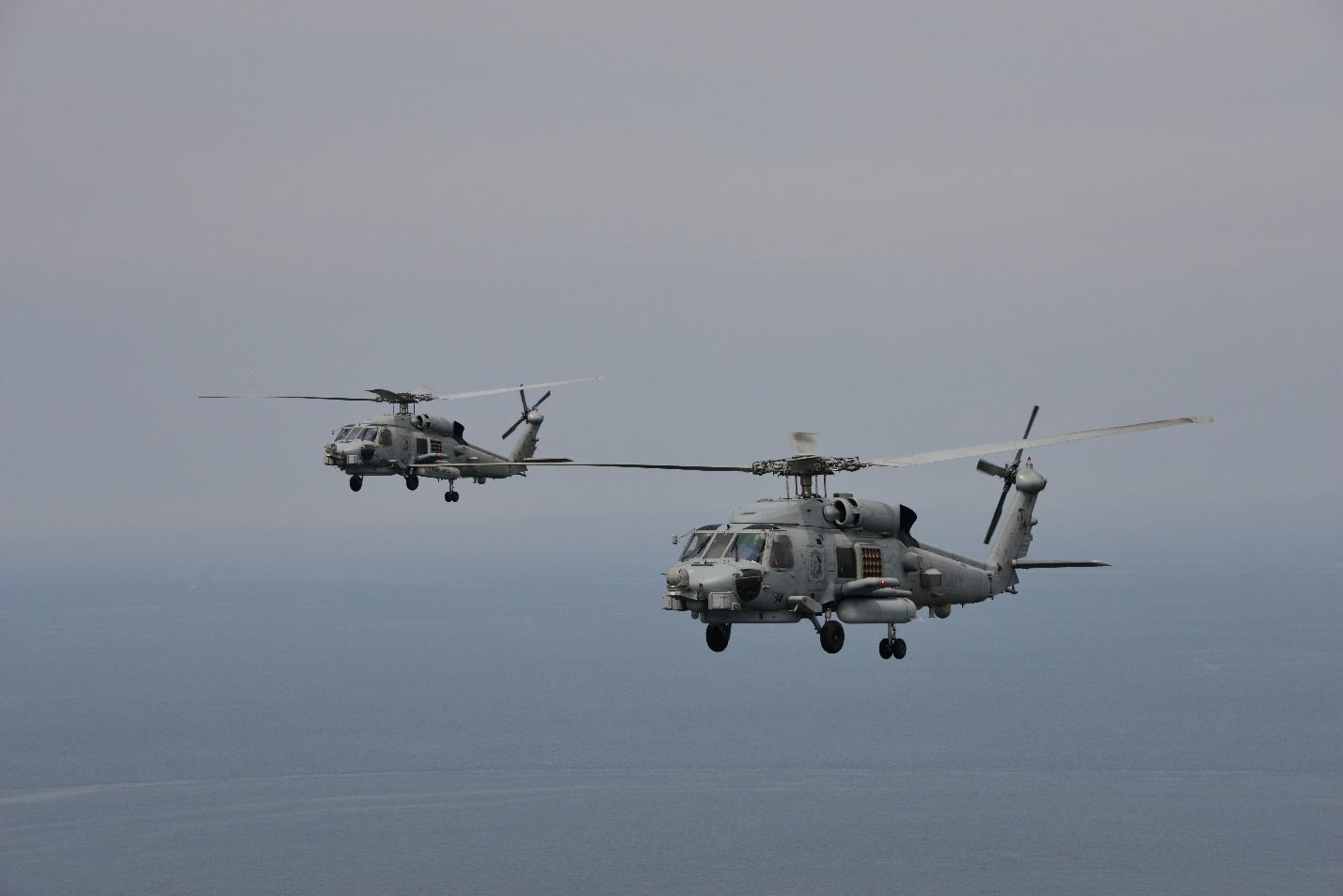
According to the announcement from the Maritime Staff Office, there were two training objectives. First, to improve the tactical skills of the Japan Maritime Self-Defense Force, and second, to enhance interoperability with the U.S. Navy. The training area was specified as Sagami Bay, and the training item was anti-submarine warfare. Sagami Bay is not just a coastal training ground. It is a location that connects Yokosuka, Atsugi, Tateyama, and the exit to the Pacific, overlapping the defense of the metropolitan area and deployment to the Western Pacific.
The significance of conducting anti-submarine training with only two helicopters in this maritime area lies not in a show of fleet scale, but in the details of tactical procedures. The job of searching for submarines does not end with lowering the sonar. It involves organizing acoustic information, sharing contact information, separating airspace with friendly aircraft, reporting to naval vessels or land command posts, and making judgments to reduce false detections. Whether Japan and the U.S. can execute this series of procedures at the same tempo will influence actual deterrence.
What Changes with the Addition of the SH-60L
The SH-60L is a new patrol helicopter developed by Mitsubishi Heavy Industries as a successor to the SH-60K for the Japan Maritime Self-Defense Force. According to Naval News, the Ministry of Defense announced the completion of development in December 2023 and secured funding for six units in the fiscal year 2023 and another six units in the fiscal year 2024. Its appearance is similar to the SH-60K, but the focus is on improvements in onboard systems and flight performance, aiming to increase the capacity for detection, identification, and information processing in anti-submarine warfare.
It is also important that the counterpart in this exercise was the U.S. Navy's MH-60R. The MH-60R is the U.S. Navy's standard multi-mission helicopter, responsible for anti-submarine warfare and anti-surface warfare. As the Japan Maritime Self-Defense Force begins to fully utilize the SH-60L, training in the same area as the U.S. standard aircraft is not merely a gesture of goodwill. It is more significant in practical terms to align actual communications, handling of detection data, and the quirks of mission division than to compare the performance differences of old and new equipment numerically.
- Date of Exercise: June 30, 2026
- Date of Announcement: July 1, 2026
- Maritime Airspace: Sagami Bay
- JSDF Participating Force: SH-60L
- U.S. Navy Participating Force: MH-60R
- Training Item: Anti-Submarine Warfare Training
Quiet Operational Readiness Before the First Island Chain
When considering anti-submarine warfare around Japan, discussions often focus on the Nansei Islands and the Taiwan Strait. Of course, this is understandable. However, from the perspective of maritime traffic routes, or SLOCs, the waters leading from Sagami Bay to the Boso Peninsula and the Izu Islands cannot be overlooked. When the U.S. 7th Fleet, based in Yokosuka, and the Japan Maritime Self-Defense Force's escort fleet head out to the Pacific, anti-submarine vigilance in these coastal waters is at the front line, not in the rear.
Looking at the capabilities of the Chinese Navy, both nuclear and conventional submarines are expanding their operational ranges. On the other hand, intentions must be carefully considered on a case-by-case basis. Therefore, interpreting this training as an immediate warning to a specific country is somewhat simplistic. More accurately, it indicates that Japan and the U.S. are normalizing anti-submarine procedures used in crises through short-term training during peacetime.
The Weakness of Deterrence is Not Just Communication Speed
However, it is also important not to overestimate the situation. A single day of training with two helicopters will not resolve the challenges of Japan-U.S. anti-submarine warfare. The number of SH-60Ls deployed is still limited, and it will take time to train maintenance personnel, crew members, and acoustic analysis staff. Helicopters alone cannot contain submarines. Only when combined with P-1 patrol aircraft, escort ship towed sonars, fixed and mobile sensors, and the U.S. military's information networks can they function effectively as a cohesive unit.
Rather, the point highlighted by this training is the human factors that remain after equipment upgrades. Even with the new SH-60L, if Japanese and U.S. personnel do not understand the same sounds with the same meanings, make judgments at the same speed, and provide necessary information within political constraints, capabilities will remain just numbers on paper. The single photo from Sagami Bay conveys the fact that it is not flashy deterrence, but rather the unglamorous repetition of training that determines the strength of the alliance.
The true challenge lies not in the performance of the SH-60L itself, but in whether it can be fully utilized within the same tactical timeframe as the U.S. Navy's MH-60R.
Sources
- Maritime Staff Office "About Japan-U.S. Joint Training" July 1, 2026
- Naval News "Japan completes new SH-60L naval combat helicopter development" December 29, 2023
Japan Maritime Self-Defense Force and U.S. Navy conducted anti-submarine warfare training in Sagamihara Bay on June 30, 2026, involving one SH-60L and one MH-60R helicopter. The training aimed to enhance tactical skills and interoperability between the two forces, focusing on detailed operational procedures rather than large-scale demonstrations.
- The training involved one SH-60L from the Japan Maritime Self-Defense Force and one MH-60R from the U.S. Navy.
- The exercise took place in Sagamihara Bay on June 30, 2026.
- The purpose was to improve tactical skills and interoperability between the two forces.