
Shaheds and Iskanders Show Russia's Bet on Exhausting Air Defense on July 30
 Dmitri Volkov
Shaheds and Iskanders on July 30 Show Russia's Bet on Exhausting Air Defense
Eight dead after a nighttime strike is not the largest number in this war. That is precisely why it is indicative. The Russian campaign of long-range strikes in the summer of 2026 has ceased to be a series of isolated raids and increasingly resembles an industrially organized procedure: cheap drones force Ukrainian air defense to activate radars, more expensive missiles target overloaded areas, and the political effect is measured not only by destroyed buildings but also by the expenditure of Ukrainian interceptors. According to a report by The New York Times on July 30, Russian missiles and drones struck Ukrainian cities at night, killing at least eight people and injuring dozens. For the General Staff in Moscow, this is not "retribution" or an emotional reaction. It is the accounting of war.
The Mechanics of Combined Strikes
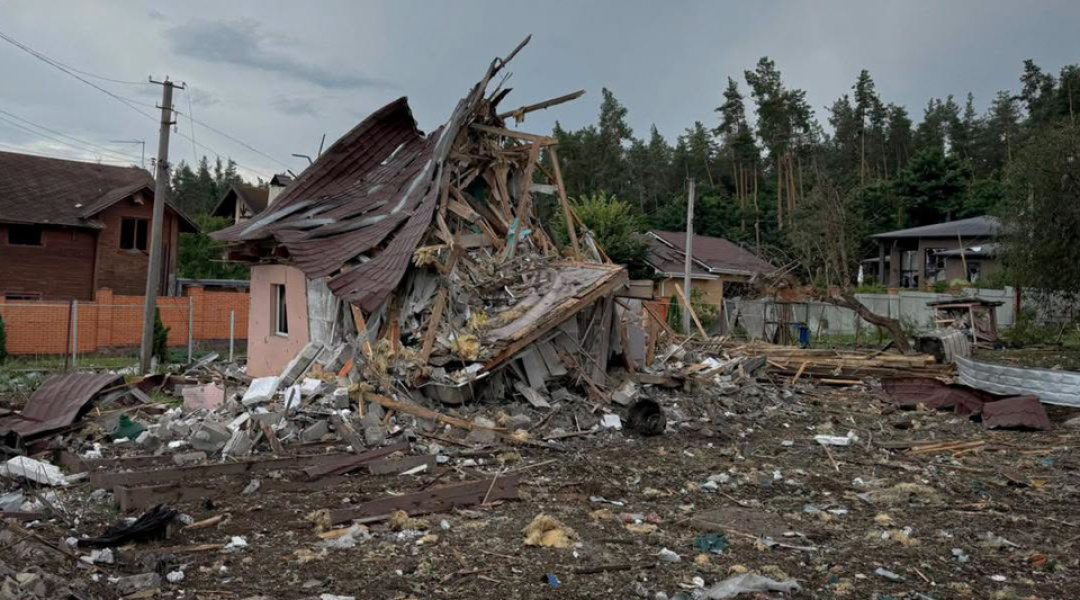
The Russian scheme of recent months is built on a combination of three types of strike means. The first layer consists of strike UAVs from the "Shahed"/"Geran" family, as well as decoys and simpler devices that create mass. The second layer includes ballistic missiles of the "Iskander-M" type and, according to Ukrainian reports, individual launches of S-400 missiles at ground targets. The third layer consists of cruise and air-launched ballistic systems, including X-59/69, "Onyx," or, in rarer cases, "Zircon." In July, this architecture was already evident in large series: GlobalSecurity, summarizing data from Kyiv Independent and ISW, pointed to a strike on July 19 involving 125 drones, 25 ballistic missiles, 10 "Zircons," and another six missiles; earlier, on July 17-18, two "Iskander-Ms," two "Onyxes," three X-59/69s, and 90 drones were recorded. These numbers may vary depending on Ukrainian, Russian, and OSINT methodologies, but the order of magnitude is more important than absolute accuracy.
The military logic here is old, although the technical shell is new. In Soviet textbooks on operations deep behind the front, it was considered important not only to destroy the target but also to paralyze the command and counteraction system. Today, such a system has become the Ukrainian multi-layered air defense. Russia is not obliged to completely breach it every time. It is enough for it to regularly force Kyiv to choose between protecting the capital, energy facilities, airfields, ports, and frontline cities. This is a war not for a single Patriot or NASAMS battery, but for the distribution of scarcity.
Why Mass Has Become the Main Parameter
A telling episode from early July is the nighttime strike reported by Reuters on July 1: 74 missiles and 496 drones. Even if considered as a separate peak, it demonstrates Moscow's production goal. The Russian defense industry is not obliged to produce perfect weapons if it can produce enough mediocre weapons to force the enemy to expend quality defense resources. This is an unpleasant but quite rational formula. The Soviet aphorism that "quantity has a quality all its own" sounds almost too literal here.
The "Shahed" in such a scheme is not just a strike drone. It is a unit of pressure on the air defense economy. Its cost is lower than that of many Western-made surface-to-air missiles, and the route can be changed to overload duty crews, mobile fire groups, and the radar field. The Russian side likely considers not only hits but also the number of Ukrainian launches, radar operating time, overload on rescue services, and the subsequent informational effect. Unlike in 2022, when Moscow often spent expensive missiles on demonstrative strikes, in the summer of 2026, a drier mathematics is visible: using the cheap layer to open the system, and the expensive layer to strike where a gap has appeared.
The Problem of Russian Effectiveness
However, from this picture, it does not follow that the Russian strategy is automatically successful. If combined strikes were yielding operational results, we would see a rapid collapse of Ukrainian ground defense. This is not the case. Even the July reports, including materials from ISW and GlobalSecurity, show the front as a positional line with large numbers of combat encounters but without confirmed strategic breakthroughs. This is an important distinction: Russia can worsen the life of the Ukrainian rear, increase the cost of defense, and inflict political damage, but it does not necessarily translate this into maneuvering ground troops. Between a destroyed house near Kyiv and the capture of an operational node in Donbas lies a long institutional distance.
Here, the chronic defect of the Russian military machine manifests itself. It has learned to scale individual tools—drones, glide bombs, missile series, electronic pressure. But it still struggles to connect these tools into a sustainable joint operation. In 2008, reformers after the war with Georgia spoke precisely about this: what is needed is not a showcase of technology, but a system of intelligence, communication, targeting, and accountability of commanders. In 2026, the Russian army has become more dangerous in tactical and technical terms, but its institutional inertia has not gone anywhere. Sometimes it seems that Moscow can produce a thousand drones faster than a single honest report on the reasons for failure.
The Ukrainian Response and Limits of Defense
The Ukrainian side is responding not only with interceptions. Strikes on Russian oil depots, logistics centers, shipping in the Sea of Azov, and infrastructure in occupied Crimea, reported by Kyiv Independent and ISW in July, create counter-pressure on the Russian war economy. This is fundamentally important: if Russia is trying to exhaust Ukrainian interceptors, Ukraine is trying to exhaust Russian fuel, repairs, logistics, and marine transport insurance. In this sense, the summer of 2026 has become a competition not only of armies but also of industrial frameworks.
For Kyiv, the most painful part is the limitation of Western supplies. The air defense system is only as good as the stability of the missile flow to it. Patriot, IRIS-T, NASAMS, and mobile groups with machine guns and MANPADS solve different tasks, but all depend on ammunition, repairs, and trained crews. When a Russian strike includes hundreds of targets, Ukrainian defense is forced to conduct selection: what to intercept with an expensive missile, what to assign to a mobile group, and what, unfortunately, will get through. This is not a moral choice but military arithmetic under sirens.
Strategic Conclusion
The strike on July 30 is important not for the number of casualties, however tragic it may be, but for the fact that it fits into a sustainable Russian model. Moscow is betting on regularity, a mix of cheap and expensive means, psychological pressure, and the expenditure of Ukrainian air defense. But this model has limits. It is capable of prolonging the war and increasing the cost of Ukrainian resistance; it has yet to prove Russia's ability to turn air pressure into decisive ground results. The Russian defense industry and army will likely continue to ramp up mass series of "Shaheds" and combined launches until the end of 2026, unless they face a serious shortage of components. Ukraine, in turn, will respond not symmetrically but with strikes on Russia's logistics and energy base. Therefore, the main question in the coming months is not "whose missile is better." It is simpler and colder: whose industrial system will be the first to start counting the war as too expensive.
On July 30, 2026, Russian forces launched a coordinated strike against Ukrainian cities using 125 drones and 25 ballistic missiles, resulting in at least eight fatalities. This operation is part of a broader strategy to exhaust Ukrainian air defenses by combining cheap drones with more expensive missiles. The strikes reflect a systematic approach to warfare, aiming to pressure Ukraine's military resources and infrastructure.
- Eight people were killed and dozens injured in the strikes on July 30.
- The strikes involved a combination of Shahed drones and Iskander-M ballistic missiles.
- The Russian military strategy aims to exhaust Ukrainian air defense systems.
- The operation reflects a shift towards a more industrially organized approach to warfare by Russia.
- Ukraine is responding with strikes on Russian logistics and energy infrastructure.