
Eagle Strike-20 Mounted on 052D Destroyer: PLA's 64-Unit Vertical Launch Ship Gains Hypersonic Anti-Ship Option
 Li Minghui
YJ-20 Mounted on 052D Destroyer, PLA's 64-Cell Vertical Launch Ships Gain Hypersonic Anti-Ship Options
On July 31, the South China Morning Post noticed a scene that could easily be overlooked by the average reader: a video released by CCTV this week showed a YJ-20 being launched from the vertical launch system of a 052D destroyer. The filming time of the video has not been disclosed, which needs to be clarified first. However, when viewed alongside the Aviation Week report from July 29, the information becomes clearer: the PLA Navy is expanding its sea-based hypersonic anti-ship munitions from a few high-end platforms like the 055-class destroyers to a larger number of 052D/052DL destroyers.
The Key is Not One Missile, But More Launch Platforms
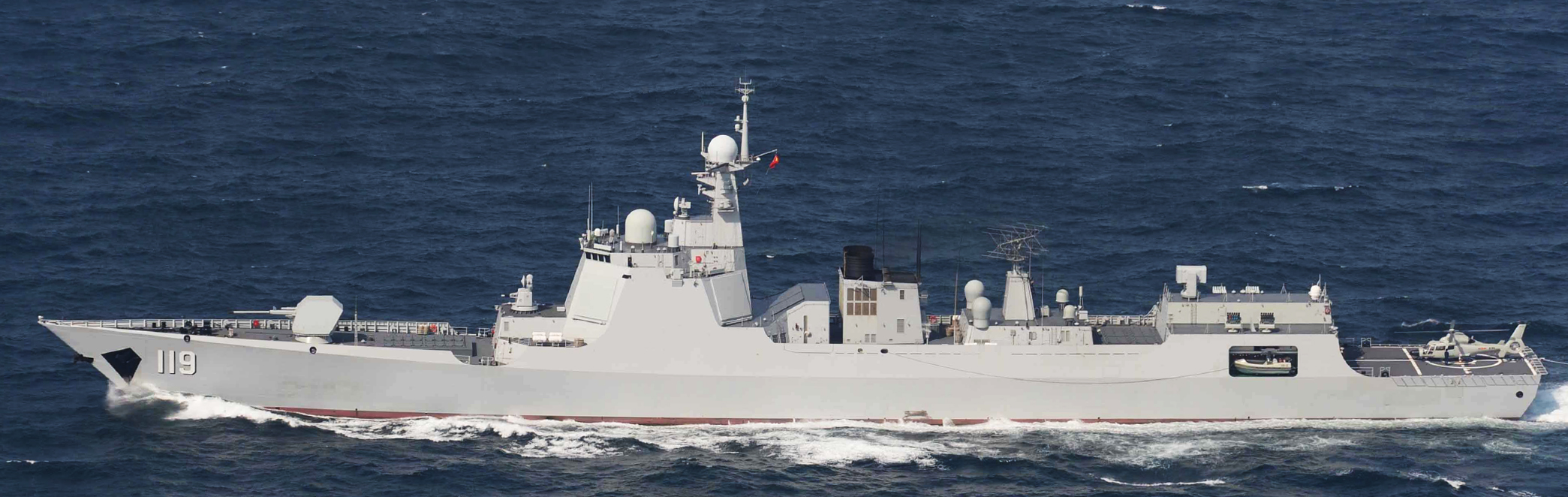
Public information shows that the 052D has a full-load displacement of about 7,500 tons, while the 052DL is about 7,700 tons, both using a 64-cell universal vertical launch system, originally mainly loaded with HQ-9 air defense missiles, YJ-18 anti-ship missiles, anti-submarine missiles, and some land-attack cruise missiles. Naval News previously reported that the 052D series is continuously being built by Jiangnan and Dalian shipyards, making it the most stable main surface combatant platform for the Chinese Navy's expansion over the past decade. In other words, if the YJ-20 truly enters the 052D system, the impact is not that a single ship's firepower suddenly becomes stronger, but rather that the deployable nodes in the anti-carrier strike chain have increased.
In the past, discussions about the Chinese Navy's long-range anti-ship capabilities often focused on the DF-21D, DF-26, and air-launched ballistic missiles carried by the H-6K, as well as the YJ-21 or similar munitions that may be carried by the 055-class destroyers. The 055 is certainly important, with more vertical launch cells, stronger radar, and command capabilities. However, the number of 055s is limited, and their tonnage and mission value are high, making it impossible for them to serve as forward launch points in all directions. The significance of the 052D is quite the opposite: it may not be the most luxurious platform, but it is easier to deploy in larger numbers.
Three Realistic Implications of Equipping 052D with Hypersonic Anti-Ship Missiles
- First, the extension of strike radius. The YJ-20 is described as a sea-based hypersonic anti-ship ballistic missile, with specific range and terminal velocity data still not publicly available, but its positioning is clearly above traditional subsonic or supersonic anti-ship cruise missiles.
- Second, changes in the ammunition structure of formations. The 64 vertical launch cells are not abundant; loading a long-range anti-ship missile will occupy space for air defense or anti-submarine munitions, requiring the 052D to rebalance between area air defense, anti-submarine escort, and long-range anti-ship capabilities.
- Third, increased demands on the operational system. The real challenge of hypersonic anti-ship missiles is not just launching them, but also discovering distant sea targets, continuous tracking, mid-course updates, and terminal damage assessment.
In simple terms, the ability of the 052D to launch the YJ-20 does not mean that a single 052D can independently solve the carrier problem. It is more like handing a sharper arrow to more archers, but whether the archers can hit a moving target still depends on satellites in the sky, unmanned reconnaissance platforms in the air, sensors at sea, and theater-level command networks.
The Pressure on the U.S. Navy Lies in Uncertainty
From the perspective of the U.S. military, the most troublesome issue is not confirming the maximum range of a specific Chinese missile, but rather having to assume that more Chinese destroyers may carry such munitions. The 052D is often referred to as the Chinese version of the Aegis destroyer; this characterization is somewhat rough, but it does possess the basic framework of modern phased array radar, area air defense, and multi-purpose vertical launch capabilities. If hypersonic anti-ship missiles become optional payloads, U.S. carrier strike groups will not be able to plan operations within and outside the first island chain by only focusing on a few 055s or coastal rocket force positions.
I believe there is also a cost logic that is easily overlooked. China does not need to keep every 052D fully loaded with YJ-20s for an extended period, as that would waste limited munitions and weaken fleet air defense resilience. A more likely approach is to mix-load based on direction and mission before a crisis, distributing a small number of high-value munitions across multiple launch platforms. What opponents see is uncertainty: which ships are loaded, how many missiles they carry, and when they will switch from air defense to anti-ship launch nodes.
Still Need to Look at Mass Production and Training
It is still too early to conclude that the Chinese Navy has completed the widespread deployment of hypersonic anti-ship capabilities. There are at least three gaps in publicly available information: the actual production volume of the YJ-20 is unclear, the scope of modifications or software adaptations for the 052D is unclear, and the frequency of live-fire training is also unclear. The fact that the missile can fit into the vertical launch tube is only part of the engineering threshold; what is truly costly is mass production, crew training, data link adaptation, and wartime target assurance.
However, the trend is becoming clearer. The Chinese Navy is shifting long-range anti-ship firepower from a few iconic platforms to a larger fleet base, which aligns with the development direction of the Fujian aircraft carrier, the 076-class Sichuan ship, unmanned systems, and maritime reconnaissance systems. It does not change the rules of naval warfare in the Western Pacific overnight, but it will gradually alter the default assumptions of countries like the U.S., Japan, and Australia when assessing the threat posed by Chinese surface ships.
Main reference sources include the South China Morning Post report from July 31, the Aviation Week report from July 29, and public information from Naval News regarding the construction and specifications of the 052D series. The CCTV video shows the launch scene, but the filming time has not been disclosed, and relevant details still need to be verified.
The real question worth asking is: the next time the Chinese Navy publicly shows such footage, will it emphasize that a specific 052D can launch, or will it showcase a complete anti-ship kill chain composed of 052Ds, 055s, H-6Ks, and unmanned reconnaissance platforms?
On July 31, the People's Liberation Army Navy launched a YJ-20 hypersonic anti-ship missile from a 052D destroyer, marking a significant enhancement in its naval capabilities. This development allows for a broader deployment of hypersonic missiles across more vessels, increasing the potential threat to U.S. Navy operations in the region. The 052D destroyer, equipped with 64 vertical launch cells, is now capable of carrying advanced anti-ship munitions, altering the dynamics of naval warfare.
- The YJ-20 hypersonic missile was launched from a 052D destroyer.
- The 052D destroyer has 64 vertical launch cells.
- The deployment of the YJ-20 increases the anti-ship strike capabilities of the PLA Navy.
- The 052D is being adapted to carry hypersonic missiles, expanding the range of platforms available for such weapons.
- The report highlights the strategic implications of this development for U.S. Navy operations.