
Singapore 2026 MRCV Shows Drone Motherships Are No Longer Experimental
 Marcus Chen
Singapore 2026 MRCV Shows Drone Motherships Are No Longer Experimental
Sixty thousand kilograms of carbon fiber does not sound like a naval turning point. In Singapore's case, it may be exactly that. Penguin Shipyard International has delivered the first of six composite forward superstructures for the Republic of Singapore Navy's Multi Role Combat Vessel, or MRCV, a 150-meter, roughly 8,000-ton class being built to replace the Victory-class missile corvettes that entered service in 1989.
The easy headline is that Singapore just built its largest composite ship structure. The better one is that a small navy is building an 8,000-ton unmanned-systems command ship before many larger navies have settled their concepts. That should bother people in Washington who still talk about drone fleets as if they are a procurement experiment instead of a fleet architecture problem.
The Ship Is Bigger Than the Label
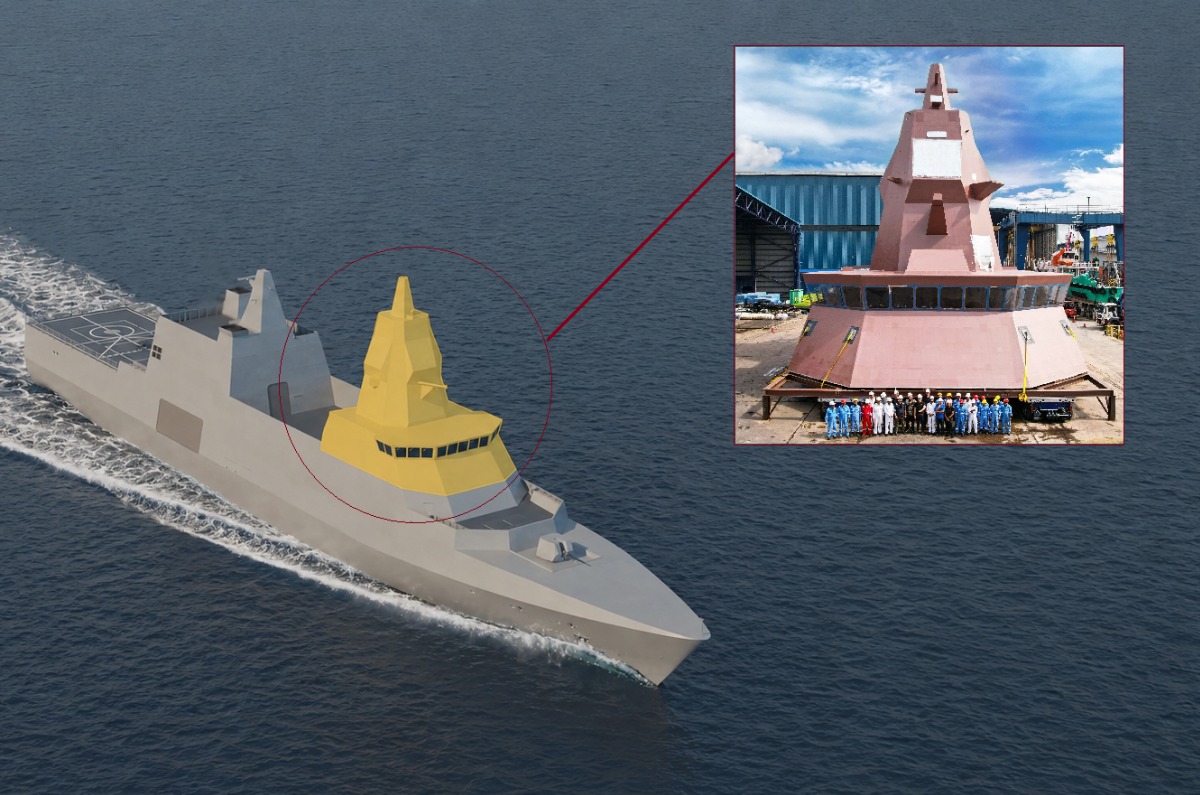
According to reporting on the Saab-Penguin delivery, the MRCV is expected to displace around 8,000 to 8,400 tonnes, with a range above 7,000 nautical miles and endurance beyond 21 days. Those numbers matter more than the label "combat vessel." This is not a patrol craft with a drone deck bolted on. It is closer in size to a destroyer and larger than many frigates, but it is being organized around mission modules and unmanned systems rather than around a traditional gun-and-missile identity.
The reported configuration includes a mission bay able to carry eight containerized modules. That gives Singapore a way to shift payloads between mine countermeasures, surveillance, surface strike support, electronic warfare, undersea search, and command functions without pretending that one hull can permanently optimize for all of them. Anyone who has served on a destroyer knows the ship's real constraint is often not the weapon brochure. It is space, weight, power, cooling, crew workload, and how fast maintainers can reset the system after three bad days at sea.
- Class size: six ships
- Approximate length: 150 meters
- Approximate displacement: 8,000 to 8,400 tonnes
- Reported range: more than 7,000 nautical miles
- Reported endurance: more than 21 days
- Mission bay: eight containerized modules
The Composite Mast Is About Margins
Composite superstructures are not magic stealth cloaks. They are engineering trades. Saab says the carbon-fiber structure reduces weight, radar cross-section, and life-cycle costs. Singapore's Ministry of Defence has previously described weight savings of roughly half compared with steel for such upper structures. If that estimate holds at this scale, the operational point is not cosmetic. Less topside weight lowers the center of gravity and gives designers margin for sensors, communications gear, electronic warfare systems, and future payloads.
That is exactly where unmanned operations become hard. A drone mothership is not just a launch platform. It needs control stations, data links, antennas, processing capacity, workshops, spare parts, charging or fuel arrangements, and people who can manage vehicles in the air, on the surface, and underwater while the ship is still fighting its own navigation, air-defense, and damage-control problems. The MRCV's composite mast is therefore less interesting as a material story than as a margin story. Singapore is buying room for systems it has not fully fielded yet.
The manufacturing chain also says something important. Saab produced the raw composite material in Sweden, shipped it to Singapore, and Penguin fabricated the final assembly locally before transfer to ST Engineering Marine for integration with the steel hull. That is not autarky. It is selective industrial depth: foreign design and material expertise, local fabrication experience, and domestic final integration. For a city-state that cannot build every defense input itself, that is a more credible model than slogans about self-sufficiency.
Why This Matters in the South China Sea
Singapore is not trying to match China ship for ship. It cannot, and it does not need to. The People's Liberation Army Navy can generate mass in the South China Sea in a way no Southeast Asian navy can answer symmetrically. The smarter question is whether a small navy can produce persistent maritime awareness, protect sea lines of communication, and complicate coercion without building a miniature version of the U.S. Navy.
The MRCV is one answer. A ship with 7,000 nautical miles of range can operate beyond Singapore's immediate waters and stay on station long enough to matter. A mothership able to deploy unmanned surface, aerial, and undersea vehicles can push sensors away from the hull and distribute risk. If one unmanned vehicle is lost, the fleet loses a node, not the ship. That is the kind of arithmetic small navies need.
There is also a political signal here, but it is secondary. Singapore has spent years maintaining defense ties with the United States, access relationships across the region, and a careful public posture toward China. The MRCV does not require Singapore to announce a bloc position. It gives the Republic of Singapore Navy a tool for sea denial, surveillance, and escort work in a region where ambiguity is often useful but weakness is not.
The U.S. Should Read the Lesson Correctly
Washington should resist the temptation to treat Singapore's MRCV as a boutique naval project. The lesson is not that every navy needs an 8,000-ton drone carrier. The lesson is that unmanned systems only become militarily useful when the host platform is designed around the boring parts: power, data, maintenance, storage, crew flow, modular payload handling, and communications discipline under electronic attack.
The U.S. Navy has tested unmanned surface vessels, experimented at RIMPAC, and published enough fleet architecture language to fill a wardroom bookshelf. But experimentation is not deployment. A drone boat that cannot be repaired forward, a UUV that cannot be recovered in bad weather, or an unmanned aircraft whose control links collapse under jamming is not a combat multiplier. It is a planning assumption waiting to fail.
Singapore's program is still unproven. The first ship, Victory, was launched in 2025, and deliveries are expected to begin in 2028. Integrating unmanned systems at sea is harder than integrating a composite mast on land. The RSN will have to prove that the modules can be swapped quickly, that command links survive congestion, and that crews can manage manned and unmanned operations without turning the combat information center into a traffic-control problem.
Still, the direction is clear. Singapore is not waiting for the perfect unmanned doctrine. It is building the hull, the margins, and the industrial process now. That is how drone warfare leaves the PowerPoint stage. The 60-ton composite structure is not the story by itself. The story is that Singapore has started building a fleet around the assumption that the next naval fight will be distributed, sensor-heavy, and too fast for ships that were designed only to fight with what they carry inside their own skin.
Singapore delivered the first of six Multi Role Combat Vessels (MRCVs) in 2026, designed to operate unmanned systems. The MRCV displaces 8,000 to 8,400 tonnes and has a range exceeding 7,000 nautical miles. This development marks a significant shift in naval capabilities, focusing on modular and unmanned operations.
- Singapore is building six Multi Role Combat Vessels (MRCVs) to replace older corvettes.
- The first MRCV is expected to displace 8,000 to 8,400 tonnes and have a range of over 7,000 nautical miles.
- The MRCV will feature a mission bay capable of carrying eight containerized modules for various operations.