
Six Iranian marches strike a US base in Bahrain as USS Theodore Roosevelt arrives, escalating the Hormuz crisis in 2026
 Ahmed Al-Rashid
Six Iranian Drones Strike US Base in Bahrain as USS Theodore Roosevelt Arrives, Escalating Hormuz Crisis in 2026
The Bahrain Attack is Not an Isolated Incident
On the evening of Sunday, November 15, Iran launched six drones towards a US air defense radar facility at the Bahrain Al-Rifaa base, according to reports from the BBC citing the Revolutionary Guard and Bahraini forces. Manama announced that its defenses intercepted the attack before it reached its targets, while Tehran stated that the Strait of Hormuz is closed and that any US aggression would be met with a harsher response. This is not the language of a border incident; it is a calculated attempt to test the weakest link in the US presence around the Gulf.
The second attack on Bahrain within three days illustrates that Tehran does not need to hit a major base to alter its adversaries' calculations. It is enough to force the population to seek shelter, to compel Washington to operate radars and defenses around the clock, and to make oil tankers move under military protection. Practically, the cheap drone serves a political and military function greater than its cost.
Three Carrier Groups and the Deterrence Message
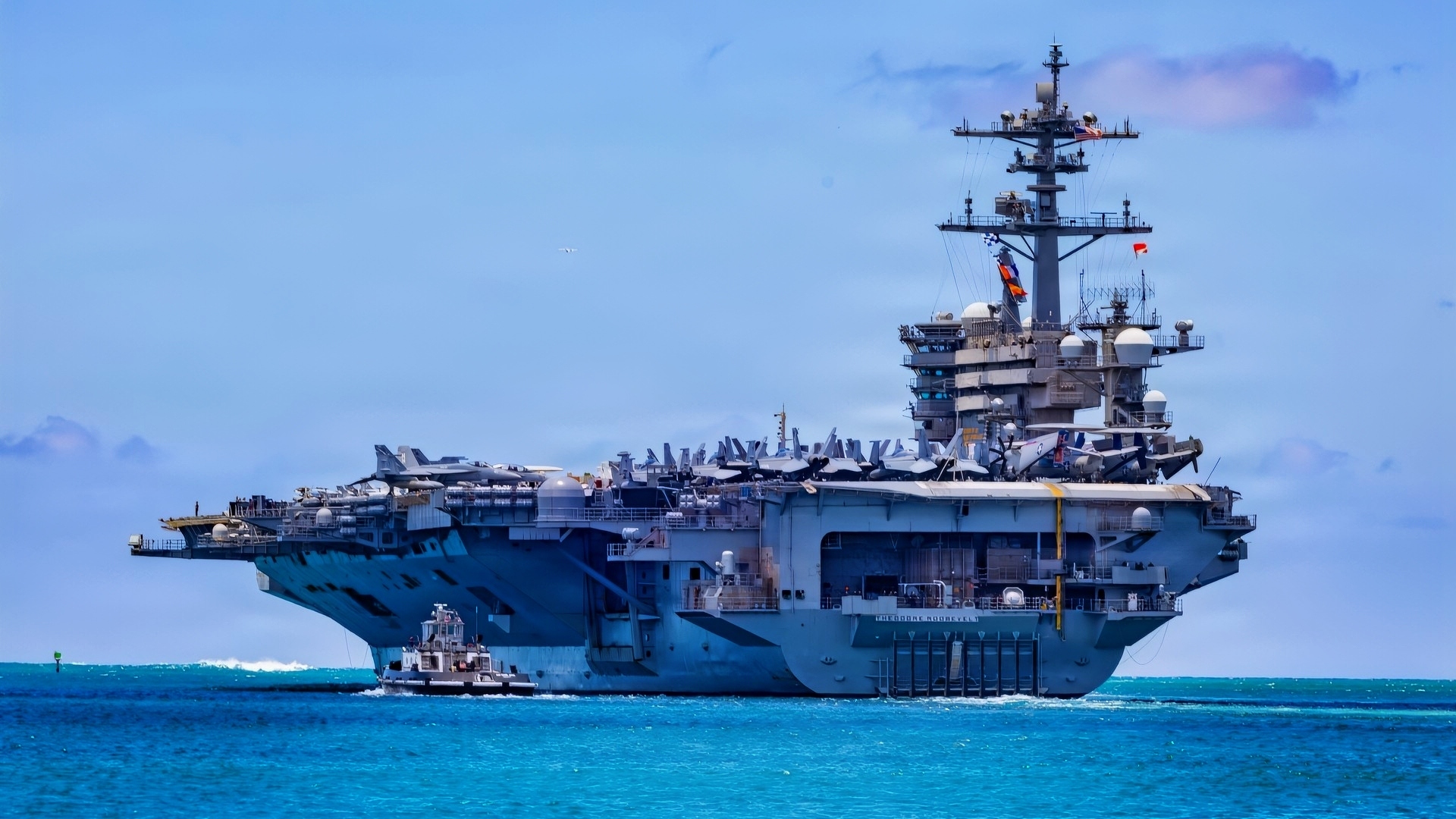
The escalation coincided with the arrival of the nuclear aircraft carrier USS Theodore Roosevelt in the Middle East on November 15, according to Al Jazeera, joining the USS George Washington and USS George H. W. Bush in the US Central Command area. Roosevelt carries more than five thousand personnel and an air wing exceeding sixty aircraft, including F/A-18 fighters. Thus, Washington now has three carrier strike groups, in addition to additional naval and Marine Corps forces whose deployment details have not been fully confirmed by the US Department of Defense.
The carrier is not just a floating runway. It is a command, reconnaissance, and strike center, capable of keeping airborne warning, protection, and attack aircraft in the air, linking ships, bases, and partners into a single network. However, its presence does not mean that Washington has decided to resume war. US President Donald Trump stated last week that additional strikes are unlikely and that the military component of the war has effectively ended, while keeping forces in a state of readiness. Here lies the dual message: to deter Iran without closing the door to negotiation, and to convince Gulf states that the United States has not left them alone.
The Gulf's Capability in the Triangle of Equipment, Training, and Institution
Bahrain possesses air defense systems, radars, and a deep security partnership with the United States, yet it cannot prevent drone launches from becoming a political crisis every few days. The reason is not solely the lack of equipment. In the triangle of military capability that combines equipment, training, and institution, the system may succeed in intercepting the target, but it cannot alone determine the source of the launch, prevent the next strike, or protect every civilian and military facility simultaneously.
The Gulf states have the funds to purchase Patriot and THAAD systems, fighter jets, and patrol vessels, but they still rely on the United States for early warning, information sharing, command and control operations, and air and maritime domain management. Buying radar does not equate to having an integrated air defense network; owning an interceptor missile does not equate to the ability to conduct a long campaign against low-cost, multi-directional attacks. Any military personnel who have served in the region know that operational hours, spare parts, and decision-making crew are more important than the shine of the platform at a weapons exhibition.
Hormuz is the Center of Pressure, Not Just a Waterway
BBC reports that about a fifth of global gas and oil supplies typically pass through the Strait of Hormuz, and navigation has declined since the outbreak of war in February. Therefore, Iran uses attacks on Bahrain and threats against shipping movements to build a pressure equation: if Washington wants to protect trade, it must keep its forces exposed; if it reduces its presence, Tehran can raise the costs of transportation and insurance and disrupt Gulf exports.
However, this weapon has its limits. Closing the strait harms Iran itself, turns the Gulf states into a single front, and gives Washington a political justification to expand its deployment. Additionally, the presence of three carriers does not eliminate the threat of fast boats, mines, drones, and coastal missiles. The carrier deters the large strike, but it does not alone solve the daily protection problem for many commercial ships or small bases scattered along the coast.
What This Means for Saudi Arabia, the UAE, and Qatar
Riyadh, Abu Dhabi, and Doha will observe Bahrain from two angles. The first is that the American umbrella is still the most capable of gathering naval aviation, missile defense, and intelligence in a short time. The second is that reliance on it makes the Gulf decision hostage to political fluctuations in Washington. Gulf capitals do not want a new US-Iranian war, but they also cannot afford to return to a logic of extortion in navigation.
The practical response is not to buy a new battery after every attack. What is needed is a genuine Gulf network for radar data and warning sharing, unified training on intercepting drones, distribution of missile stocks and spare parts, and plans for sustaining ports and energy under bombardment. These steps are less glamorous than signing a fighter jet contract, but they enhance actual capability. If each country continues to buy individually and waits for Washington to take the lead in a crisis, the term "defensive independence" will remain a slogan without capability.
Conclusion
The attack of the six drones and the arrival of the USS Theodore Roosevelt place the Gulf in front of an old equation with cheaper and faster means. Iran is testing the limits of deterrence without declaring a full-scale war, the United States is brandishing power without abandoning negotiation, and Gulf states are paying the price of tension while possessing advanced equipment still tied to an American network. The structural contradiction is clear: Gulf capitals want guaranteed American protection, but they also want independence from American decision-making. In crises, it is not possible to fully possess both.
Sources
- BBC News, Iran targets US military base in Bahrain with drone attack, November 16, 2026.
- Al Jazeera, USS Roosevelt arrives in Middle East, November 16, 2026.
- Official US Navy website, USS Theodore Roosevelt data and Nimitz-class carrier capabilities.
Iran launched six drones targeting a US military radar facility in Bahrain on November 15, 2026, which were intercepted by Bahraini defenses. Concurrently, the USS Theodore Roosevelt arrived in the Middle East, joining two other carrier groups. This escalation highlights ongoing tensions in the region, with Iran asserting control over the Strait of Hormuz and threatening a stronger response to US actions.
- Iran launched six drones at a US military radar facility in Bahrain on November 15, 2026.
- The US Navy's USS Theodore Roosevelt arrived in the Middle East on the same day.
- Bahrain's defenses reportedly intercepted the drone attack before it reached its targets.
- Iran threatened a harsher response to any US aggression, claiming the Strait of Hormuz is closed.
- The presence of three US aircraft carrier groups in the region is intended to deter Iranian aggression.