
South Korea's KF-21 Enters Service and Expands the Indo-Pacific Fighter Base in 2026
 Marcus Chen
South Korea's KF-21 Enters Service and Expands the Indo-Pacific Fighter Base in 2026
\nOne production KF-21 Boramae has now moved from a Korean factory into an operational Air Force unit. That handover matters less as a single-aircraft event than as a test of whether South Korea can build a usable fighter force without waiting on Washington, Moscow, or Beijing. The answer is promising, but the aircraft will not create an instant air-power advantage over China.
\n\nThe Delivery Is the Start of a Fleet
\n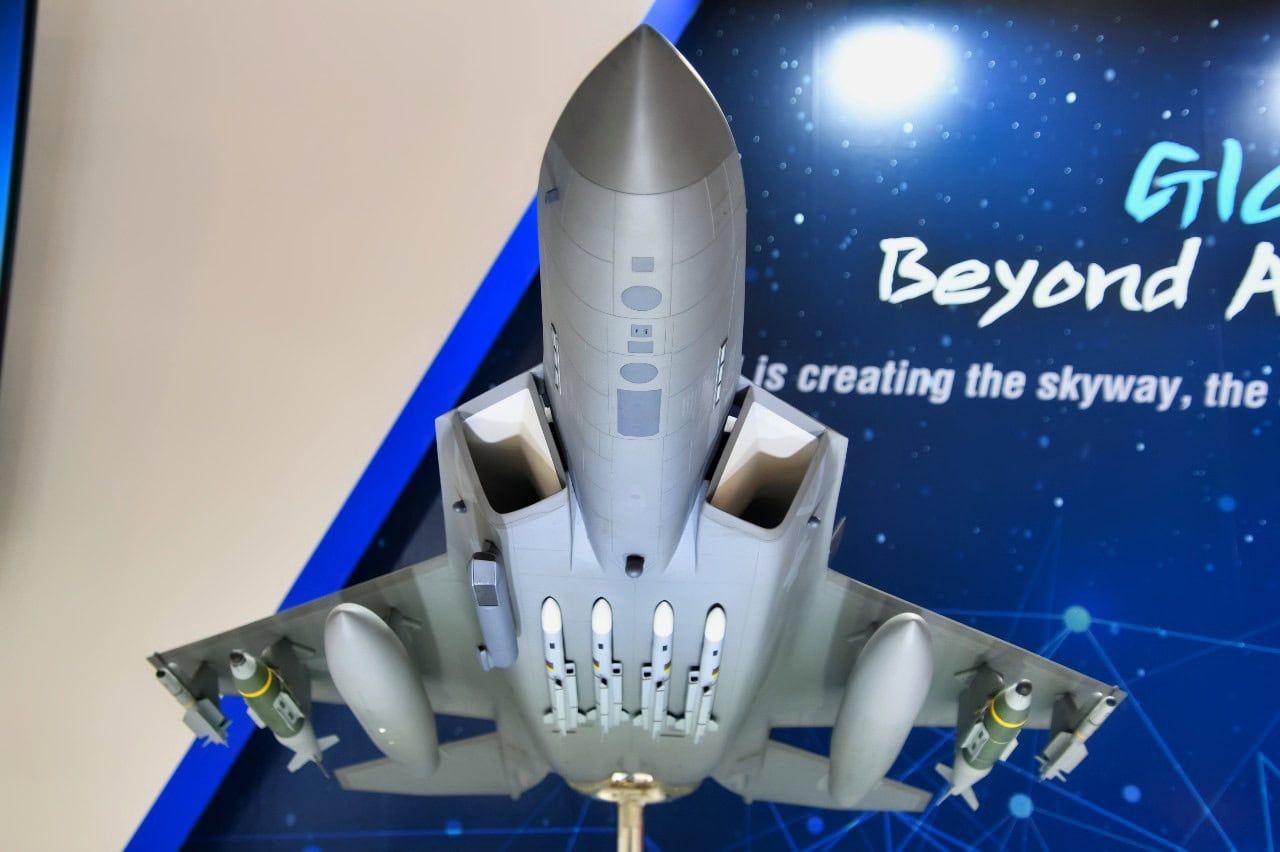 \n
\nSouth Korea's Defense Acquisition Program Administration and Air Force said the first production aircraft flew approximately 165 kilometers from Korea Aerospace Industries' plant at Sacheon to its operating base at Yecheon. It was escorted by an FA-50, a TA-50, and a T-50 trainer. The symbolism was obvious: the Republic of Korea was displaying a domestic fighter family moving from development into routine service.
\nThe schedule is also notable. The first KF-21 prototype flew in July 2022. The production handover came about four years and two months later, after combat compatibility certification in May 2026 and completion of systems development the following month. That is a comparatively fast transition for a new supersonic aircraft, especially one intended to replace aging F-5s while complementing South Korea's F-35A and F-15K fleets.
\n\nWhat the KF-21 Actually Brings
\n- \n
- Top speed: approximately Mach 1.8. \n
- Configuration: twin-engine, multirole fighter with an active electronically scanned array radar. \n
- Weapons carriage: up to 10 external stations in the initial configuration. \n
- Production plan: 40 air-to-air-focused aircraft by 2028, followed by 80 aircraft with longer-range air-to-ground weapons by 2032. \n
- Longer-term objective: more than 100 aircraft in service in the early 2030s. \n
Those numbers describe a force-generation program, not a wonder weapon. The initial KF-21 is not a fully internal-weapons stealth fighter in the same class as the F-35 or China's J-20. Its value is different. It offers modern radar, supersonic performance, a growing domestic support base, and a path to replace aircraft that are already consuming disproportionate maintenance effort.
\nFor a frontline air force, availability often beats brochure performance. A fighter that can be repaired, armed, and returned to a hardened base without waiting for a foreign contractor has operational value that a more advanced aircraft may lose when spare parts or software support are delayed.
\n\nThe China Problem Is Not One-for-One Combat
\nBeijing does not need to defeat every KF-21 in a classic fighter engagement. The People's Liberation Army Air Force would try to attack runways, fuel farms, command networks, and aircraft shelters while using J-20s, long-range missiles, electronic warfare, and standoff weapons to shape the air battle. South Korea therefore cannot treat the Boramae as a substitute for dispersal, base repair, air defense, and resilient communications.
\nBut adding a locally supported fighter still changes the arithmetic. South Korea has a population, industrial base, and threat environment that justify a large fleet, yet every aging F-5 removed from service creates pressure on the F-16, F-15K, and F-35 force. The KF-21 gives Seoul another squadron-generation engine. If production stays on schedule, the country can preserve mass while reserving its most expensive stealth aircraft for missions that require them.
\nThat matters beyond the Korean Peninsula. A more capable South Korean Air Force complicates Chinese planning around the Yellow Sea, the Korea Strait, and the northern approaches to Japan. It also gives the United States a partner with a larger indigenous supply chain during a regional crisis. The aircraft does not have to deploy to Taiwan to influence a Taiwan contingency; it only has to force China to keep more sensors, missiles, and aircraft oriented toward the Korean theater.
\n\nIndustrial Independence Has Limits
\nSouth Korea has solved the hardest political problem: it has created a domestic fighter program that can survive changes of government and reach production. It has not solved every industrial problem. The KF-21 still depends on foreign engines, weapons, subsystems, and a global network of suppliers. Indigenous assembly is not the same as complete autonomy.
\nThe planned scale exposes the next challenge. Forty aircraft by 2028 and 80 more by 2032 would produce a meaningful fleet, but only if engines arrive, radar and electronic-warfare systems mature, weapons integration keeps pace, and maintenance units receive enough spares. A fighter force is not counted by airframes delivered. It is counted by aircraft that can generate sorties after the first missile attack and continue doing so on day seven.
\nIndonesia's participation in the program adds export and cost-sharing potential, but it also introduces another variable in production and technology arrangements. Seoul should welcome international demand while protecting the throughput needed for its own squadrons.
\n\nThe Verdict Is Simple
\nThe KF-21 is not a stealth shortcut and it is not an answer to China's missile inventory. It is something more useful: a credible attempt to make fighter numbers, sustainment, and national industrial capacity reinforce one another.
\nSouth Korea has shown that it can move a modern combat aircraft from prototype to service. The next test is harder. Can it build more than 100, keep enough of them operational under attack, and integrate them with the F-35, ground-based air defenses, and American command networks? If the answer is yes, the KF-21 will become a real Indo-Pacific asset. If not, the first delivery will remain a ceremony with wings.
\n\nSources
\n- \n
- South Korea Defense Acquisition Program Administration, KF-21 program and delivery information. \n
- Korea Aerospace Industries, KF-21 program overview. \n
- International Institute for Strategic Studies, assessments of Korean and Chinese air-power modernization. \n
- Center for Strategic and International Studies, Indo-Pacific air and missile-balance analysis. \n
South Korea's KF-21 fighter jet entered operational service in 2026, marking a significant milestone for the Republic of Korea Air Force. The first production aircraft was delivered from Sacheon to Yecheon, supported by various trainer aircraft. Plans include producing 40 KF-21s by 2028 and 80 more by 2032, enhancing South Korea's air capabilities amid regional tensions.
- The KF-21 Boramae has moved into operational service with the Republic of Korea Air Force.
- The first production aircraft was delivered in 2026 after a fast transition from prototype to service.
- South Korea plans to produce 40 KF-21 aircraft by 2028 and 80 more by 2032.
- The KF-21 is a twin-engine, multirole fighter with a top speed of approximately Mach 1.8.
- The aircraft aims to replace aging F-5s and complement existing F-35A and F-15K fleets.