
Southern Theater Command's Anti-Submarine Training for Dozens of Hours: PLA KQ-200 Highlights Underwater Shortcomings in the South China Sea
 Li Minghui
Southern Theater Command Conducts Hours of Anti-Submarine Training, PLA KQ-200 Highlights Underwater Shortcomings in the South China Sea
On June 14, the English website of the Ministry of Defense released a video of anti-submarine training conducted by the naval aviation of the Southern Theater Command. The official statement was brief: a certain naval aviation unit carried out "dozens of hours of uninterrupted anti-submarine training," covering tasks such as searching for submarines, identification, tracking and locking, and simulated attacks. If this news is viewed merely as training footage, it can easily be overlooked. However, in my opinion, the truly interesting aspects are the terms "dozens of hours" and "full process."
Anti-submarine warfare is not just about showcasing individual aircraft capabilities. It tests whether aircraft, sonar buoys, magnetic anomaly detection, data links, ships, and shore-based command posts can operate in sync. The South China Sea has complex depths, sea conditions, and noise from civilian vessels; once a submarine enters below the thermocline, relying on a single aircraft to find a target often yields limited results. In simple terms, anti-submarine warfare is more like weaving a net than shooting at a target.
KQ-200 is Not New Equipment, But Training Intensity Reveals New Issues
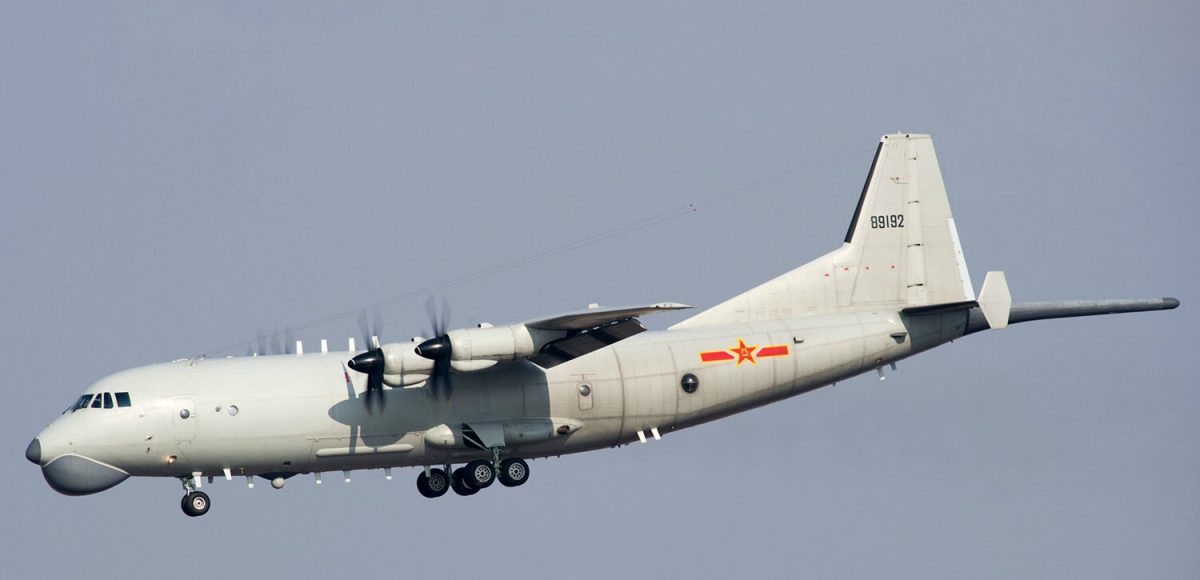
Public information typically refers to the KQ-200 as a fixed-wing anti-submarine patrol aircraft developed from the Y-8/Y-9 platform, and it is often called "Y-8Q" or "Gaoxin-6" by outsiders. Its typical features include a nose/ventral search radar, a tail-mounted magnetic anomaly detection rod, an electro-optical turret, and the capability to deploy sonar buoys and lightweight torpedoes. The 2024 report from the U.S. Naval War College's China Maritime Studies Institute mentions that the fixed-wing anti-submarine capability of the PLA Navy's aviation is a key part of addressing its underwater shortcomings.
However, the issues with the KQ-200 are also clear: it is not a long-range jet platform like the P-8A, and there are still gaps in speed, range, mission system integration, and the U.S.-Japan anti-submarine system. According to the Mitchell Institute's public data, the KQ-200 has a maximum takeoff weight of about 77,000 kilograms and a range of approximately 2,700 nautical miles, making it a sufficient but not luxurious platform. The Southern Theater Command's emphasis on "dozens of hours of uninterrupted" training indicates that the PLA is compensating for the limitations of a single platform's performance through rotation and process refinement.
Pressure in the South China Sea Comes from Two Ends
The first source is external submarine activities. U.S. Navy nuclear submarines, reconnaissance aircraft, and allied maritime platforms have long operated in the South China Sea and surrounding waters, with reports frequently highlighting close interactions between U.S. P-8As, sonar buoys, and Chinese air and naval forces. For the Chinese Navy, the Hainan direction is both the frontline of the South China Sea and an important passage for strategic nuclear submarines. The anti-submarine capability in this area is not just a tactical patrol issue; it also relates to the security boundaries of strategic deterrence.
The second source is the PLA's own expansion into distant seas. After the commissioning of the Fujian aircraft carrier, the operational radius of carrier strike groups, Type 075 amphibious assault ships, Type 055 destroyers, and supply ships will continue to extend outward. The further the fleet goes, the more sensitive it becomes to underwater threats. In the past, the Chinese Navy excelled at creating an anti-access system with surface vessels and shore-based missiles, but the greatest fear for distant fleets is not visible destroyers, but invisible attack submarines. Anti-submarine aviation is the most mobile layer in this net.
Production Capacity is More Important than a Single Training
Estimates suggest that there are about 30 KQ-200s currently in service. This number seems substantial, but when distributed across the North Sea, East Sea, and South Sea directions, and considering training, maintenance, readiness duties, and mission rotations, the actual number of aircraft that can maintain pressure in a specific maritime area is not ample. Anti-submarine patrol aircraft also consume a large number of sonar buoys, and personnel and algorithms are needed to process acoustic data. The aircraft are just the most visible part; consumables and data processing represent the long-term costs.
- Platform level: The KQ-200 has solved the issue of the Chinese Navy's fixed-wing long-range anti-submarine capability from non-existence to existence.
- System level: It must coordinate with Type 056A frigates, Type 052D/055 destroyers, Z-20 anti-submarine variants, and shore-based sensors.
- Shortcomings level: Continuous patrol density, sonar buoy inventory, and target classification capability in complex sea conditions remain hard constraints.
Therefore, what is most noteworthy about this training is not whether torpedoes were launched in the video, but rather that the official statement included the entire chain of "search, identify, track, lock, and attack." In the past, when the PLA publicly conducted anti-submarine training, it often emphasized individual actions; now it places greater emphasis on continuous processes. This indicates that the training focus of the naval aviation of the Southern Theater Command is shifting from "can we reach the mission area" to "can we maintain pressure on an underwater target."
Actual Impact on the Taiwan Strait and South China Sea
Improvements in anti-submarine capabilities also have spillover effects on the Taiwan Strait. The Taiwan Strait itself is not suitable for large nuclear submarines to maneuver freely, but the Bashi Channel, Miyako Strait, and northern South China Sea are key passages. On June 15, the Taiwanese military reported that five PLA Navy vessels were still active around Taiwan in the past 24 hours. The number of surface vessels does not fluctuate significantly daily, but the underlying underwater vigilance is much harder to observe.
I am not inclined to interpret every anti-submarine training exercise as a prelude to a major battle. A more realistic assessment is that the PLA is transitioning anti-submarine operations from "remedial training" to routine consumption-type training. This process is not flashy and is difficult to prove progress with just one or two parameters, but it will gradually change the risk calculations for U.S. and allied submarines operating within the first island chain.
The real unanswered question is whether a larger jet anti-submarine platform will emerge after the KQ-200, or whether drones will take on some long-endurance acoustic relay tasks. The Chinese Navy has already begun to submit its homework on anti-submarine warfare, but it is still far from a perfect score.
Main Sources
Sources include the information on anti-submarine training released by the Southern Theater Command's naval aviation on June 14, research from the U.S. Naval War College's China Maritime Studies Institute on the PLA Navy's anti-submarine aviation, public technical data on the KQ-200 from the Mitchell Institute, and the Taiwan defense department's report on maritime and aerial dynamics around Taiwan on June 15.
The People's Liberation Army Navy Aviation conducted several hours of uninterrupted anti-submarine training in the South China Sea on June 14, utilizing 30 KQ-200 aircraft. The training focused on integrating various systems for effective submarine detection and tracking, highlighting the PLA's efforts to enhance its anti-submarine capabilities in response to external submarine activities. The KQ-200, while not as advanced as the P-8A, plays a crucial role in China's maritime defense strategy.
- The PLA conducted several hours of uninterrupted anti-submarine training on June 14.
- The KQ-200 is a fixed-wing anti-submarine patrol aircraft developed from the Y-8/Y-9 platform.
- The training emphasized the integration of various systems for effective anti-submarine operations.
- The South China Sea presents complex underwater conditions for submarine detection.
- The KQ-200 fleet is estimated to have over 30 operational units.