
Striking Two Ships West of Khasab and the Drain of Patriot in Jordan Reveal That the Hormuz War Is No Longer a Passing Maritime News
 Ahmed Al-Rashid
Strikes on Two Ships West of Khasab and the Consumption of Patriot Missiles in Jordan Reveal That the War in Hormuz Is No Longer Just a Passing Maritime News
On September 11, 2026, the most alarming signal in the Gulf was not just the number of damaged ships, but the location of the strikes. GlobalSecurity's summary of War Day 196 quoted UKMTO stating that two ships were struck west of Omani Khasab, about four nautical miles away, by four unknown projectiles, and that one of the ships caught fire, while a third ship observed the projectiles falling from about six nautical miles away. If this sequence is accurate, we are facing an attack within the narrowest psychological corridor in the Strait of Hormuz, rather than a distant incident that shipping companies can categorize as general risks.
This is a follow-up, not a rehash of the oil tanker file from September 9 and 10. In that file, the headline was the escalation of the tanker war between the United States and Iran to the largest wave against commercial shipping since the war began. Here, the headline is different: the continuation of strikes near Khasab, along with increased damage estimates at Muwaffaq Salti / Al Azraq base in Jordan and the consumption of dozens of Patriot missiles, means that Iranian pressure is operating on two simultaneous tracks: one that undermines confidence in maritime passage, and another that depletes U.S. and regional air defense stocks.
The Maritime Incident Near Khasab Undermines Confidence Before It Affects Structure
According to GlobalSecurity's summary, UKMTO reported that two ships west of Khasab were hit by four unknown projectiles, with a fire on board one of them. I could not find, up to the moment of preparing this report, the original UKMTO bulletin available for direct verification from its site due to access restrictions, and the names of the ships were not published in the available version of the summary. Therefore, the names of the ships, the type of projectiles, the executing party, the extent of the damage, injuries, and any maritime pollution remain uncertain points.
But the location alone is enough to understand the military significance. Khasab is not a marginal name on the map; it is at the tip of Musandam, where Hormuz transforms from a broad geographical concept into a monitored and congested corridor. Any insurance company or maritime operations room knows that a strike near this point does not need to sink a ship to change calculations. It is enough to tell the captain, the owner, and the financier that the distance between the trade route and the routine of war has become just four nautical miles.
Practically, navigation confidence does not collapse all at once. It declines in the form of small decisions: a captain waiting for additional instructions, a company delaying a voyage, an owner requesting a risk premium, a port reviewing its entry schedule, and tankers starting to calculate turnaround or waiting times. Therefore, the Khasab incident should not be measured by the number of ships alone. The second strike following the previous wave of tankers means that the market did not receive a sufficient cooling-off period to believe that the escalation was an exception.
Muwaffaq Salti Base Is Not Just a Jordanian Detail
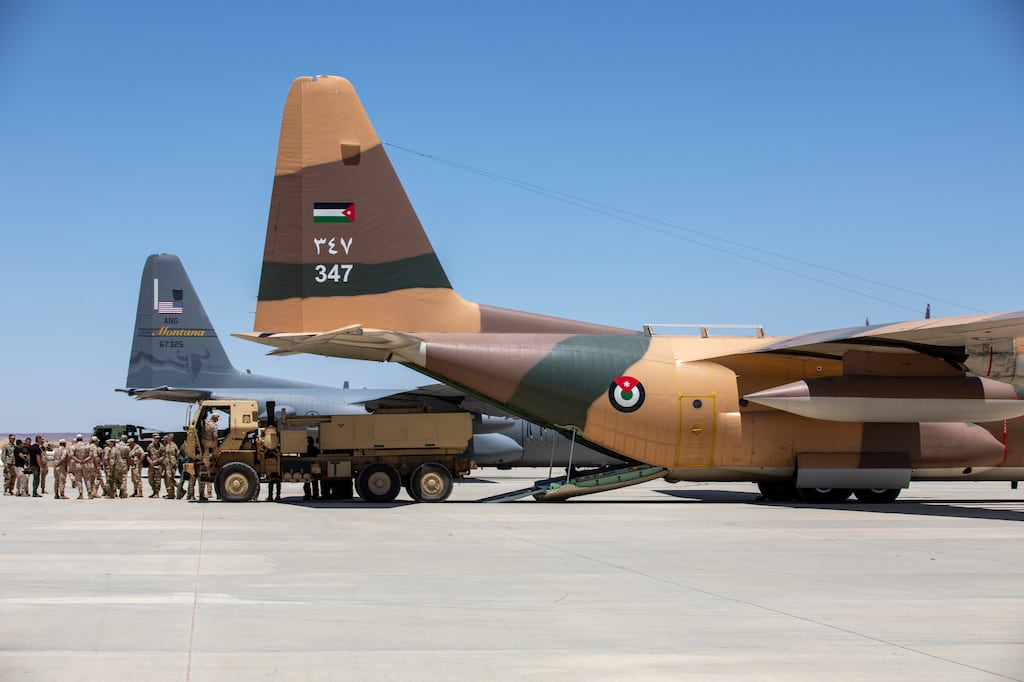
The second part of the picture comes from Jordan. The summary itself cites Reuters stating that the Iranian ballistic barrage towards Muwaffaq Salti / Al Azraq caused severe damage to the wing of an A-10 Thunderbolt II aircraft, and light damage to about eight F-15 aircraft that were returned to service, with the consumption of nearly 30 Patriot missiles. This figure is higher than the previously circulated narrative in reports from CBS/Xinhua, which stated that the Jordanian air defense destroyed 18 Iranian ballistic missiles, and that Trump denied any American aircraft were damaged.
The difference between 18 intercepted missiles or declared targets and nearly 30 consumed Patriot missiles is not just an accounting detail. In air defense, stockpiles are part of combat capability just like radar and crew. A Patriot missile is not an artillery shell that can be quickly replenished from a nearby depot. Its production, maintenance chain, and distribution between Ukraine, the Gulf, East Asia, and the United States itself make every launch a political decision as much as an operational one.
Any military personnel who has served in the region knows that an airbase does not need to be extensively destroyed to be affected. If an A-10 aircraft is damaged in the wing and eight F-15s lose hours or days of readiness and then return, it does not mean the base has fallen, but it does mean that Iran was able to impose a cost on the air defense system. If the closer figure is 30 Patriot missiles, the problem is not just in the success or failure of the interception, but in the rate of depletion. An attack that forces the defender to launch a large number of expensive missiles achieves an effect even when it does not destroy all its targets.
Conflicting Narratives Must Remain Apparent to the Reader
So far, there are three layers of narrative. The first is the UKMTO narrative as reported by GlobalSecurity regarding the attack west of Khasab, which is strong as a maritime warning but lacks details on the names of the ships, the type of weapon, and the executing party. The second is the Reuters narrative as conveyed in the summary about the damage at Muwaffaq Salti and the consumption of Patriot missiles, which is more serious than the earlier versions because it links the damage to the defense stockpile, but it requires the original Reuters text or independent U.S./Jordanian confirmation. The third is the official and political narrative: CENTCOM has not issued, according to the summary, a new announcement for the second consecutive day, and Trump denied any damage, while Iranian reports indicated strikes on areas where hostile aircraft were deployed and hangars for F-35, F-16, and F-15, and the previously conveyed Jordanian narrative spoke of a successful interception of missiles.
These layers do not cancel each other out. In the Middle East, operational truth is often found between an incomplete military statement, an overly confident media leak, and adversarial propaganda that exploits the void. Therefore, we must write clearly: there are still no confirmed names of the ships, no independent confirmation of the type of projectiles, no reliable announcement of injuries or pollution, and no public agreement on the number of consumed Patriot missiles. Additionally, there is no detailed Emirati or Jordanian narrative that publishes damage photos or interception tables that can be compared to the Reuters narrative.
What Has Changed After Day 196
What has changed is that Iran, if these facts are confirmed, is not trying to win a conventional naval battle. It is pressuring the economic nerves in Hormuz while simultaneously pressuring U.S. air defense stocks. This is a strategy suited to a power that knows it cannot defeat the United States in an open confrontation, but it can make U.S. protection costly and uncomfortable for its allies.
For the Gulf states, the lesson is troubling. Purchasing Patriot, THAAD, F-15, and F-16 provides a layer of protection, but it does not answer the question of sustainability. Who owns the missile? Who decides to launch it? Who compensates when the stockpile decreases? And who protects the commercial ship when the danger is between the tip of Musandam and Khasab? In my view, this is the knot that Gulf capitals do not want to voice out loud: the American umbrella is still necessary, but it is no longer sufficient to reassure the market or to eliminate Iran's ability to impose daily costs.
The Khasab attack, if fully confirmed, reduces confidence in passage through Hormuz because it proves that the threat persists within the corridor itself. And the damage at Muwaffaq Salti, if Reuters' figures are accurate, confirms that air defense does not fight with missiles alone, but fights with stockpiles, time, and the ability to replenish. Between the sea and the airbase, an old equation appears in new clothes: whoever has the ability to deplete does not always need to achieve a quick victory.
Sources and Verification Status
- GlobalSecurity, Iran War Day 196, September 11, 2026: Quoted UKMTO on the incident of two ships west of Khasab and noted that no new CENTCOM announcement was issued for the second consecutive day.
- Reuters as reported in GlobalSecurity's summary: Damage to A-10 and F-15 and consumption of nearly 30 Patriot missiles at Muwaffaq Salti / Al Azraq.
- CBS/Xinhua as appeared in the hiwars report on September 10: Trump denied any damage, and previous reports mentioned the A-10 and eight F-15s, along with a Jordanian statement about intercepting 18 ballistic missiles.
- Unconfirmed: Names of the ships, type of weapon used near Khasab, responsible party, injuries, maritime pollution, damage photos, and the final number of consumed Patriot missiles.
Two ships were struck by unknown projectiles near Khasab, Oman, on September 11, 2026, resulting in one ship catching fire. Concurrently, Iranian ballistic missile strikes caused significant damage to the Muwaffaq Salti / Al Azraq base in Jordan, consuming approximately 30 Patriot missiles. This dual incident highlights the ongoing military pressure from Iran on maritime and air defense systems in the region.
- Two ships were struck by unknown projectiles near Khasab, Oman.
- Significant damage occurred at the Muwaffaq Salti / Al Azraq base in Jordan.
- Approximately 30 Patriot missiles were consumed in defense against Iranian strikes.
- An A-10 Thunderbolt II was severely damaged, and eight F-15s sustained minor damage.
- The incident indicates ongoing Iranian pressure on maritime and air defense capabilities.