
"Sweden's Gripen over Finland will show in 2026 how NATO improvises drone defense"
 Dr. Klaus Weber
Sweden's Gripen over Finland will show in 2026 how NATO improvises drone defense
1,340 kilometers of border with Russia, a deployment until the end of 2026, and an additional order of 1.2 billion Swedish kronor for ground-based air defense: There is not much more to know about the security situation in Northern Europe in August 2026. Sweden is sending Gripen fighter jets and corvettes to Finland to help protect Finnish airspace and the Baltic Sea. Officially, this is a reinforcement at the request of Helsinki. In reality, it is an admission. NATO has produced accession ceremonies, regional plans, and ever-new situational reports on its northern flank. What it lacks is a robust doctrine for the everyday drone and hybrid pressure below the classical threshold of an armed attack.
The strategic significance of this step lies precisely in that. Sweden is not helping Finland because two Nordic states want to demonstrate their new alliance solidarity. Sweden is helping because Finland needs to free up resources to respond to recurring incidents, airspace violations, and unmanned systems at a border that is geographically long, operationally thin, and politically sensitive. Those who need neighbors for permanent reinforcement no longer have a tactical problem. They have an institutional one.
A bilateral response to a multilateral problem
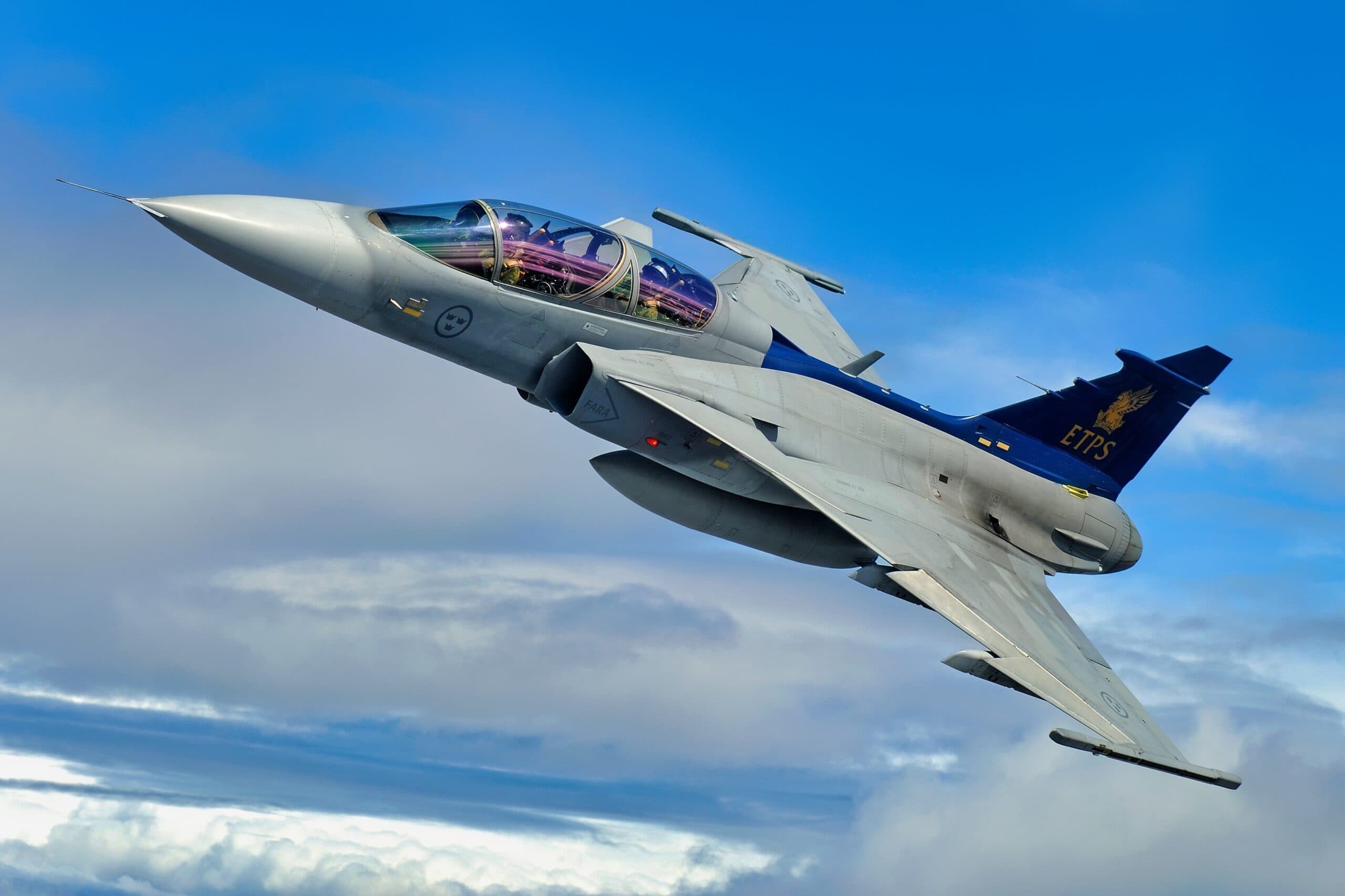
According to the Finnish armed forces, Swedish Gripen and corvettes are expected to assist in monitoring and protecting Finnish territory at least until the end of 2026. Defense Minister Pål Jonson articulated the core of the problem unusually openly: Sweden is responding to a Finnish request to strengthen air defense due to the deteriorating security situation. That is the crucial sentence. Not an abstract future threat, but an already deteriorated present compels both states to act.
The military logic behind this is plausible. Swedish platforms are primarily intended to strengthen airspace monitoring, thereby freeing up Finnish resources. Stockholm also indicated that it could provide ground-based systems against drones if needed. In parallel, Saab reported an order from the Finnish Defence Forces Logistics Command for 1.2 billion SEK for the air defense solution RBS 70 NG. Finland has been using the predecessor version since 2008; the new generation includes, among other things, a jamming-resistant laser-guided missile, automatic target tracker, and night capability. That sounds like modernization. But is it enough?
No, at least not as a response to the actual problem. Because drones on NATO's northern flank are not just a procurement issue. They are a command and responsibility problem. Who recognizes, classifies, and engages an unmanned target that moves between sabotage, misflight, reconnaissance, and the precursor to an attack? What rules apply at sea, what in the border area, what in the civil-military dense airspace? And who bears political responsibility if a shootdown hits a Russian system, a Ukrainian system, or just an object whose origin cannot be clearly established in real-time? Exactly these questions cannot be answered by an additional missile.
NATO measures solidarity in platforms and overlooks the regulations
For months, there have been increasing signs of a new normal in the Baltic Sea region: suspicious drones, hybrid incidents, infrastructure fears, scramble launches, and improvised countermeasures. Reuters has now additionally reported that Baltic Sea states are planning a joint task force for drone defense. Even the wording is revealing. A task force is not a sign of mature institutions, but rather a provisional arrangement that arises when the existing organization is too sluggish or unclear to address the new threat.
This is precisely where the Weberian paradox of the North in 2026 lies. The militarily best-integrated region of Europe is responding to the fastest-growing everyday threat with ad-hoc coalitions. NATO membership has integrated Finland and Sweden into a more robust deterrence architecture. However, it has not yet provided an operational doctrine for the gray area in which drones operate today. One can proudly say that allies help each other. One should just not pretend that help is already synonymous with structure.
The temptation is great to celebrate this step as a success story: two new NATO members, more interoperability, more presence, more joint capabilities. But higher presence does not automatically mean higher resilience. If Finland has to free up its own resources because daily airspace security requires additional Swedish support, it not only shows solidarity. It shows strain. And if the response to this strain is organized bilaterally, even though the threat affects the entire Baltic Sea region, then the alliance level lags behind the regional reality.
Why the 1.2 billion SEK is politically more important than operationally
The Saab order is militarily useful, but politically even more interesting. It represents a trend that Europe has been trying to overlook for two years: drone and missile defense is becoming the actual currency of credible sovereignty. Not tank parades, not summit communiqués, but the ability to intercept cheap, frequent, and politically ambiguous aerial threats determines whether a state remains capable of action in the gray area.
That is precisely why the package of Gripen presence, possible ground-based counter-drone assistance, and RBS-70 NG procurement is more than just a technical mix. It is a kind of emergency bridge between old air defense and new threat reality. Finland buys time, Sweden provides depth, and both hope that political clarity will follow later. But time is not a doctrine. Procurement is not a command structure. And an unjamable guidance does not replace a common situational and decision-making regime.
The harsher judgment is therefore: The NATO northern flank is currently not primarily weakened by a lack of political will, but by the gap between alliance promises and everyday threats. Article 5 is written for the big war. The drone tests something else: the alliance's ability to act coherently below this threshold on a daily basis. If Swedish jets now have to circle over Finland for this, it is a reasonable operational step. Strategically, it is also proof that the institution still lags behind the operational profile of the threat.
In the end, it does not matter who helps, but who standardizes
Sweden and Finland are acting rationally. That is precisely why one should not romanticize the process. It shows how Northern Europe organizes its security in 2026: less through finished NATO procedures and more through regionally dense neighborhood, rapid procurement, and operational improvisation. This may work in the short term. Permanently, it is not enough.
The uncomfortable conclusion is: As long as the alliance organizes drone defense in the Baltic Sea region through task forces, neighborhood assistance, and temporary reinforcements, it is only managing the threat. It is not institutionalizing it. Those who must send Gripen to replace rules have not yet created a new order. They have only proven how urgently it is needed.
```Sweden is deploying Gripen fighter jets and corvettes to Finland until the end of 2026 to enhance airspace security amid deteriorating conditions. This deployment is part of a broader effort to address drone threats and improve air defense capabilities, including a 1.2 billion SEK contract for the RBS 70 NG system. The situation reflects the need for stronger regional cooperation and operational responses to emerging threats in the Baltic Sea area.
- Sweden is deploying Gripen jets and corvettes to Finland by the end of 2026.
- A contract worth 1.2 billion SEK for the RBS 70 NG air defense system has been awarded to Saab.
- The deployment is a response to deteriorating security conditions in the region.
- The NATO northern flank is facing challenges in addressing drone threats effectively.
- A joint task force for drone defense is being planned by Baltic Sea states.