
Swedish JAS 39 Gripen over Finland until the end of 2026 shows NATO's northern flank will be defended bilaterally
 Dr. Klaus Weber
Swedish JAS 39 Gripen over Finland until the end of 2026 shows NATO's northern flank will be defended bilaterally
Until at least the end of 2026, Swedish JAS-39 Gripens and a Visby-class corvette will participate in the monitoring and protection of Finland's territorial integrity. This time-limited but operational commitment is politically more revealing than many larger summit formulas. Two new NATO members are responding to a concrete strain on the northern flank not with a new EU initiative, not with another paper on resilience, and not with symbolic presence, but with immediately usable relief. That is the actual finding.
A small deployment with a significant statement
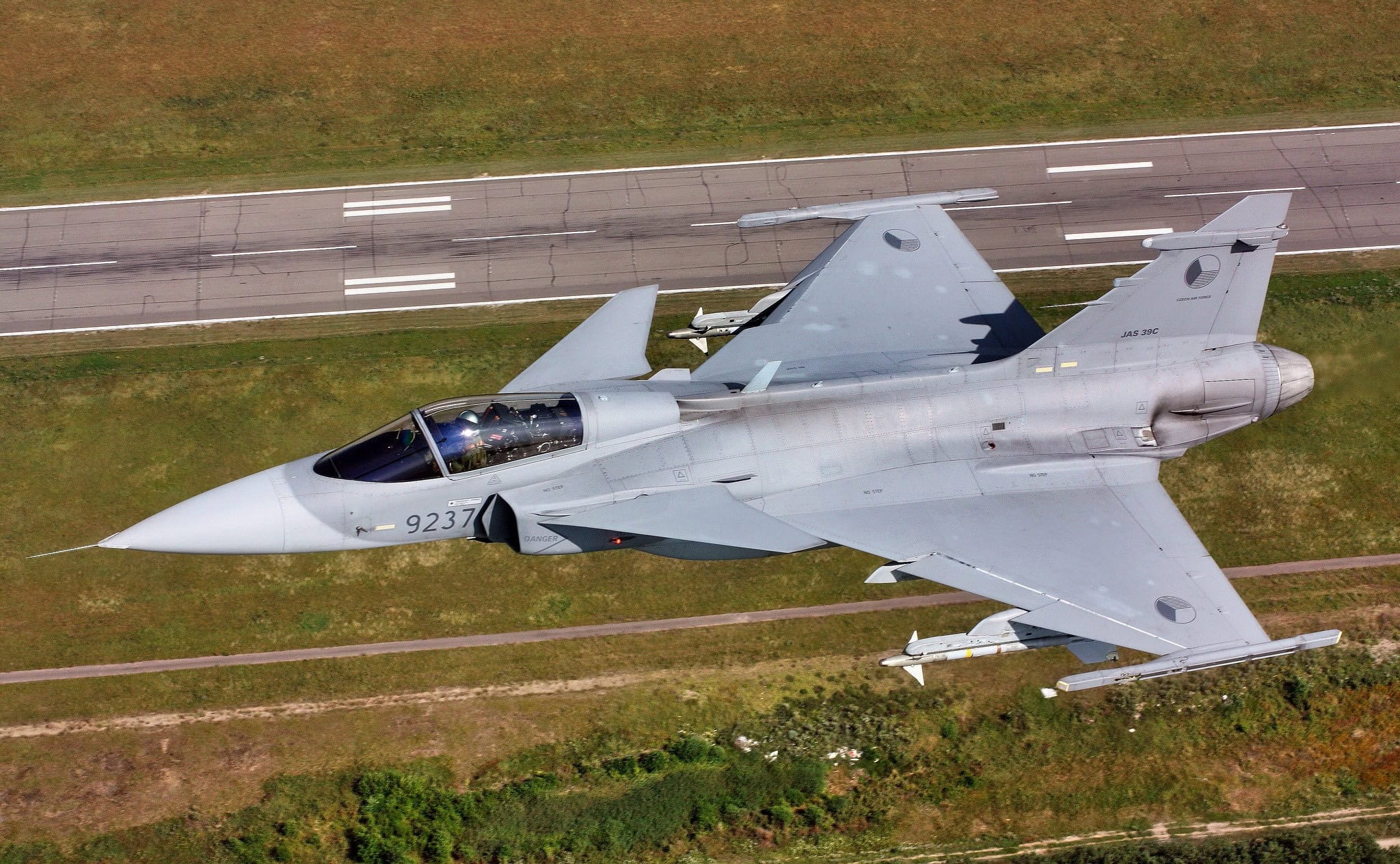
The Finnish armed forces express the occasion remarkably soberly. There is no immediate military threat against Finland. At the same time, the country must maintain an increased readiness for an extended period because Ukrainian drone attacks against targets in Russia have repeatedly caused side effects in Finnish airspace. This is precisely where the new security policy pattern of Northern Europe lies: not a classic attack, but the fraying of a large war forces neighboring states into permanent readiness.
The Gripen is not an accidental symbol for this task. Saab specifies a length of 15.2 meters for the E-series, a maximum takeoff weight of 16,500 kilograms, ten external hardpoints, AESA radar, IRST, and an integrated electronic warfare system. For a potential serious situation in the Baltic Sea, this is more important than the often ritualized talk about generational labels. Finland does not need a prestigious air power demonstration but a robust system for air situational awareness, rapid response, and high survivability in an electronically contested environment. Sweden's additional deployment of a Visby-class corvette to the Baltic Sea extends this logic from airspace to the maritime surveillance domain.
Why Finland needs relief even though there is no direct threat
The apparent contradiction in the Finnish text is, in fact, the strategic point. Deterrence in the north in 2026 is not only organized against tank units or cruise missiles but also against persistent strain. When drones are distracted by electronic warfare, when response times remain short, and when the political threshold for incidents is low, then readiness itself becomes a scarce resource. Therefore, Finland is not primarily trying to defend more territory. It is trying to free its own forces through Swedish participation.
This is a very Nordic, very sober approach. The operational question is not who finds the sharper formulation against Moscow at the press conference. It is which air force is less fatigued tonight if an incident is indeed reported tomorrow morning. Sweden is therefore not just taking on solidarity but also operational rhythm. This is much more valuable militarily.
NATO gains substance in the north precisely through bilateralism
For Brussels, the decision is both flattering and uncomfortable. Flattering because it would be politically inconceivable without the NATO framework. Uncomfortable because the practically most effective integration is once again happening outside the large institutional machines. Helsinki and Stockholm are deepening an already existing collaboration from cross-border training, a joint maritime situational picture, and the Nordic Air Power concept with Norway and Denmark. NATO provides the strategic framework, but the concrete capability arises in a regional coalition with short lines of communication.
Particularly clauses, funds, and capability goals are often confused with capability in Europe. Here, the opposite is evident. An alliance only becomes credible when states take on real burdens for each other. Sweden is not helping Finland with a credit instrument but with aircraft, crews, and time. This is the kind of integration that Europe has rhetorically invoked for years but has rarely achieved institutionally.
The deeper finding for Europe's defense
The process also says something uncomfortable about the European defense debate. Europe's security elite continues to prefer discussing strategic autonomy in abstract categories. In the north, something much more prosaic and therefore much more relevant is currently emerging: regional operational autonomy within NATO. Sweden and Finland are not waiting for an EU structure to first harmonize definitions, responsibilities, and financial lines. They are responding to a concrete readiness pressure with a concrete force approach.
This is not a counter-model to the alliance but possibly its most functional part. The eastern flank in the north does not become more stable by everyone using the same political wording. It becomes more stable when Stockholm allows Helsinki to concentrate its own resources where a violation of airspace could quickly escalate into a serious incident. The value of this decision lies less in the number of deployed platforms than in the organizational maturity it makes visible.
Europe is thus learning an uncomfortable lesson again. The most effective responses to new threats are often small, regional, and immediately deployable. Large defense architectures appear at conferences, but readiness is created in shift plans, joint situational pictures, and interoperable aircraft. Those who find this too unspectacular misunderstand defense.
The Nordic region may thus provide the clearest European lesson of the year in 2026. More integration does not begin with a new headline but with shared operational burden. But therein lies the paradox: Europe prefers to talk about sovereignty where it is least tangible and practices it most effectively where hardly anyone speaks of sovereignty.
Sweden is deploying JAS 39 Gripen aircraft and a Visby corvette to Finland until at least the end of 2026 to monitor and protect its territorial integrity. This action reflects a strategic military cooperation between the two nations in response to regional tensions, despite the absence of an immediate military threat. The initiative is part of a broader Nordic defense strategy involving collaboration with other Nordic countries.
- Sweden will deploy JAS 39 Gripen aircraft and a Visby corvette to Finland until at least the end of 2026.
- The deployment aims to monitor and protect Finnish territorial integrity.
- There is no immediate military threat to Finland, but increased readiness is necessary due to regional tensions.
- The cooperation is part of a broader Nordic defense strategy involving multiple countries.
- This military support is seen as a significant step in bilateral defense efforts.