
Taiwan 2026 SINKEX Tests Whether Its Missile Network Can Survive
 S.W
S.WTaiwan 2026 SINKEX Tests Whether Its Missile Network Can Survive
Three days of live fire beginning September 16 will put Taiwan precision-strike network through a test that matters more than the spectacle of sinking a retired frigate. At Jiupeng in Pingtung, the military will fire across services against decommissioned vessels, including the Chi Yang-class frigate Lan Yang. The lineup includes HIMARS, ALTIUS 600M loitering munitions, Sky Sword II missiles, Hsiung Feng II and III anti-ship missiles, and Patriot PAC-2 and Sky Bow III air-defense weapons. Taiwan is rehearsing a kill chain under range, timing, and command pressure. That is the useful part.
The Exercise Is About Integration
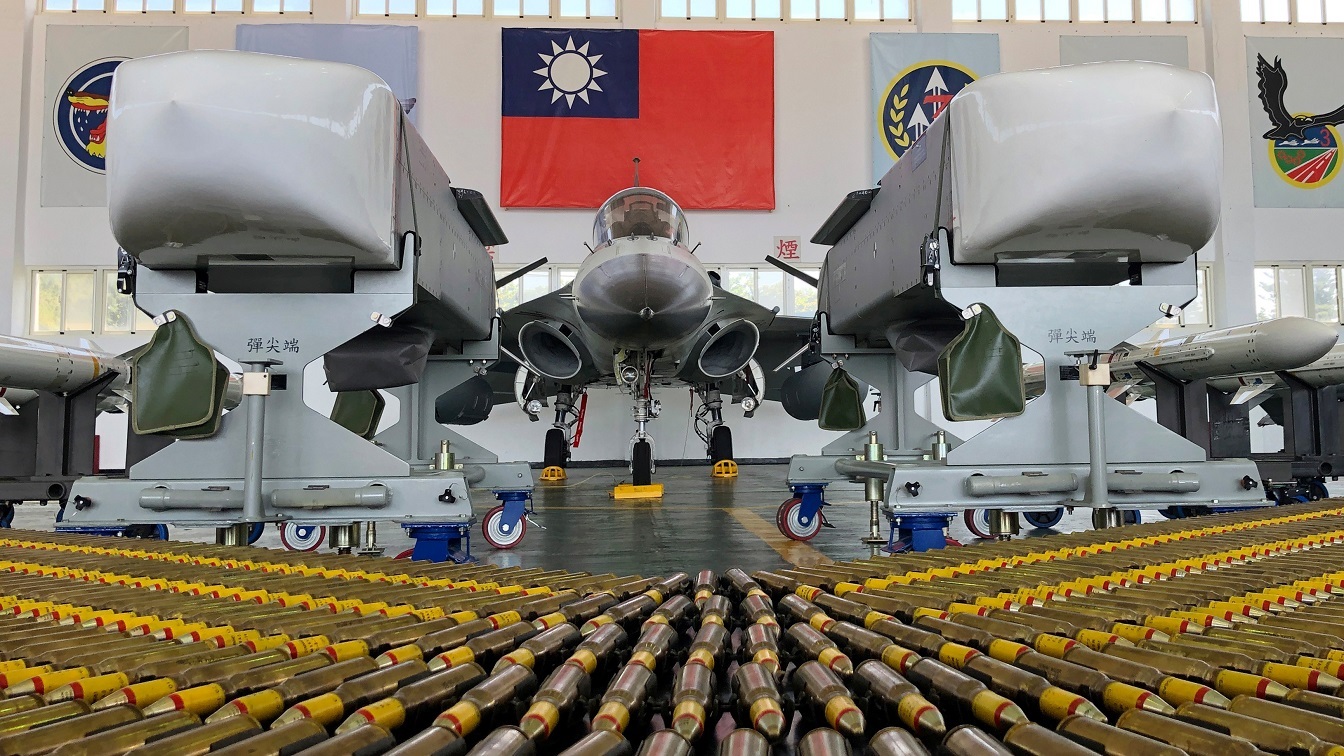
Taiwan News reported that the three-day Joint Precision Munitions Live-Fire Exercise will use a RIMPAC-style sinking exercise. Liberty Times described it as one of the largest and most intensive such drills in recent years. The difference from a service demonstration is important: a real maritime target must be found, identified, assigned, struck, and assessed while every participant operates inside a contested electromagnetic environment.
HIMARS supplies mobile precision fires, while the Hsiung Feng family supplies the maritime punch. The standard Hsiung Feng II is a subsonic anti-ship cruise missile with a reported 100 to 120 kilometer range, a 695-kilogram launch weight, and a 225-kilogram warhead, according to CSIS Missile Threat. The Hsiung Feng III is supersonic, with a reported 120 to 150 kilometer range and a terminal speed of roughly 680 to 780 meters per second. Those are not interchangeable weapons. They impose different detection, targeting, and defensive problems on a fleet.
What the Numbers Say
The missile count is less important than the number of usable firing opportunities. Taiwan western coast faces the main Chinese military threat, but the exercise is being conducted off the east and south coasts, with three warning zones extending eastward from Taitung and Pingtung. That geography forces crews to practice moving the fight around the island rather than treating a fixed western battery as the whole defense.
An Anping-class coast guard ship can reportedly be converted into a missile platform within hours and carry up to 16 Hsiung Feng II or III missiles, as Taiwan News reported on September 12. That gives Taiwan another mobile launcher, but it does not create 16 independent targeting solutions. The ship still needs a survivable command link, current coordinates, rules for target confirmation, and a way to fire without exposing its location for too long.
The same arithmetic applies to HIMARS and ALTIUS 600M. A launcher or loitering munition is a firing asset; it is not the entire kill chain. Sensors must survive long enough to detect a moving ship. Communications must work through jamming. Battle managers must avoid duplicate engagements. Damage assessment must arrive before a second salvo is committed. A sinking exercise can validate some of that sequence, but it cannot reproduce the density of Chinese missiles, aircraft, decoys, and cyber effects that would arrive in a war.
The Air Defense Layer Is the Harder Problem
Including Patriot PAC-2 and Sky Bow III in the same exercise is a useful signal. Taiwan is not planning only to shoot ships; it is training for the return salvo. Beijing would have strong incentives to attack air bases, radars, fuel sites, and mobile missile units before attempting to force a crossing. The exercise therefore tests whether Taiwan can connect offensive fires to defense of the network that produces them.
The test is especially relevant as Taiwan keeps adding expensive surface-to-air missiles while retaining short-range guns for low-cost threats. A missile battery cannot waste a high-end interceptor on every drone or decoy. Conversely, a gun cannot cover every altitude or defend a radar hundreds of kilometers away. The practical question is whether Taiwan can preserve enough sensors, launchers, and reloads for the second and third day of a campaign. The first successful hit is easy to headline. Sustained firing is the measure of combat power.
Lan Yang Is a Useful Target but a Safe One
Using Lan Yang, retired in January 2025 after nearly three decades of service, adds realism to the exercise. Liberty Times reported that the frigate sailed roughly 438,284 nautical miles during its career. It is a representative naval target with a known location and no crew trying to defend it. That makes it suitable for safety, instrumentation, and post-strike analysis.
It also makes the result easy to overstate. A stationary, unarmed frigate cannot maneuver, jam, launch interceptors, deploy decoys, or hide among merchant traffic. A real People Liberation Army task group would do all five. The drill can show whether Taiwan weapons reach the target and whether separate services can share the engagement. It cannot show whether the network can keep doing so after the first radar site is hit.
What Taiwan Should Measure
- Time to engage: the interval from first detection to a valid firing solution.
- Network survival: how many sensors and command nodes remain available after simulated strikes and communications loss.
- Magazine discipline: whether crews can reserve the right weapon for the right target instead of spending premium missiles on cheap decoys.
- Reload and relocation: how fast mobile units can move, rearm, and rejoin the network.
- Assessment quality: whether Taiwan can confirm damage without exposing another aircraft or ship.
Those measures will tell Taiwan more than the number of missiles that hit Lan Yang. The goal is not to win a demonstration. It is to make a blockade or landing operation consume more time, more ships, and more weapons than Beijing can comfortably budget.
The Verdict
Taiwan 2026 SINKEX is a credible step toward a distributed defense, especially because HIMARS, drones, coastal missiles, and air defense are being exercised together. But the exercise will not prove that Taiwan can stop a Chinese invasion. It will prove something narrower and more valuable: whether the island can turn a collection of capable weapons into repeated, coordinated salvos.
The math is unforgiving. If the sensors and command links fail, 120-kilometer and 150-kilometer missiles are irrelevant. If the network survives, even a numerically inferior force can impose a serious sea-denial problem. Taiwan should judge this drill by the speed and resilience of its kill chain, not by the photograph of a retired ship going under.
Sources: Taiwan News, September 15, 2026; Liberty Times, September 15, 2026; CSIS Missile Threat, Hsiung Feng II; CSIS Missile Threat, Hsiung Feng III.
Taiwanese Armed Forces conducted a three-day live-fire exercise at Jiupeng, Pingtung, starting September 16, 2026, testing its missile network. The exercise involved various missile systems, including HIMARS and Hsiung Feng missiles, to assess integration under combat conditions. This drill aims to enhance Taiwan's capabilities against potential threats.
- Taiwan is conducting a three-day live-fire exercise starting September 16, 2026.
- The exercise involves multiple missile systems including HIMARS and Hsiung Feng missiles.
- The exercise is taking place at Jiupeng in Pingtung.
- The goal is to test Taiwan's missile network under combat conditions.
- The exercise aims to improve integration of offensive and defensive capabilities.