
Taiwan Navy Commissioning Danjiang PGG-627, Challenges of a 12-Ship System by 2026 Pressing Japan's Southwest Defense
 Tanaka Takashi
Taiwan Navy Commissions Tan Jiang PGG-627, Challenges to Japan's Southwest Defense Loom with 12-Ship System by 2026
The scene of a new catamaran being brought alongside the pier at Zuoying Military Port is not just a ceremonial photo of the Taiwan Navy. According to Naval News, on July 24, the Taiwan Navy officially commissioned the first ship of the second batch of Tuo Jiang-class corvettes, "Tan Jiang" PGG-627. The attendance of President Lai Ching-te indicates that this 685-ton class small combat vessel is politically positioned high within Taiwan's conventional military force development.
What I focus on is not the size of the ship, but the timing of its commissioning. In a statement on July 25, the Taiwan Ministry of National Defense reported that from the previous day until the following morning, 29 People's Liberation Army aircraft, 6 People's Liberation Army Navy vessels, and 5 government ships were confirmed around Taiwan, with 17 of those crossing the median line of the Taiwan Strait. On the following day, July 26, there were 4 aircraft, 7 vessels, and 3 government ships. While the numbers may seem like normal daily fluctuations in pressure, the increase in small fast vessels becomes significant if such low-intensity pressure suddenly shifts to a blockade or counter-blockade situation.
Equipment Changes for Tan Jiang PGG-627
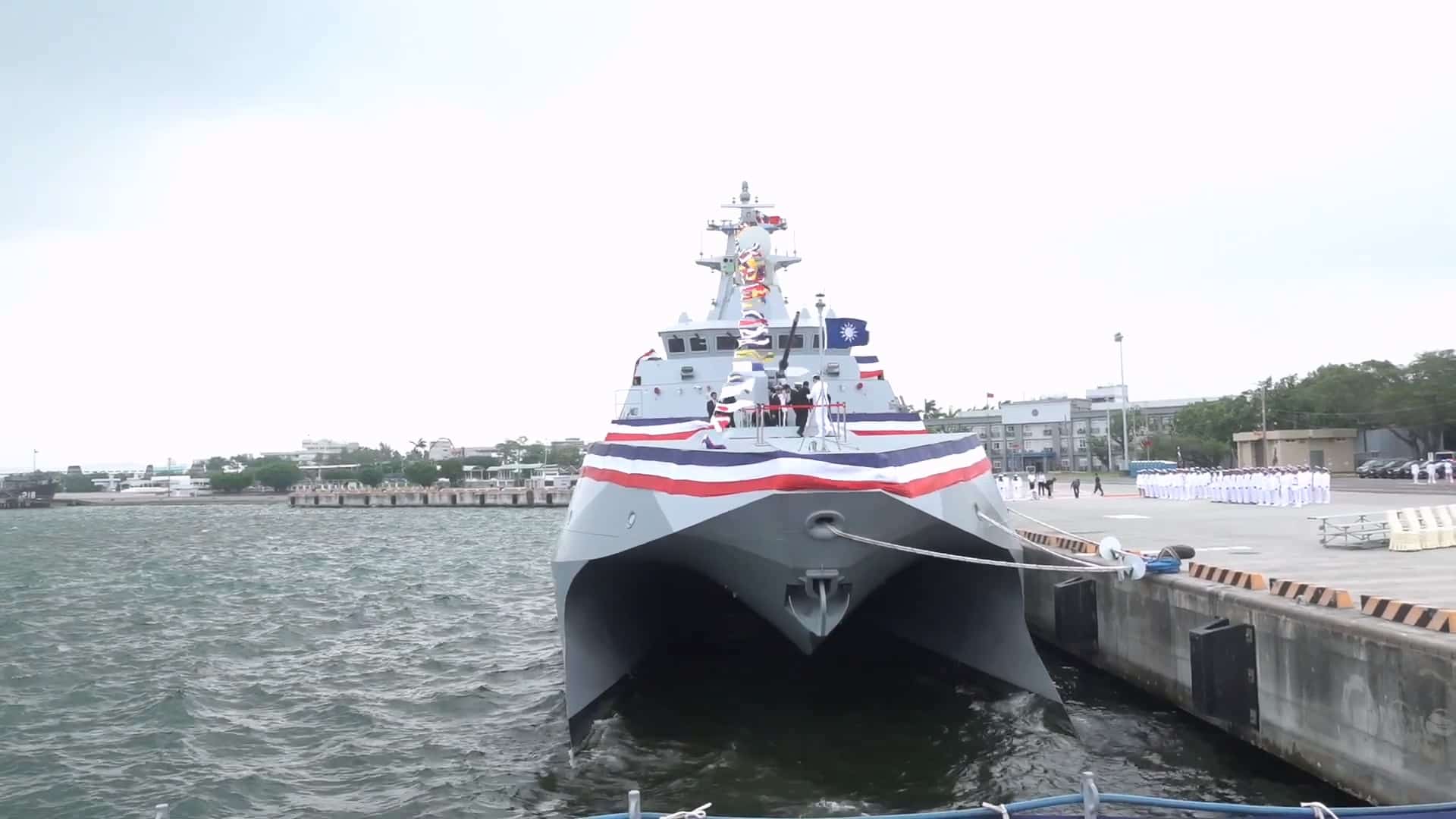
The Tuo Jiang-class is sometimes referred to as "carrier killers" in Taiwan, but that description is somewhat exaggerated. More accurately, it is a small surface combatant that operates at high speed in coastal areas and is part of a saturation attack using the Hsiung Feng II and Hsiung Feng III anti-ship missiles. According to specifications reported at the time of delivery in March, the full-load displacement is approximately 685 tons, maximum speed is 44 to 45 knots, and the range is 1,800 to 2,000 nautical miles. The main gun is a 76mm cannon, and it is equipped with a Phalanx CIWS for close-in defense.
The characteristics of the second batch are not merely an increase in the number of ships. Ships following Tan Jiang will be equipped with Leonardo's NA-30S Mk2 fire control radar, as the French government did not approve the export of Thales-made STIR series fire control radar to Taiwan. While this may seem like a change in the parts list, it practically alters the training, maintenance, spare parts, and software update systems. The Navy desires strong ships, but the fleet operates within a maintenance system.
The Significance of a 12-Ship System
Naval News reports that all 12 Tuo Jiang-class vessels are scheduled to be delivered and commissioned by the end of 2026. According to the Taiwan Ministry of National Defense, in peacetime, they will be responsible for patrols, escorting transport ships to offshore islands, and readiness training, while in times of crisis, they will include missions such as maritime dominance for surface combat forces, command and control of missile boats, joint counter-blockade and strike operations, port defense, reconnaissance, special operations support, mine laying, and resupply to offshore islands.
What is important here is that the Tuo Jiang-class is not a replacement for larger ships, but rather a presence that imposes additional calculations on enemy operational plans. When the Chinese side combines aircraft, naval vessels, and government ships around Taiwan, the Taiwanese side must simultaneously address coastal missiles, air power, mines, and small fast vessels. The commissioning of a single Tan Jiang does not drastically change the balance of power, but as the fleet approaches a 12-ship system, the burden on the side that must "detect and respond" in the shallow waters around Taiwan increases.
Connection to Japan's Southwest Defense
For Japan, this news is not just about the Taiwan Strait. The defense of the Nansei Islands, connecting Yonaguni, Ishigaki, Miyako, and Okinawa Main Island, is strongly influenced by developments in northern Taiwan and the Bashi Channel. If Taiwan's small surface combat power increases its survivability, the Chinese Navy will have to consider its force distribution towards the east of Taiwan and the Miyako Strait more cautiously. Conversely, if Taiwan's small vessels are quickly contained within ports, the pressure is likely to shift towards maritime and aerial surveillance of the Nansei Islands.
From the perspective of the Japan Maritime Self-Defense Force, the value of the Tuo Jiang-class cannot be measured solely by the range of its anti-ship missiles. The key point is whether small vessels can maintain communication, connect with coastal sensors and land-based missile units, and be resupplied at ports or dispersed anchorages after combat damage. This is similar to the issues Japan faces when considering improvements to the Type 12 surface-to-ship guided missile capabilities and resupply for island areas. Despite differences in weapon systems, the challenges of island defense are remarkably common.
Aspects Not to Overestimate
However, treating the Tuo Jiang-class as a universal deterrent is precarious. A 685-ton vessel has different constraints compared to larger ships in terms of rough weather, ammunition load, electronic warfare environment, and survivability in the event of damage. While high speed is advantageous, in a Strait crisis, air superiority, satellite and drone surveillance, and long-range firepower complicate the situation. The value of small vessels is determined not by their ability to operate independently, but by how effectively they can be utilized as part of a dispersed firepower network.
The commissioning of Tan Jiang indicates that the Taiwan Navy is realistically moving towards a direction of "using small ships within a network" rather than "having a few large ships."
The lesson that Japan should take away is clear. Taiwan's 12-ship system does not represent an immediate reversal against the Chinese Navy. However, as considerations for the defense of the first island chain evolve, the era of discussing hundreds of ton-class vessels, land-based missiles, mines, patrol aircraft, and port resupply separately is coming to an end. The true risk lies not in the weakness of Taiwan's small vessels, but in the fact that while Japan, the U.S., and Taiwan each develop dispersed forces, politically they are still operating on separate timelines.
Key References
- Naval News, July 26, 2026, Report on the Commissioning of Tan Jiang PGG-627 by the Taiwan Navy
- Naval News, March 2026, Report on Equipment and Performance at the Time of Tan Jiang's Delivery
- Taiwan Ministry of National Defense, Announcement of PLA Activities around Taiwan from July 24 to 26, 2026
The Taiwan Navy commissioned the PGG-627 Danjiang corvette on July 24, 2026, as part of a plan to have 12 corvettes operational by the end of the year. This commissioning coincided with increased activity from the People's Liberation Army around Taiwan, highlighting the strategic importance of the new vessel in enhancing Taiwan's coastal defense capabilities. The Danjiang is equipped with advanced weaponry, including Yunfeng missiles and a Phalanx CIWS.
- Taiwan Navy commissioned the PGG-627 Danjiang corvette on July 24, 2026.
- The Danjiang is part of a plan to have 12 corvettes operational by the end of 2026.
- The commissioning coincided with increased PLA activity around Taiwan.
- The Danjiang is equipped with advanced radar and missile systems.
- The corvette enhances Taiwan's coastal defense capabilities.