
Taiwan teams up with a US firm to build AI-guided attack boats
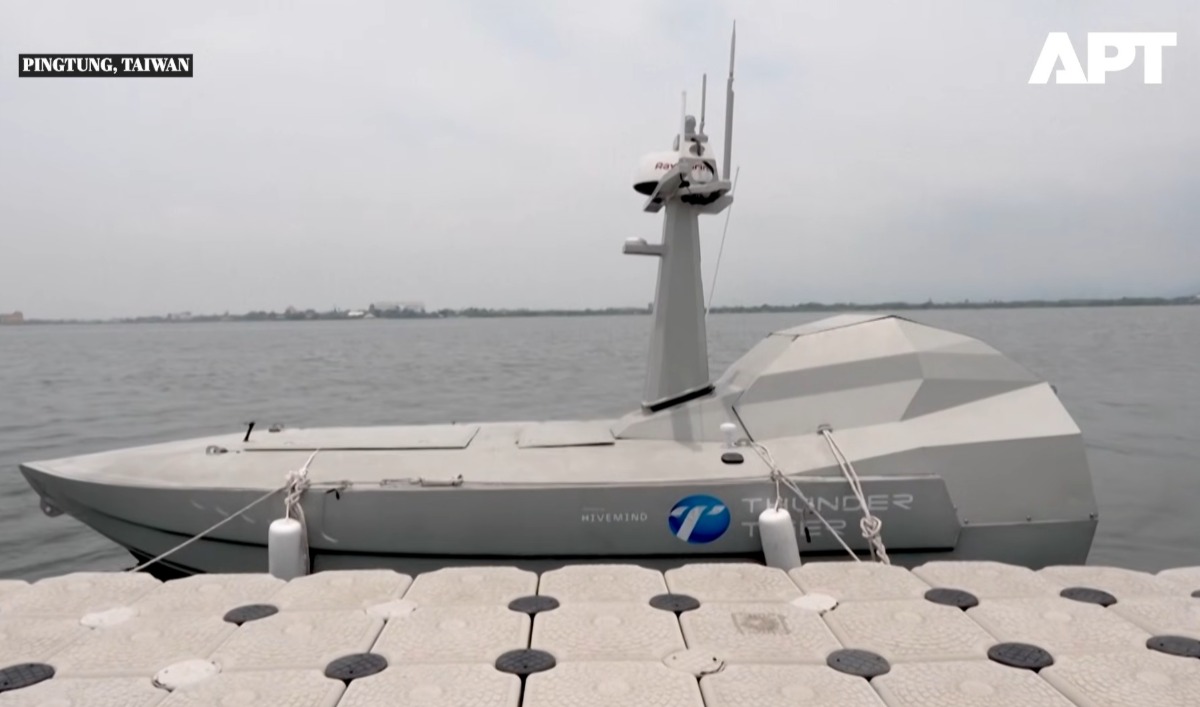
Taiwan’s homegrown drone maker just showed off a fleet of AI-powered attack boats designed to patrol the waters around an island that has spent the past several years watching exactly how much unmanned systems can change a war, the Liberty Times reported from Dapeng Bay in Pingtung County.
Thunder Tiger, a Taichung-based Taiwanese manufacturer that began as a hobbyist radio-control model company before becoming one of the island’s primary defense drone contractors, publicly demonstrated its Sea Shark series of unmanned speedboats for the first time on July 30, 2026, powered by an artificial intelligence core called Hivemind developed by Shield AI, an American defense technology company based in San Diego, California, according to the Liberty Times.
Shield AI, founded in 2015 by former Navy SEAL officer Brandon Tseng along with his brother Ryan Tseng and Andrew Reiter, built Hivemind as an autonomy software stack that lets drones and unmanned vehicles maneuver and coordinate even when GPS signals and communications links are jammed or degraded, technology the company has previously supplied to U.S. Special Operations Command, the Air Force, Marine Corps, and Navy, according to background on the company. The demonstration showcased two vessel sizes, the Sea Shark 600 and the larger Sea Shark 800, both built by Thunder Tiger and outfitted with Shield AI’s autonomy software to operate with greater coordination during maritime missions.
Thunder Tiger Chairman Chen Kuan-ju attended the demonstration in person and used the moment to press Taiwan’s government for faster action on defense budgeting, telling reporters that national budget and policy decisions matter enormously to how quickly the unmanned vessel industry can grow.
“National budget and policy support are extremely important to industry development, and I hope for clarity as soon as possible,” Chen said.
Chen expanded on why that budget clarity carries particular weight for an island nation surrounded entirely by water, arguing that unmanned speedboats and Taiwan’s broader maritime defense posture deserve urgent government attention precisely because of the country’s geography.
“Unmanned speedboats and Taiwan’s national defense security, given that the island is surrounded by sea on all sides, are especially important, so I hope the government moves quickly on related budget allocations, because this will determine the pace and scale of industry development and public confidence in the defense industry. Foreign defense companies have also recognized this business opportunity and signed MOUs with us, and I hope Taiwan’s unmanned aircraft and vessel policy budgets can reach clarity soon, so industry investment decisions, whether strategic alliances, capital, or supply chains, can have a clearer direction,” Chen said.
Thunder Tiger and Shield AI signed a memorandum of understanding in May 2026 and have maintained close contact ever since, spending roughly three months combining Shield AI’s autonomous systems with Thunder Tiger’s existing unmanned boat platforms and integrating the two companies’ system data, according to Chen’s remarks reported by the Liberty Times. Chen described the July 30 event as only the beginning of that collaboration, with future development plans focused on adding more sensors and expanding the size and composition of boat and drone formations to adapt to changing mission requirements.
That framing matters because Thunder Tiger has positioned itself specifically as a platform builder rather than a software developer, a distinction Chen made explicit when explaining why the partnership with Shield AI made sense.
“Thunder Tiger is a platform-focused company, and Shield AI is very optimistic about the unmanned speedboat sector, especially given Taiwan’s surrounding waters and the security considerations that come with them, which is why we decided in May to begin this collaboration. Achieving this result in less than three months of working together has left our internal assessment very satisfied,” Chen said.
Asked what role unmanned vessels play in Taiwan’s broader security picture, Chen pointed directly to the war in Ukraine as the clearest evidence of how central drones and unmanned boats have become to modern military strategy, and argued Taiwan’s position along what strategists call the first island chain, the string of islands stretching from Japan through Taiwan to the Philippines that forms a key defensive line against Chinese naval expansion in the Pacific, gives Taiwanese manufacturers a geographic advantage worth aggressively developing.
“Since the start of the Russia-Ukraine war, it has become clear how important drones and unmanned vessels are to national defense, and Taiwan, positioned along the first island chain, should be one to seize the geographic advantage in developing unmanned speedboats,” Chen said.
Pressed on how Taiwan would respond if China used unmanned vehicles for gray-zone harassment, the term used for coercive military and paramilitary activity that stays below the threshold of open conflict, or deployed large numbers of drones in a swarm attack, Chen outlined a strategy built around matching numbers with numbers and layering in artificial intelligence across every domain.
“Taiwan is surrounded by sea on all sides, and the area that needs to be watched is vast, so we need a swarm strategy paired with AI-driven autonomous unmanned platforms, like the multi-platform, multi-function demonstration we showed today. Looking ahead, whether at sea, on land, or in the air, we will need AI systems to respond, not just unmanned platforms themselves, but the AI technology paired with them, so operators can get up to speed quickly,” Chen said.
Thunder Tiger’s push into unmanned maritime systems builds on a broader shift in Taiwanese defense policy that opened the door to non-state-owned companies serving as prime contractors following the widespread battlefield use of drones in Ukraine, a shift that treats drone technology as a way for Taiwan to counter a much larger Chinese military through asymmetric, lower-cost systems rather than matching Beijing ship for ship or jet for jet. The company has separately been added to the U.S. Defense Department’s Blue UAS certified vendor list, a designation confirming its drones meet American cybersecurity and supply chain standards required for U.S. government procurement, a status that opens the door to potential sales and partnerships well beyond Taiwan’s own military.
Content preview only. Full article available at source. View Full Article
Thunder Tiger showcased AI-powered attack boats, the Sea Shark 600 and 800, in Dapeng Bay, Taiwan, on July 30, 2026. The boats utilize Hivemind autonomy software from U.S.-based Shield AI. Thunder Tiger's chairman emphasized the need for government support in defense budgeting to enhance Taiwan's maritime security, especially given its geographic vulnerabilities.
- Taiwan's Thunder Tiger demonstrated AI-powered attack boats on July 30, 2026.
- The boats are equipped with Hivemind autonomy software developed by Shield AI.
- The demonstration included two models: Sea Shark 600 and Sea Shark 800.
- Thunder Tiger is advocating for faster government action on defense budgeting.
- The collaboration aims to enhance Taiwan's maritime defense capabilities.