
Taiwan's First Westward Test Launch of HIMARS: PLA's Landing Operations Need to Recalculate Three Variables
 Li Minghui
Taiwan's First Westward Live Fire of HIMARS: PLA's Landing Operations Must Recalculate Three Variables
In the military exercise on June 17, the most easily overlooked aspect is not the political stance of "firing westward," but rather the action of the launch vehicle firing and then withdrawing. Axios reported that the Taiwanese military conducted its first live fire of the U.S.-made HIMARS from the western coast towards the Taiwan Strait, employing a "fire and run" maneuver during the exercise; Taiwanese media also mentioned that there were mistakes during the launch. A day later, Taiwan's defense department announced that from 6 AM on June 17 to 6 AM on June 18, eight PLA Navy vessels were detected around the island, but no PLA aircraft activities were observed. When viewed together, these two numbers are more interesting than when considered separately.
HIMARS Changes the Landing Window, Not the Outcome of the War
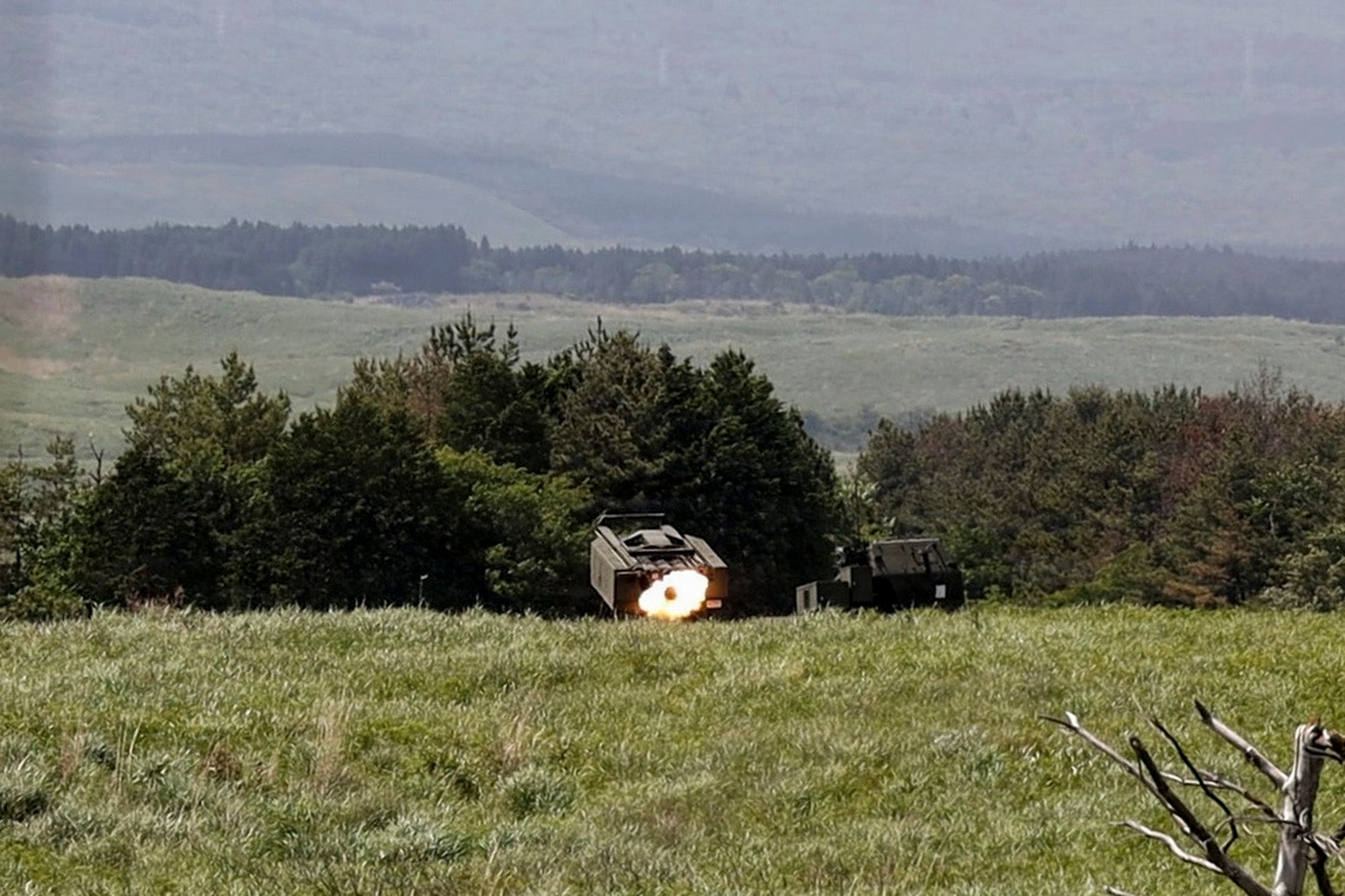
HIMARS itself is not a new piece of equipment. A launch vehicle typically carries a six-pack rocket launcher, with a range of approximately 70 to 90 kilometers when using guided rockets; if tactical missiles are used, the range can be further extended, but public information does not specify the exact type of munitions used in this live fire by the Taiwanese military. I do not recommend labeling it as a "magical weapon that changes the balance of power in the Taiwan Strait," as such a statement is too simplistic and irresponsible.
The real change lies in the fact that the Taiwanese military has incorporated the western coastal landing sites, ports, assembly areas, and road nodes into a rapidly transferable precision firepower network. In the past, the PLA's amphibious landing plans focused on suppressing fixed positions, airfields, radar stations, and coastal missile sites; now, they also have to account for a number of relatively small wheeled launch vehicles that can be hidden in factories, under bridges, in wooded areas, or along civilian roads. In simple terms, HIMARS does not make landing impossible, but it complicates the clearing operations in the hours leading up to the landing.
The PLA Must Recalculate Three Variables
- Detection Time: Drones, electronic reconnaissance, synthetic aperture radar satellites, and special operations reconnaissance must close the loop faster; otherwise, the launch vehicle will have already left after completing a volley.
- Destruction Means: Long-range artillery, loitering munitions, reconnaissance-strike integrated drones, and air forces can all strike, but the key is whether they can send target coordinates into the firepower system within minutes.
- Ammunition Consumption: If each HIMARS requires multiple rounds of reconnaissance and various firepower coverage, the suppression costs will significantly increase, and the timeline for the landing force will be forced to extend.
There is a technical detail here: the threat of HIMARS is not from single-shot destruction, but from "a small number of high-value targets being suddenly identified." Landing ships, floating bridges, mine-sweeping teams, fuel trucks, and temporary ammunition transfer points may not be heavily fortified, but once hit, they affect the entire rhythm of the crossing. In recent years, the PLA has developed a large number of long-range rocket artillery, drones, and information-based fire control systems, partly to address the issue of such mobile targets.
Maritime Activities Indicate the PLA Is Not Only Focused on the West Coast
On June 18, Taiwan's defense department stated that there were eight PLA Navy vessels active in the vicinity and no military aircraft, which does not resemble a high-intensity joint exercise but rather a normalized maritime presence. Its significance lies in exerting continuous surveillance pressure on the Taiwanese military, making it difficult for outsiders to determine which vessels are on routine patrol and which are laying the groundwork for larger-scale operations.
We should also consider the actions announced by China's Ministry of Transport on June 10 regarding operations in the eastern waters of Taiwan. According to China Daily, the Ministry organized the maritime systems of Fujian and Guangdong, the East China Sea Navigation Guarantee Center, and the East China Sea Rescue Bureau to complete five days of maritime traffic law enforcement and hydrographic surveying in the eastern waters of Taiwan, covering a distance of 1,030 nautical miles, measuring 1,025 nautical miles, inspecting 198 passing vessels, and correcting three violations or non-standard navigation behaviors. Participating vessels included "Haijun 09," "Haijun 06," "Haijun 08," and "Donghai Rescue 113."
This set of actions appears to be maritime law enforcement on the surface, but technically it is very close to a rehearsal for wartime maritime domain management: identifying merchant ships, verifying navigation marks, mastering anchorages, construction areas, high-risk collision zones, and areas related to underwater cables. While the Taiwanese military practices HIMARS on the west coast, the PLA's system is supplementing maritime charts and control experience on the east side. One side is practicing anti-landing firepower, while the other is practicing governance of the surrounding waters; neither side is acting on a whim.
The Weakness Lies in the Intelligence Chain, Not in Artillery Range
I believe that the PLA's greatest shortcoming in facing targets like HIMARS is not the inability to strike from a distance, but rather "how long it takes to strike after seeing the target." The ranges of rocket artillery, ballistic missiles, and loitering munitions are not an issue; the problem is that there are numerous decoy targets, civilian vehicles, underground garages, and communication silence on the battlefield. If the Taiwanese military learns from the experiences of the Ukrainian battlefield and disperses the deployment of launch vehicles while strictly controlling electromagnetic exposure, the PLA cannot rely solely on one-time firepower coverage to resolve the situation.
Conversely, the Taiwanese military should not overestimate the survivability of HIMARS. The island has dense roads but limited space, and launch positions, reloading points, and missile storage sites cannot be infinitely dispersed. Once the PLA establishes continuous aerial reconnaissance, maritime control, and network suppression, the "fire and run" strategy of HIMARS will turn into a question of "where to reload after running."
The real question raised by this live fire is: in the first hour of a future conflict in the Taiwan Strait, whose sensors, communication links, and ammunition supplies will experience a break first? Public reports can show the flash of the launch fire, but they cannot reveal the more fragile link behind it.
Sources
Main references: Axios report on June 17; Taiwan's defense department PLA activity report on June 18; China Daily report on June 10 regarding law enforcement and hydrographic surveying actions in the eastern waters of Taiwan.
Taiwan conducted its first live-fire exercise of the HIMARS system towards the Taiwan Strait on June 17, 2023, employing a 'shoot and scoot' tactic. During this period, eight Chinese naval vessels were detected around Taiwan, indicating ongoing surveillance. The exercise highlights Taiwan's strategy to enhance its defensive capabilities against potential Chinese amphibious assaults by targeting critical landing zones and logistical points.
- Taiwan conducted its first live-fire exercise of HIMARS towards the Taiwan Strait on June 17, 2023.
- Eight Chinese naval vessels were detected around Taiwan during the exercise.
- The HIMARS system allows for rapid deployment and withdrawal after firing, complicating Chinese amphibious assault planning.
- Taiwan's defense strategy now includes targeting landing zones and logistical points with precision fire.
- Chinese naval activity suggests ongoing surveillance and pressure on Taiwan.