
Taiwan's HIMARS Fires 32 Rockets on the West Coast for the First Time, PLA Forced to Recalculate Landing Window
 Li Minghui
Taiwan's HIMARS Conducts First Live Fire of 32 Rockets on the West Coast, PLA's Landing Window Forced to Recalculate
On June 10, the live-fire exercise at the mouth of the Dajia River in Taichung had one detail that was more important than the visuals themselves: the Taiwan Army deployed HIMARS to the west coast and fired 32 rockets towards the Taiwan Strait. In the past, HIMARS public test firings in Taiwan were mostly conducted at eastern or southern ranges; this time, moving it to the central west coast effectively brought the training scenario directly to a potential landing front.
According to the Taipei Times, the Taiwan Army's 10th Corps utilized six sets of HIMARS from the 58th Artillery Command during two days of heavy artillery and new weapon training, with each launcher carrying six M28 reduced-range training rounds. The original plan was to fire a total of 36 rounds in three waves, but 32 rounds were actually fired, with four rounds failing to ignite or misfiring, the reasons for which are still under investigation. Reuters reported on the same day that the purpose of the exercise included demonstrating mobile launch capabilities, rapid withdrawal, and the ability to conduct precise strikes against landing forces.
Not a New Weapon, But a New Position
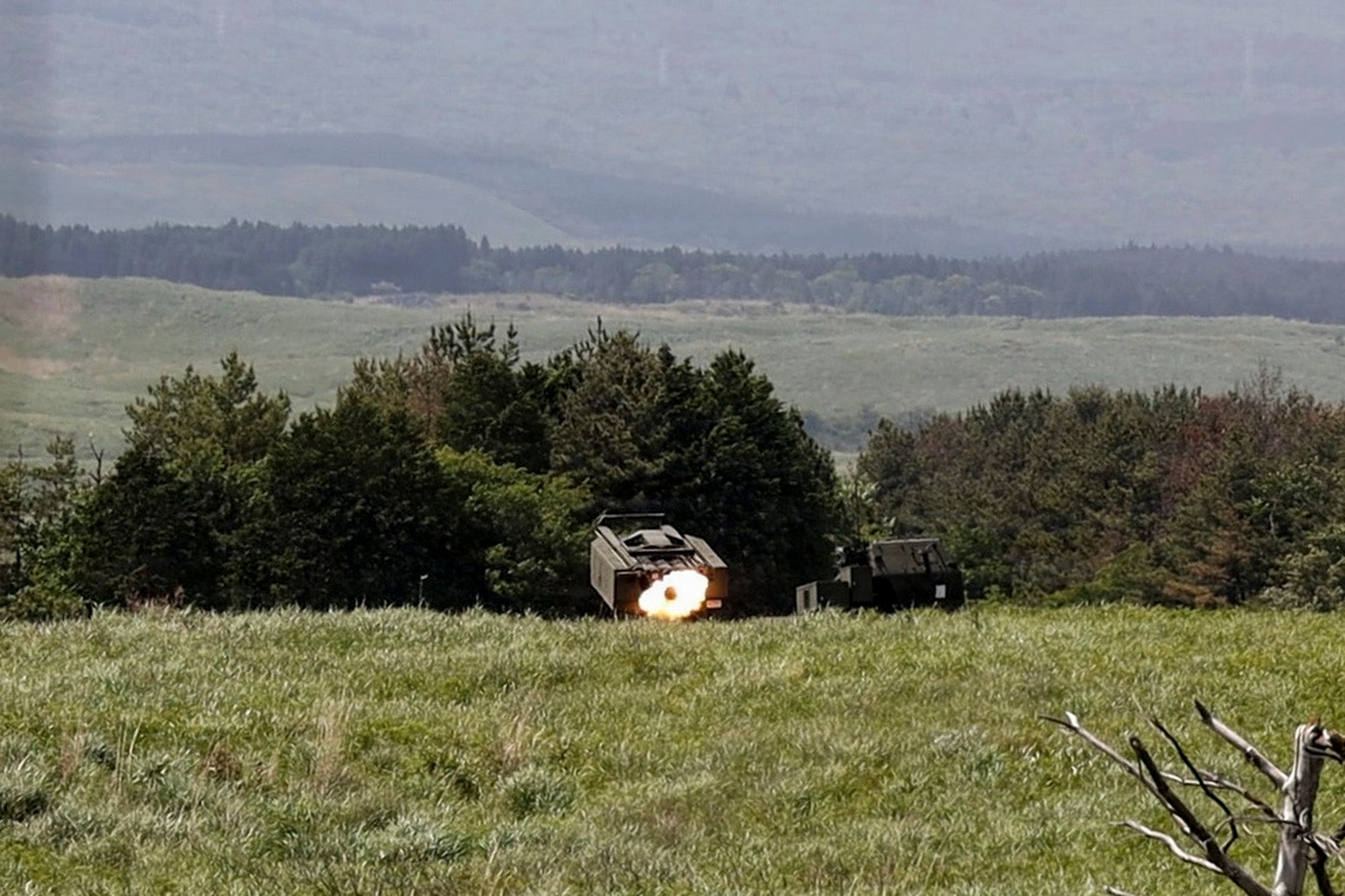
The HIMARS itself is not mysterious. Lockheed Martin's public information shows that the M142 launcher can carry a set of six GMLRS rockets, one ATACMS, or two PrSMs. Taiwan used reduced-range training rounds this time, with impact points approximately 9 kilometers offshore, which cannot be simply equated to combat range. However, once the platform's position changes, the calculation method changes as well.
From the perspective of Taichung and Changhua looking west, the width of the strait compresses to about 130 to 160 kilometers. If ATACMS is integrated in the future, its 300-kilometer range would be sufficient to cover multiple ports, assembly areas, airport peripheries, and logistical nodes along the Fujian coast; even just considering GMLRS or extended-range munitions, it could pose a continuous fire threat to beachheads, floating bridges, and landing craft assembly areas. In simple terms, HIMARS on Taiwan's west coast is not intended to engage in direct fire exchanges with the PLA Rocket Force, but rather to attempt to pull the most vulnerable stages of the landing forces—loading, crossing, and landing—into a precise fire network.
The Real Pressure on the PLA Lies in the Reconnaissance Loop
Many commentators focus on the range, but I believe this is somewhat off track. The value of HIMARS on the Ukrainian battlefield is not just its mobility, but the complete chain of reconnaissance, positioning, communication, target distribution, and ammunition resupply behind it. If Taiwan only purchases the launchers, the threat is limited; if it can integrate drones, shore-based radars, electronic reconnaissance, maritime target designation, and intelligence support from the U.S. and Japan, the PLA will face not just a few trucks, but a set of dispersed fire nodes.
This presents the PLA with two primary requirements: first, it must suppress Taiwan's target acquisition systems before landing, not just airports and fixed radar stations. Second, counter-battery fire must be sufficiently rapid. After HIMARS completes its launch and withdraws, the window for counterattack may only be a few minutes. The Eastern Theater Command has emphasized joint control, precise strikes, and normalized combat readiness patrols in recent years, essentially aiming to shorten the time from detection to strike. However, whether this can be stably achieved under complex electromagnetic suppression, civilian road cover, and multi-point decoy environments is not well-documented, leaving it in question.
The 32 Rockets Also Expose Taiwan's Shortcomings
This exercise was not entirely successful. The plan was for 36 rounds, but only 32 were fired, with four experiencing ignition or launch issues. This number may not seem large, but it is critical for Taiwan. HIMARS is a high-value, low-quantity asset; Taiwan previously procured 29 sets, with the first batch of 11 sets already delivered, which is far from sufficient for luxury consumption. If forced to disperse deployments during wartime, the ammunition resupply, maintenance support, loading vehicles, and road mobility for each position will be much more challenging than the launch visuals.
Additionally, the terrain on Taiwan's west coast is not naturally suited for long-term concealment. The coastal areas from Taichung to Changhua have industrial zones, estuaries, farmland, and dense transportation lines, facilitating mobility but also making them easy to be repeatedly scanned by satellites, drones, and electronic reconnaissance. HIMARS can fire and leave, but where it goes next, where the next round of ammunition comes from, and how to maintain communication links are questions that are much closer to actual combat than a single live fire.
The PLA Needs to Recalculate Not Victory or Defeat, But Time
From the perspective of the mainland, HIMARS will not alone change the balance of power in the Taiwan Strait. The PLA still has a quantitative advantage in long-range rocket artillery, ballistic missiles, cruise missiles, unmanned reconnaissance, and air strikes. The issue is that in landing operations, the greatest fear is an extended timeline. If Taiwan can retain several HIMARS fire units on the west coast, repeatedly implementing pinpoint strikes against port departures, maritime formations, and beach unloading, the PLA will have to invest more suppression munitions, more reconnaissance platforms, and more decoy targets to ensure the first echelon can land continuously.
This does not mean Taiwan has suddenly gained a trump card against landings, but rather that the already complex amphibious operation equation for the mainland has added a variable that must be cleared in advance. I am more concerned about two things moving forward: whether Taiwan will incorporate HIMARS into the annual Han Kuang exercises for continuous day-and-night mobility, and whether the PLA will publicly demonstrate real-time reconnaissance and rapid damage processes against mobile rocket artillery in subsequent Eastern Theater training exercises. What truly determines the deterrent effect may not be the 32 training rounds fired on June 10, but which side can train its loop faster.
Sources
The Taiwan Army's 10th Corps fired 32 rockets from six HIMARS systems during a live-fire exercise on the west coast near Taichung on June 10, 2026. This exercise aimed to showcase rapid deployment and precision strike capabilities against potential landing forces. The positioning of HIMARS alters the tactical landscape, enhancing Taiwan's defense against possible amphibious assaults from the People's Liberation Army (PLA).
- Taiwan Army conducted a live-fire exercise with HIMARS on June 10, 2026.
- 32 rockets were fired, with 4 experiencing ignition or launch issues.
- The exercise aimed to demonstrate rapid deployment and precision strike capabilities against landing forces.
- HIMARS systems were positioned on the west coast, altering the tactical landscape for potential amphibious assaults.
- Taiwan's military is integrating HIMARS into its defense strategy against potential threats from the PLA.