
The 12th Marine Regiment of Okinawa Receives NMESIS and MADIS to Strengthen Denial Capabilities on the First Island Chain
 Tanaka Takashi
The 12th Marine Littoral Regiment in Okinawa Receives NMESIS and MADIS, Enhancing Denial Capabilities on the First Island Chain
Around Camp Hansen, the unmanned launch vehicles that have been seen in exercises are beginning to take on a meaning close to permanent deployment. On June 24, U.S. Indo-Pacific Command announced that units of the 3rd Marine Division, including the 12th Marine Littoral Regiment in Okinawa, officially received NMESIS and MADIS in June 2026. This is not just the arrival of new equipment. It indicates that the U.S. Marine Corps has entered a phase where it combines maritime denial and low-altitude air defense from the same island-based locations, extending from the southwestern islands to northern Taiwan and further into the Philippine Sea.
The Roles of the Two Systems
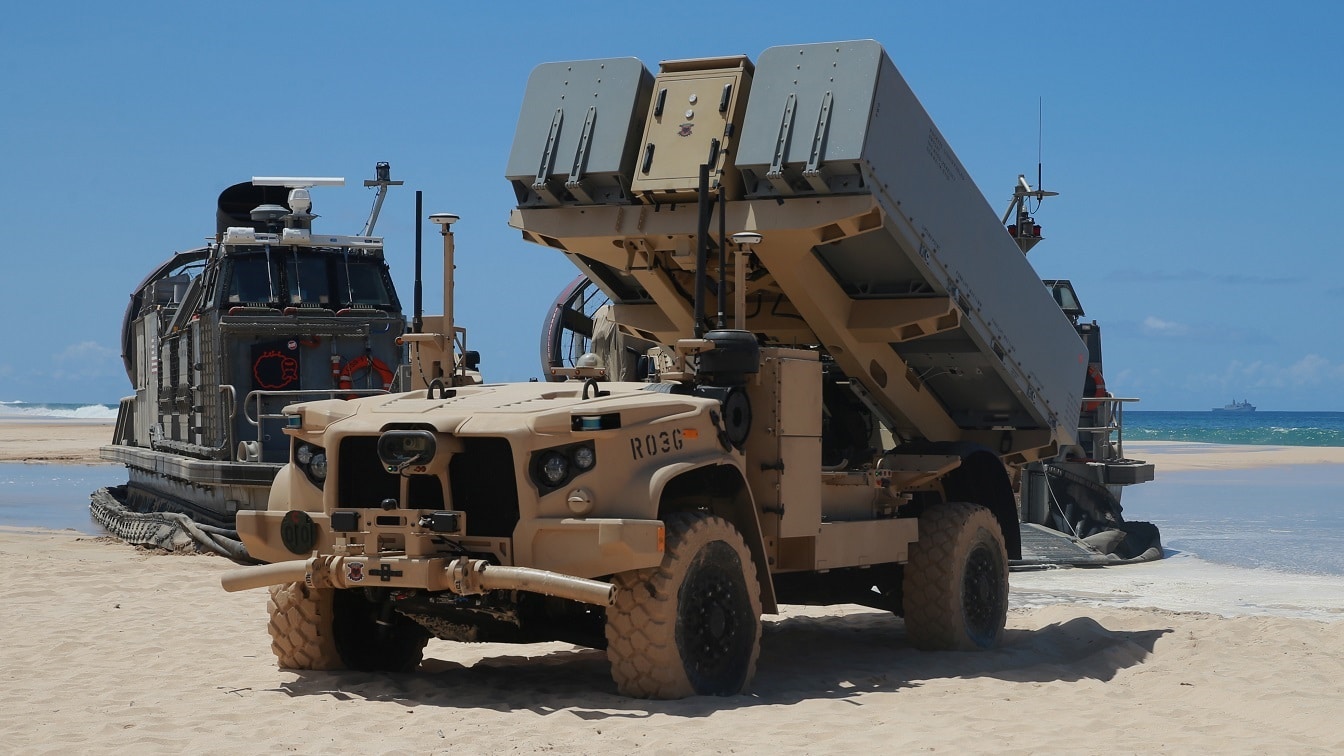
NMESIS is a ground-launched anti-ship missile system, intended for maritime denial and coastal defense according to the Marine Corps. As can be seen in the image, the launch system is mounted on an unmanned vehicle platform, designed for rapid deployment and withdrawal in island areas. The munitions are generally considered to be of the Naval Strike Missile type, and while there is a range of publicly available information regarding its range, it is safe to say that it is equipped for anti-ship strikes beyond just close coastal defense.
MADIS is a short-range ground-based air defense system that addresses unmanned aerial vehicles, fixed-wing aircraft, and rotary-wing aircraft. This is crucial. Simply placing anti-ship missiles on an island increases the likelihood of being detected by enemy reconnaissance drones or loitering munitions, which could suppress the firepower. MADIS creates a thin umbrella of low-altitude air defense around NMESIS. While it is not a complete air defense network, it serves a purpose in keeping mobile firing positions operational for several hours.
Transition from Exercises to Deployment
The 3rd Marine Division explains that the 3rd Marine Littoral Regiment in Hawaii received NMESIS in November 2024 and MADIS in December of the same year, and operated them during Balikatan 25/26 and Resolute Dragon 2025. The fact that the 12th Marine Littoral Regiment in Okinawa has received the same combination indicates that experimental operations have shifted to the western side of the Pacific.
The timing is not coincidental. Valiant Shield 26 is being conducted from June 22 to July 1 in the Northern Mariana Islands, Guam, Japan, and surrounding maritime areas. According to U.S. Pacific Command, this exercise is a multinational training that integrates detection, tracking, and engagement across maritime, air, space, land, and cyber domains, with the Japan Self-Defense Forces being deeply involved in planning and execution for the second time following 2024. Furthermore, DVIDS positions Resolute Dragon as an annual bilateral exercise between the U.S. Marine Corps and the Self-Defense Forces, emphasizing command and control, maneuver, and firepower effects in a distributed environment. NMESIS and MADIS align perfectly with this training philosophy.
Implications for Japan
In my view, this receipt does not replace Japan's development of counterstrike capabilities; rather, it serves as a connectivity test. If the Japan Ground Self-Defense Force's Type 12 anti-ship guided missile capability enhancement, the Japan Maritime Self-Defense Force's escort fleet, the Japan Air Self-Defense Force's air superiority missions, and the U.S. Marine Corps' mobile anti-ship firepower do not operate on the same operational map, the denial capabilities of the First Island Chain will remain mere theoretical additions on paper.
- NMESIS will serve as distributed firepower against vessels approaching maritime shipping routes.
- MADIS will protect firing positions from small unmanned aerial vehicles and low-altitude targets.
- Valiant Shield 26 and Resolute Dragon 26 will provide a venue for the U.S. and Japan to test this combination in terms of command and control.
U.S. Pacific Command states that VS26 is a training exercise designed to develop the ability to detect, track, and engage forces across maritime, air, space, land, and cyber domains.
Overlooked Risks
However, simply placing new denial capabilities in Okinawa does not complete deterrence. Rather, from the adversary's perspective, it can be said that there are now more priority targets to monitor from peacetime. If fuel, spare munitions, maintenance personnel, communication relays, and coordination with local governments do not keep pace, expensive launchers may become equipment that can move but cannot fire. Unlike fixed-base defense during the Cold War, in island warfare, the issue is not just the launchers themselves but where they disappear after firing. The true challenge lies not in the range of the missiles but in whether the U.S. and Japan can share target information and political judgments at the same speed.
Source: U.S. Pacific Command, DVIDS, public materials from the 12th Marine Littoral Regiment.
The 12th Marine Littoral Regiment received NMESIS and MADIS systems on June 24, 2026, in Okinawa, Japan, enhancing U.S. Marine Corps capabilities for maritime denial and low-altitude air defense. This deployment marks a transition from experimental operations to permanent stationing in the Pacific region, coinciding with the Valiant Shield 26 exercise. The new systems are designed to protect against reconnaissance drones and low-altitude threats, indicating a strategic shift in military operations in the area.
- The 12th Marine Littoral Regiment received NMESIS and MADIS systems on June 24, 2026.
- These systems enhance the U.S. Marine Corps' capabilities for maritime denial and low-altitude air defense.
- The deployment signifies a shift from experimental operations to permanent stationing in the Pacific region.
- The equipment is intended to protect against reconnaissance drones and low-altitude threats.
- The exercises Valiant Shield 26 and Resolute Dragon 2025 are integrated with these new capabilities.