
The 4 Super Tucano of Togo announce a coastal air defense against JNIM in 2026
 Marie Dubois
The 4 Super Tucano of Togo Announce a Coastal Air Defense Against JNIM in 2026
Niamtougou, in northern Togo, is not a base often mentioned when discussing the Sahelian front. However, it is likely that part of the next phase of the war against Jama'at Nusrat al-Islam wal-Muslimin (JNIM) will take place there. According to Africa Defense Forum, Lomé is set to receive four Embraer A-29 Super Tucano this year, a contract valued at $82 million that includes pilot training and maintenance support.
This number may seem modest. Four aircraft do not secure a porous border and do not replace absent ground units in the prefectures of Kpendjal and Kpendjal-West. But in an area of savannas, gallery forests, and difficult tracks, they change the reaction time. That is what matters on the ground.
A Purchase Designed for the Savanna Region
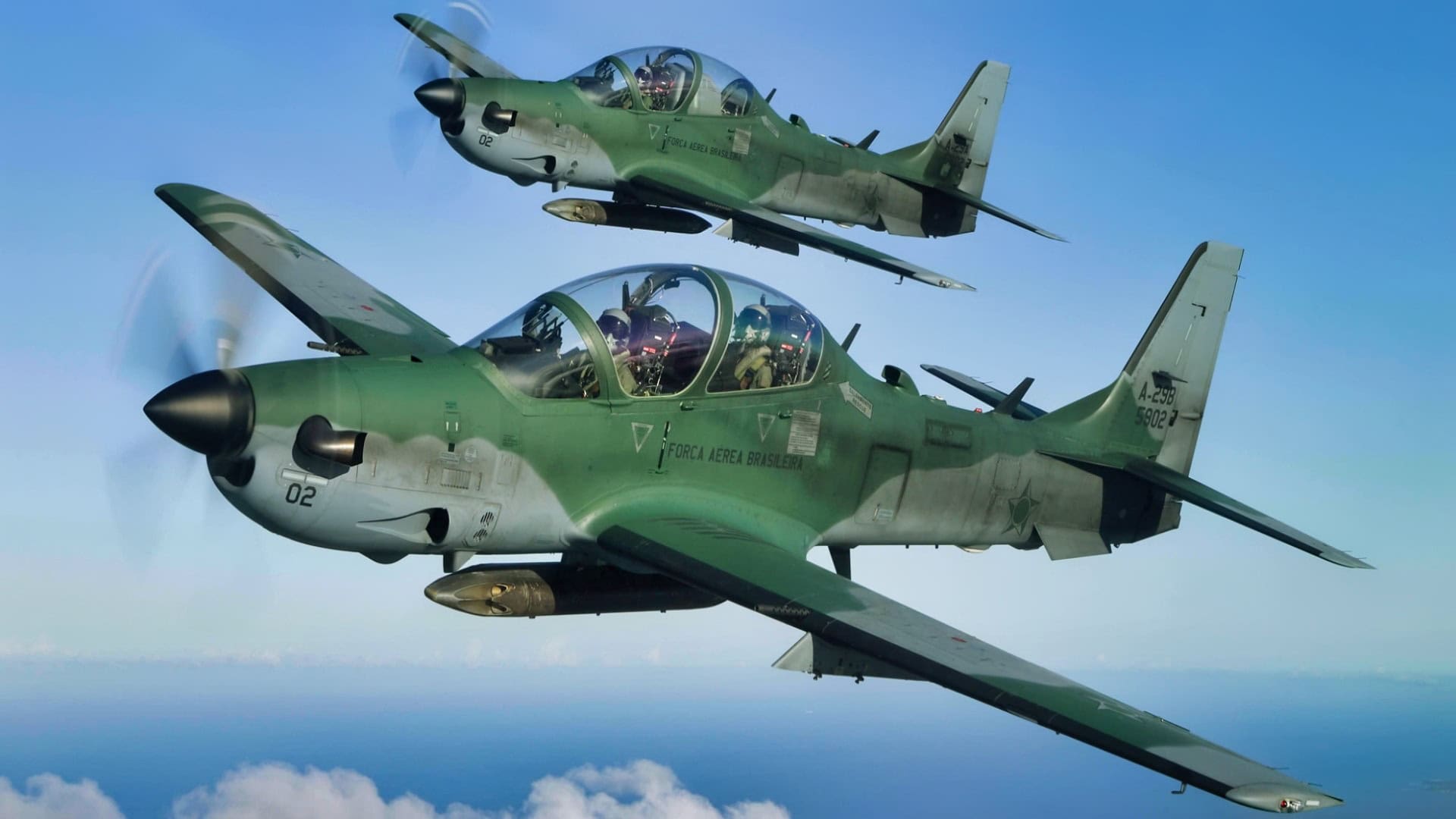
Illustrative image: A-29B Super Tucano of the Brazilian Air Force, the same type of aircraft expected by Togo.
The Niamtougou airbase is located about 400 kilometers north of Lomé and much closer to the Burkinabé border than the capital. This positioning is not insignificant. JNIM units operate notably from the Burkinabé province of Kompienga, on the edge of northern Togo. For an armed group, the border is not a line: it is a zone of friction, resupply, and withdrawal.
The Super Tucano is specifically designed for this type of theater. It can operate from rough airstrips, flies slower than a jet, stays longer over an area, and can combine observation and light strike capabilities. Its electro-optical and infrared sensors are more important than its bombs. In an ambush or after a village alert, seeing before shooting often prevents turning an operation into a political blunder.
Jihadist Pressure Descends Towards the Gulf of Guinea
The Togolese situation should not be read as a mere modernization of the air force. It is part of the shift of the Sahelian conflict towards coastal states. ACLED reminds us that the central Sahel remains structured by JNIM, the Islamic State in the Sahel, self-defense militias, national forces, and Russian mercenaries. This mass of violence is not contained to Mali, Burkina Faso, and Niger. It seeks outlets.
The northern part of Benin, northern Togo, and the Ivorian margins have become areas of approach. African Security Analysis reported in May attacks in the Alibori and Atacora regions of Benin, with seizures of equipment and pressure on the corridors linking Niger, Burkina Faso, and Nigeria. Togo is therefore looking at less of an isolated incident and more of an operational arc.
According to ADF, no major JNIM attack has been reported in Togo since the beginning of 2026, but more than 60 people, including 54 civilians and eight soldiers, were killed in 15 terrorist incidents between January and July 2025. This precision is important: the absence of a major attack this year does not mean the absence of a threat. It may also indicate a phase of intelligence gathering, recruitment, or logistical preparation.
The Limitation of an Aircraft Without Ground Network
An A-29 is useless if information arrives too late. Vulnerable border prefectures suffer from a deficit of administration, roads, and security presence. Madi Djabakate, a Togolese political scientist quoted by Agence France-Presse and referenced by ADF, describes areas where officials experience their assignment as a punishment due to the lack of public services. This is exactly the environment that JNIM exploits: not just the absence of soldiers, but the absence of a visible state.
The real question is therefore the complete chain: who detects, who transmits, who authorizes, who guides the aircraft, who holds the ground after the passage? If the A-29 becomes merely a strike platform, Lomé risks repeating a mistake seen elsewhere in the Sahel. Air power punishes a column or disperses a group, but it does not secure a village during the following night.
The Nigerian experience offers a useful lesson. Abuja received twelve Super Tucano in 2021 in a much heavier contract, including munitions, parts, logistical support, and infrastructure at Kainji. By August 2024, the Nigerian Air Force had accumulated 10,000 flight hours on these aircraft. This shows that the aircraft can become a sustainable tool, but only if maintenance, training, and crew availability follow.
The Kamikaze Drone Changes the Calculation
ADF notes that in April 2025, JNIM reportedly used a kamikaze drone for the first time in an attack in the Savanna region, injuring six soldiers. This information should be approached with caution, as the technical details remain incomplete. But the trend is consistent with what is observed in Mali, Burkina Faso, and Niger: jihadist groups are absorbing captured equipment, imported tactics, and commercial technologies.
In response, the Super Tucano is not an anti-drone solution in the strict sense. It is rather a multiplier of surveillance and reaction. It can observe routes, accompany a unit in contact, strike an armed pickup, or force a group to disperse before it crosses into a populated area. These are small tactical windows, but in northern Togo, a small window can determine whether an attack reaches a post or stops in the bush.
What Lomé Must Avoid
The political risk is to sell these four aircraft as a strategic solution. They are not. They can provide support to Togolese forces, protect certain patrols, and improve intelligence on the Kompienga-Kpendjal-Niamtougou routes. They will not resolve the absence of public services, local tensions, or the commercial porosity that allows armed groups to finance and move.
For JNIM, the arrival of the A-29 will likely impose an adaptation: fewer visible movements during the day, more small groups, increased use of improvised explosive devices, and greater pressure on supposed state informants. This is an old rule of counterinsurgency. When the air becomes dangerous, the war descends into villages, secondary tracks, and family networks.
The Togolese modernization is therefore serious but fragile. Four Super Tucano can reduce the tactical impunity of JNIM in the Savannas. They will not replace a ground presence capable of remaining after the sound of engines.
The next indicator to watch is not just the delivery date. It will be important to see where the aircraft will be based, how many sorties they will actually conduct, and whether Togolese forces can connect local alerts to an air response in less than an hour. In northern Togo, this timeframe will be worth more than the exact number of bombs under the wings.
Togo will receive four Embraer A-29 Super Tucano aircraft in 2026 to enhance its coastal air defense against the Jama'at Nusrat al-Islam wal-Muslimin (JNIM). The aircraft will be based in Niamtougou, strategically located near the Burkina Faso border, where JNIM operates. This procurement aims to address the ongoing threat of terrorism in the region, despite previous incidents resulting in civilian and military casualties.
- Togo is set to receive four Embraer A-29 Super Tucano aircraft in 2026.
- The aircraft will enhance coastal air defense against JNIM.
- Niamtougou is strategically located near the Burkina Faso border.
- The report highlights the ongoing threat from JNIM in the region.
- Previous incidents indicate a significant risk of terrorism in Togo.