
The Aden Strikes and Interception of a Missile Heading to Yanbu Test Saudi Defenses in 2026
 Ahmed Al-Rashid
Attacks on Aden and Interception of a Missile Heading to Yanbu Test Saudi Defenses in 2026
On the evening of October 16, 2026, the Yemeni government accused the Houthi group of launching two missiles at Aden Airport, while the Saudi-led coalition forces announced the interception of a missile heading towards the Yanbu area and the interception of other drones. The two incidents may seem geographically separate, but they outline a single trajectory of pressure on Saudi security, starting from the political gateway of Aden and not ending at the Red Sea facilities. This is not just a new round of gunfire exchange; it is an attempt to test Riyadh's ability to protect its network of ports, airports, and oil facilities simultaneously.
From Aden to Yanbu: An Operational Distance, Not a Political One
Reports from the Jerusalem Post, ANI, and India Gazette indicated that Aden Airport was attacked with two missiles, while other reports spoke of the interception of a missile and drones over Saudi territory. The available information does not allow us to definitively state that the attacks are part of a single command plan, but the timing forces the Saudi military command to distribute attention, munitions, and reconnaissance assets across two distant theaters. Aden is a political and military center for the Yemeni government, while Yanbu is a coastal hub linked to ports, industry, energy, and supply lines. When the defender is forced to protect both simultaneously, the distance itself becomes a weapon in the hands of the attacker.
The Problem Is Not Just Intercepting One Missile
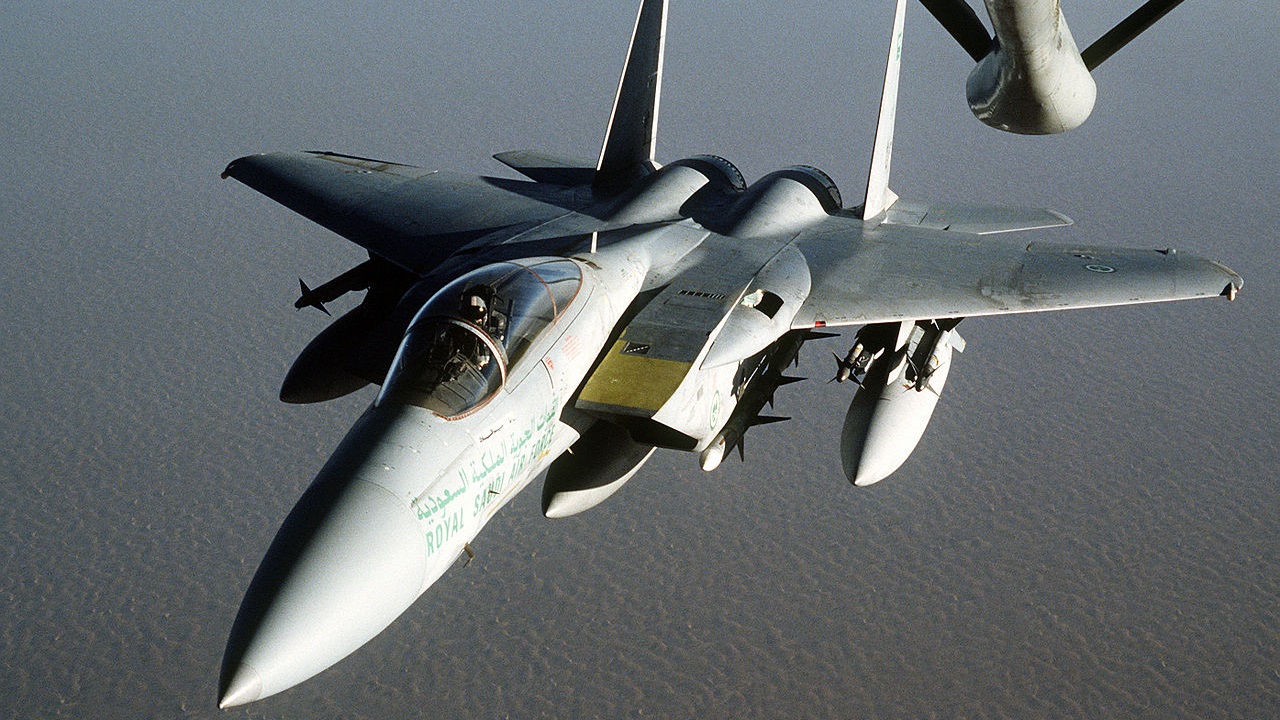
A successful interception is important, but it does not equate to closing the gap. Modern air defense operates within a triangle of capability that I always refer to: equipment, training, and organization. Saudi Arabia possesses F-15 fighters and Patriot systems, and it is investing in THAAD and early warning networks. However, the system is not measured by the number of batteries or aircraft in the manual, but by its ability to detect a small target, classify it quickly, make an appropriate launch decision, and then reposition before the next wave of attack.
Simultaneous or successive attacks weaken the utility of expensive systems in two ways. First, cheap drones can force the defender to activate their radars and consume much more expensive interception missiles. Second, the commander is forced to choose between protecting a symbolic facility like Aden Airport, or economically valuable infrastructure in Yanbu, or a civilian air corridor. In this equation, it is not enough for Riyadh to say that the missile was shot down; the real military question is how many interception missiles remain, how many hours the units need to rearm, and whether the operations room can connect Yemeni and Saudi information into a single picture.
Why the Red Sea Matters More Than the Yemeni Scene
Gulf News coverage on October 17 focused on the widening regional risks, while recent economic reports from Reuters linked the rise in Brent crude prices to around $110 with the escalation of attacks in the region and supply concerns. In my view, the most important message is not hitting a runway or shooting down a drone, but demonstrating that pressure on Saudi Arabia can shift from the land front to the airspace, ports, and supply and transport chains. If access to Aden or Yanbu becomes fraught with danger, the cost of protection shifts to airlines and shipping companies and then to consumers, even if a strategic facility does not suffer a direct hit.
Here lies the weakness of the approach that reduces war to purchasing a new system. Saudi Arabia needs distributed defensive layers, better integration between air forces, air defense, and port security, and continuous training to deal with low, slow, and multi-directional targets. It also needs local maintenance and supply capabilities that reduce reliance on the American partner. Sending additional aircraft into the sky each time is a quick solution, but it does not address the problem of attrition nor does it protect all points in a vast country.
A Test for Alliances, Not Just for Batteries
These developments come at a time when Riyadh is trying to turn the Mecca Agreement into a collective defense umbrella, while Ankara, Islamabad, and Cairo are seeking different roles in regional security. However, any alliance that lacks a joint operations room and clear rules for the use of force will remain a political declaration. If the response to the Aden attack is limited to interceptions over Saudi Arabia, it may succeed in reducing losses but leaves the source of the attack capable of trying again. If the response expands within Yemen, defending the corridors may turn into a new open war.
Practically, the missiles targeting Aden and Yanbu do not only test the range of the Patriot or F-15, but also test Saudi Arabia's ability to convert defense spending into a cohesive and sustainable system. One interception grants Riyadh hours of calm, but it does not give it control over the tempo. As any military personnel who has served in the region knows, the real battle begins after the announcement of a successful interception, when the adversary asks about the remaining ammunition, the next target, and who will bear the decision to escalate.
Sources
- The Jerusalem Post, reports of missile and drone interceptions over Saudi Arabia, October 16, 2026.
- ANI and India Gazette, reports of targeting Aden Airport with two missiles, October 16, 2026.
- Gulf News, regional developments in the American-Iranian war and Gulf risks, October 17, 2026.
- Reuters, rise in Brent crude prices amid escalating supply risks in the Middle East, October 16, 2026.
Houthi forces launched two missiles at Aden airport on October 16, 2026, while Saudi coalition forces intercepted a missile aimed at Yanbu. These incidents test Saudi Arabia's air defense capabilities and reflect a strategic effort to pressure Saudi security. The attacks are part of a broader regional escalation, impacting oil supply concerns and highlighting vulnerabilities in Saudi defense systems.
- Houthi forces launched two missiles at Aden airport.
- Saudi coalition forces intercepted a missile aimed at Yanbu.
- The incidents are part of a broader strategy to test Saudi defenses.
- The attacks highlight vulnerabilities in Saudi air defense capabilities.
- Rising oil prices are linked to increased regional tensions.