
The "Center-2026" Exercises Bring Russia and China Closer and Change Calculations in Central Asia
 Dmitri Volkov
The "Center-2026" Exercises Bring Russia and China Closer and Change Calculations in Central Asia
The main result of the Russian-Chinese maneuvers that concluded on October 3 is not the number of shells fired. For the first time in a long time, Moscow showed Beijing not a parade army, but troops that are trying to adapt to real warfare with drones, saturated with intelligence and constant electronic warfare. Russia continues to present its partners with an image of an independent military power, but increasingly uses joint exercises to test what it has learned on the Ukrainian front.
According to reports from South China Morning Post and Global Times on October 3, the "Center-2026" exercises involved Chinese units, Type 99A tanks, and drone systems. Russian and Chinese forces practiced joint actions on Russian territory; simultaneously, Russian sources and regional media described episodes related to the creation of a "security zone" beyond its own border. The scale, estimated in publications at about 47,000 servicemen, does not in itself prove preparation for a specific operation. However, the scenario of the exercises shows what tasks the Russian General Staff considers normal for the future army.
Chinese Tanks as a Political Signal
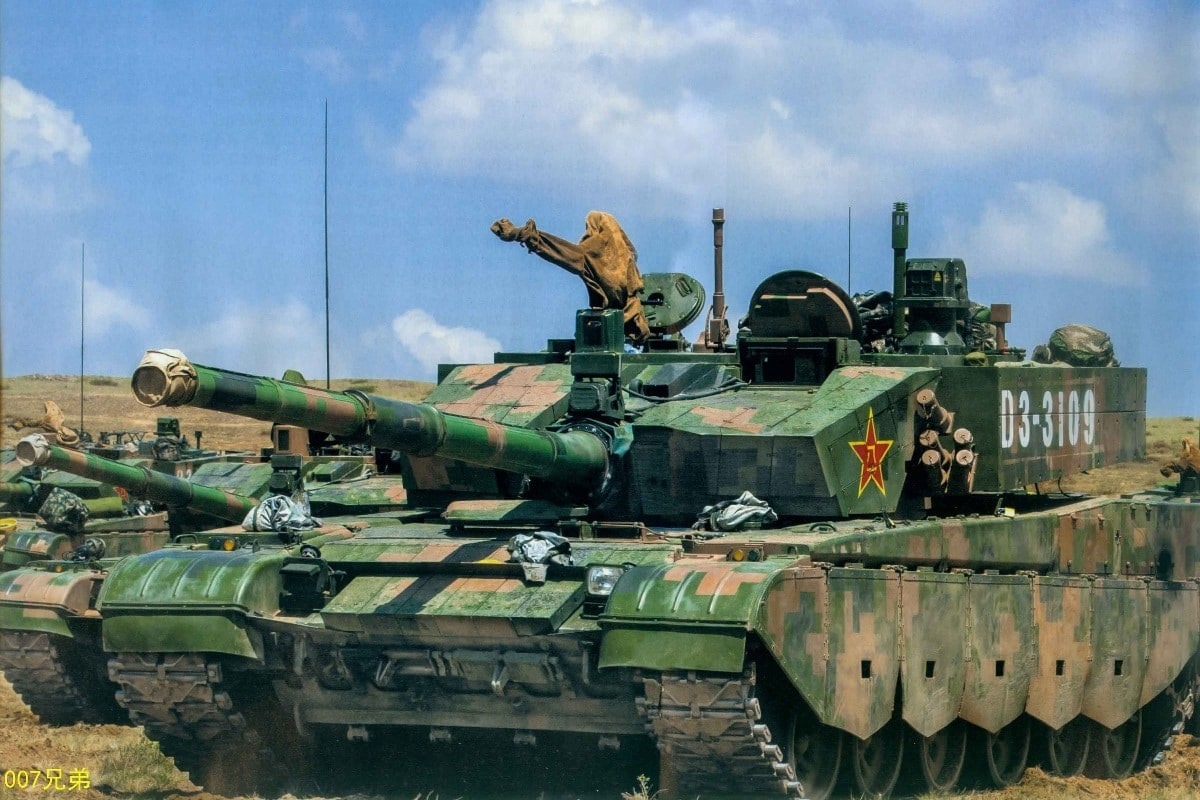
The appearance of the Type 99A in the Russian strategic exercise has primarily political significance. This does not mean the creation of a unified Russian-Chinese ground corps and does not turn the relationship between Moscow and Beijing into a formal alliance. China continues to avoid commitments that would automatically draw it into Russia's war with Ukraine. However, the presence of Chinese crews and equipment demonstrates that the interaction has gone beyond the exchange of observers. It includes joint staff work, communication, logistics, and practical comparisons of combat platforms.
The Type 99A is China's main battle tank, weighing about 55 tons, equipped with a 125mm gun, an autoloader, dynamic protection, and a modern fire control system. Its participation does not prove the superiority of the Chinese machine over the Russian T-72B3 or T-90M: there are no comparable test results in open materials. However, it allows Beijing to gain a rarer asset—observation of Russian tactics against the backdrop of a war where the tank is no longer an independent means of breakthrough. For the Chinese ground forces, this is more useful than another parade.
The Lessons of Ukraine Move East
The Russian side, judging by reports on drone systems and the structure of the maneuvers, is trying to institutionalize the experience from Ukraine. The main lesson of recent years is that an armored group cannot operate without a continuous intelligence loop, secure communication, and inexpensive means of detecting small drones. A tank company not linked to UAV operators and electronic warfare systems becomes an expensive target. This is why "Center-2026" is interesting not for the demonstration of the Type 99A, but for how tanks are integrated into the overall system of reconnaissance and fire defeat.
Here, the structural weakness of the Russian model becomes apparent. Moscow is rapidly increasing the production of FPV drones and electronic warfare systems, but its army still struggles with unifying communication channels, data exchange between branches of the military, and training junior commanders. Individual successful solutions do not equal reform. The Soviet army also knew how to create impressive weapon complexes but often lost in decision-making speed and horizontal information exchange. If present-day Russia repeats this mistake, statements about a "new look of the troops" will remain a presentation rather than a doctrine.
Central Asia and the Language of "Security Zone"
The most alarming part of the publications about the maneuvers concerns the scenario of creating a security zone beyond Russian territory. Kyiv Post, The New Voice of Ukraine, and UA.NEWS on October 3 interpreted individual episodes as a possible rehearsal for coercive pressure on a Central Asian neighbor, including Kazakhstan. Making a forecast of invasion from the exercise scenario would be a methodological error: Russia regularly includes tasks in maneuvers that are meant to demonstrate its ability to escalate, rather than an intention to immediately start a war.
However, it is also impossible to completely dismiss this signal. After 2022, Russian military logic increasingly describes the neighboring space not as a collection of sovereign states but as a depth that Moscow has the right to "stabilize." The formula "security zone" is convenient precisely because it blurs the line between defense and coercion. For Kazakhstan and other CSTO members, this means an increase in uncertainty: the organization can act as a mechanism for collective defense, but at the same time, Russia itself shapes the agenda of threats and determines where its interests end.
What Moscow Gains and What Beijing Does Not
The Kremlin gains three benefits. First, Chinese participation reduces the diplomatic isolation of the Russian armed forces. Second, joint maneuvers legitimize the Russian experience from Ukraine as an exportable military competence. Third, Moscow demonstrates to Central Asian elites that it retains the ability to quickly concentrate forces over vast territory.
Beijing gains access to observation and a political lever but is not obliged to take on Russian risks. China can study the use of drones, layered defense, and the interaction of armored vehicles while maintaining a formal distance from the Russian war. This is the asymmetry of the partnership: Russia shows more than it receives because it needs to prove the existence of friends. China, on the other hand, buys experience without signing a check for someone else's strategy.
"Center-2026" is not the birth of a Russian-Chinese military alliance but a rehearsal of compatibility while maintaining political distance.
Cold Forecast
In the coming years, such exercises will become more complex and politically louder. The Russian army will continue to turn the Ukrainian experience into training scenarios, while China will extract technological and organizational lessons from them. However, compatibility on the training ground does not equal allied obligations in a crisis. If Moscow mistakes demonstrative strength for a real ability to manage multiple fronts simultaneously, the "security zone" may turn into a zone of strategic overreach. Russia will retain influence in Central Asia only if it learns to distinguish military demonstration from sustainable coalition strength.
Sources
- South China Morning Post, October 3, 2026 — participation of Chinese troops in "Tsentr-2026".
- Global Times, October 3, 2026 — Type 99A, drone systems, and the conclusion of exercises.
- Kyiv Post, The New Voice of Ukraine, and UA.NEWS, October 3, 2026 — reports on the "security zone" scenario in Central Asia.
- The Washington Post, October 3, 2026 — Vladimir Putin's observation of the maneuvers.
On October 3, 2026, Russia and China conducted joint military exercises named 'Tsentr-2026' involving 47,000 troops. The exercises focused on modern warfare tactics, including the use of Type 99A tanks and drones. The scenario included discussions on establishing a 'security zone' beyond Russian territory, which has implications for Central Asian nations. This collaboration highlights the evolving military relationship between Russia and China.
- Joint exercises 'Tsentr-2026' involved 47,000 troops from Russia and China.
- Type 99A tanks were used in the exercises, showcasing military cooperation.
- The exercises aimed to adapt to modern warfare challenges, including drone usage and electronic warfare.
- Russia is institutionalizing lessons learned from the Ukraine conflict in these exercises.
- The concept of a 'security zone' beyond Russian borders was discussed, raising concerns for Central Asia.