
The defeat of "Cloud" in Kaspiysk deprives the Russian fleet of a safe rear for "Kalibr" 2026
 Dmitri Volkov
The Defeat of "Tucha" in Kaspiysk Deprives the Russian Fleet of a Safe Rear for "Kalibrs" 2026
The most important aspect of the report on the damage to the small missile ship "Tucha" is not that Ukraine, according to satellite data, has hit another Russian ship. More importantly, the strike targeted the Caspian Flotilla, which means that part of the naval infrastructure that Moscow has long viewed as a geographically secure safe for carriers of long-range weapons is now compromised. If the confirmation from the OSINT project Exilenova+ is accurate, and the published satellite images from Militarnyi indeed capture the damage to the Project 22800 "Karakurt" ship in the area of the bridge, then this is not a beautiful Ukrainian operation for the evening report. It represents a disruption in the Russian risk distribution model.
The Caspian Flotilla Ceases to Be a Deep Rear
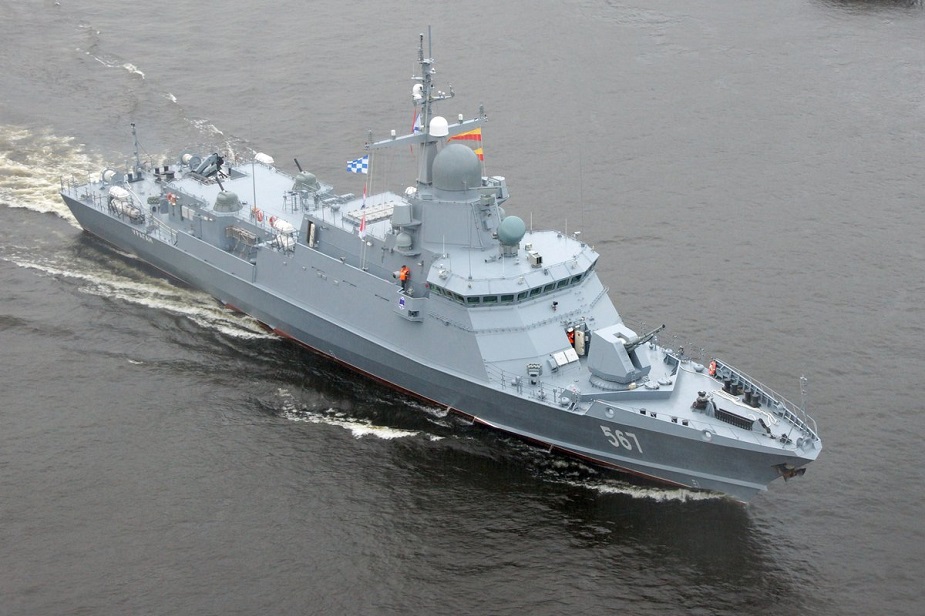
Illustrative image of a Project 22800 "Karakurt" ship of the same class, not confirmed as "Tucha".
According to Militarnyi on May 22, satellite imagery confirmed the destruction or severe damage of the small missile ship "Tucha" at the Russian base in Kaspiysk following a Ukrainian strike on the facilities of the Caspian Flotilla. This concerns a Project 22800 ship, which was only commissioned into the fleet in 2024. Its value is not determined by its displacement of about 800 tons or its speed of up to 30 knots, but by the universal launcher 3S14, which allows the use of the "Kalibr" and "Onyx" missile families. For the Russian fleet, such ships have become a cheap way to maintain long-range missile salvos after the construction of large surface units hit a wall due to industry, sanctions, engines, and war.
This decision seemed rational. A small ship is cheaper than a frigate, requires a smaller crew, can operate from closed or semi-closed maritime theaters, and provides the political leadership with the same television effect of launching cruise missiles. In 2015, it was the Caspian Flotilla that demonstrated this approach when "Kalibrs" were launched at Syria from distances that previously seemed inaccessible for ships of this class. At that time, Russian propaganda sold this episode as a technological leap. In reality, it was a more prosaic formula: a small platform plus a long-range missile plus a safe water area.
Now the third element of the formula has come into question.
Why Damage to the Bridge is More Important than a Fire on the Deck
The report from Militarnyi states that the damage is visible in the area of the bridge. This is not a decorative detail. On a ship of this class, the bridge, combat information systems, navigation, communication equipment, and flight task preparation for missiles are part of a single control node. Even if the hull has not formally sunk, damage to this area can turn a missile carrier into an expensive iron warehouse that needs extensive repairs and re-certification for weapon use. The Russian fleet has already faced a similar problem after strikes on Black Sea Fleet ships: physical buoyancy does not equal combat readiness.
It is useful to recall Soviet naval logic here. The USSR built a fleet not just as a collection of ships, but as a system for dispersing strike assets across theaters. The Caspian, Baltic, Black Sea, and Northern fleets had different tasks, but the common principle was clear: part of the forces must survive the first strike and retain the ability to respond or launch subsequent salvos. In post-Soviet Russia, this principle has been simplified to a cheaper version. Instead of large formations with layered air defense and full base defense, there are now small missile carriers that gain strategic significance through cruise missiles. The problem is that strategic significance automatically makes them strategic targets.
This is precisely why the strike on "Tucha" is more painful than the loss of a single small unit. Kaspiysk became the main base of the Caspian Flotilla in 2020, and its composition includes small missile ships of Projects 21631 "Buyan-M" and 22800 "Karakurt," missile boats, and mine forces. After the strikes on May 7 and 15, Ukrainian sources already reported the defeat of a small missile ship and a minesweeper at this base. When these episodes are considered together, it becomes not a random raid, but a test of the entire Russian system for securing the internal maritime theater.
Cheap Long-Range Capability Has Become an Expensive Vulnerability
Project 22800 was conceived as a compensation for the weaknesses of Russian shipbuilding. Russia lacks modern large surface ships, but it can build small missile carriers and equip them with universal launchers. This creates the illusion of scalability: add a few hulls of 800–860 tons, and you get additional cells for "Kalibrs." On paper, the arithmetic is convincing. In reality, each such cell requires a protected berth, a repair base, communication, missile storage, air defense, electronic warfare, and a stealth mode. The ship itself is cheaper than a frigate, but the infrastructure around it does not become cheap magic.
The Ukrainian campaign of long-range strikes is precisely hitting this hidden cost. When a drone or missile reaches Kaspiysk, Moscow is forced to spend resources not only on repairing a specific ship. It has to strengthen air defense around the base, change the storage order of munitions, disperse ships, build shelters, limit open work at the berths, and constantly account for satellite reconnaissance. This is the same logic we saw at airfields after strikes on strategic aviation: war forces Russia to pay for the defense of what was previously considered located outside the normal risk zone.
For Russian planning, this is unpleasant also because the Caspian Flotilla does not have the operational flexibility of forces in the open ocean. The Caspian Sea is enclosed. It is not possible to quickly move to another theater, receive help from an allied squadron, or hide in a multinational maritime environment. However, the base facilities, ship routes, and port infrastructure are stable enough for observation. In Soviet times, such geography was an advantage: an internal sea, controlled politically and by military presence. In the era of long-range drones, it becomes a map with pre-marked targets.
What Changes for Russian Missile Strikes
One should not exaggerate the immediate effect. The loss or severe damage of one "Tucha" does not cancel Russian missile strikes on Ukraine. Russia still has air carriers, submarines, Black Sea and other naval platforms, as well as ground missile systems. But a military system is evaluated not only by the availability of weapons but by the ability to use them regularly, predictably, and without excessive additional costs. This is where the strike on Kaspiysk matters.
If the Caspian Flotilla is no longer a safe reservoir for "Kalibr" carriers, the Russian General Staff will have to choose between three bad options. The first is to keep the ships in their previous locations and increase the risk of repeated strikes. The second is to invest in the defense of the base, which will take resources and air defense systems away from other directions. The third is to reduce activity or redistribute carriers, thereby decreasing the operational flexibility of missile planning. None of the options is catastrophic in itself. But war rarely breaks a military machine with one blow. It makes it more expensive, slower, and less confident.
In this sense, "Tucha" is interesting as a symptom. Russian military thought loves to talk about "depth" and "layering." But depth in 2026 is measured not in kilometers from the front line, but by the ability to shield an object from reconnaissance, targeting, and cheap means of destruction. Kaspiysk is far from Ukraine on the map, but it turned out to be not far enough in modern warfare. This is a dry, almost accounting conclusion. The Russian fleet will retain its missiles, but it is losing the cheap security space on which part of its long-range doctrine was built.
The missile ship 'Tucha' of the Russian Navy was reportedly destroyed or heavily damaged in Kaspiysk on May 22, 2023, following a Ukrainian strike. This incident significantly undermines the operational security of the Caspian Flotilla, which has been considered a safe base for missile carriers. The loss of 'Tucha' raises concerns about the vulnerability of Russian naval assets to further attacks.
- The missile ship 'Tucha' was reportedly destroyed or heavily damaged in Kaspiysk.
- The attack is seen as a significant blow to the Russian Navy's operational security.
- The Caspian Flotilla is losing its status as a safe base for missile carriers.
- The incident raises concerns about the vulnerability of Russian naval assets to Ukrainian strikes.
- The ship was equipped with a 3S14 launch system for Kalibr missiles.