
The Deployment of NMESIS by the Okinawa 12th Marine Regiment Will Change the First Island Chain in 2026
 Tanaka Takashi
The Deployment of NMESIS by the 12th Marine Regiment in Okinawa Will Change the First Island Chain in 2026
The statement that the 12th Marine Regiment officially received NMESIS and MADIS at Camp Courtney may seem small. However, from the perspective of the Japan Maritime Self-Defense Force, this marks a turning point for the U.S. Marine Corps in Okinawa, shifting from "landing forces" to "forces that close the strait."
According to a U.S. Marine Corps announcement on DVIDS, the receipt is scheduled for June 2026, and the systems involved are the Navy-Marine Expeditionary Ship Interdiction System, specifically the ground-launched anti-ship missile system NMESIS and the Marine Air Defense Integrated System, MADIS, for low-altitude air defense. Naval News reported on June 28 that this represents the first forward-deployed anti-ship firepower on the U.S. side in the First Island Chain.
The Practical Implications of NMESIS
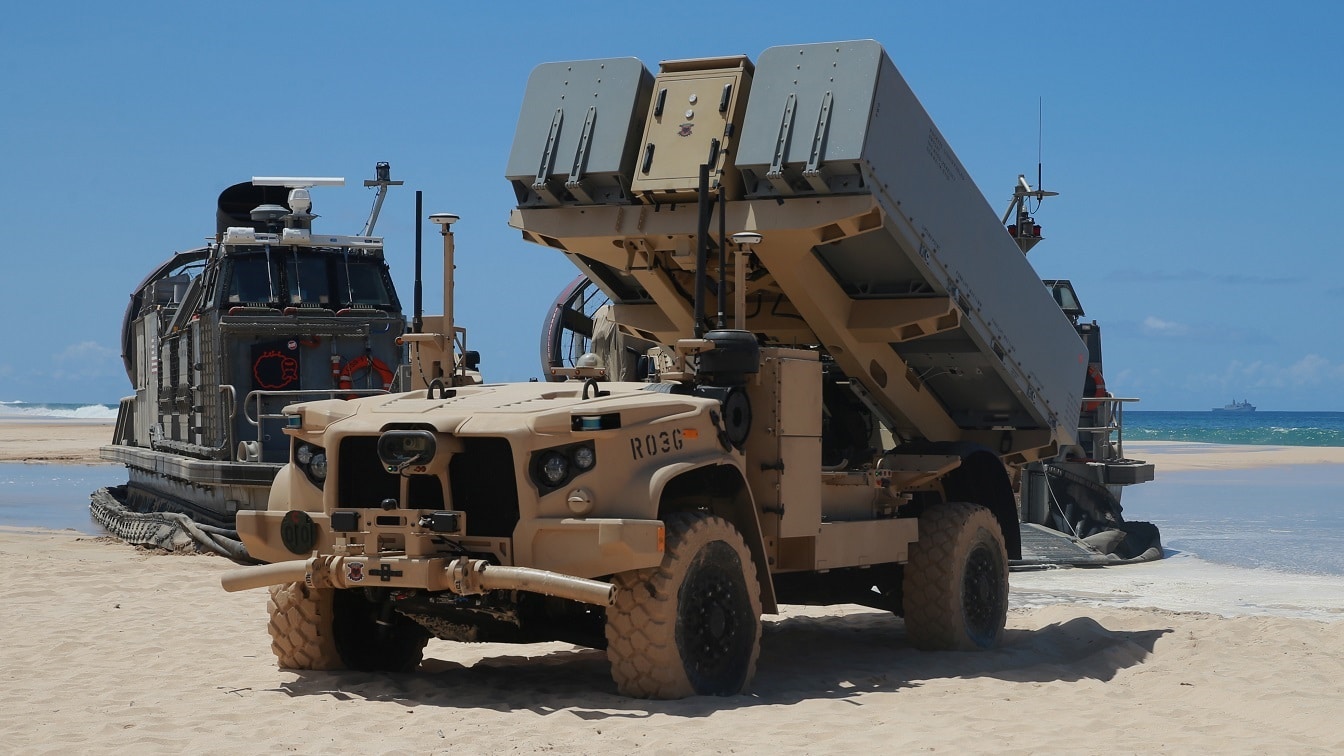
NMESIS is equipped with two Naval Strike Missiles mounted on an unmanned JLTV-type vehicle. According to Naval News, one company will be organized into six sections of three vehicles each, totaling 18 launchers. A simple calculation shows that the immediate ammunition is only 36 rounds, but the important factor is not the quantity of ammunition. When viewing Okinawa, the Sakishima Islands, the Luzon Strait, and the Bashi Channel as a single area, the fact that mobile launchers are "unknown in location" itself will hinder the Chinese Navy's route planning.
The role that the Japan Maritime Self-Defense Force has long held has been continuous monitoring and anti-submarine operations using escort ships, P-1 patrol aircraft, and submarines. With the addition of U.S. Marine Corps ground-based anti-ship firepower, the First Island Chain will become a net projecting firepower from islands to the sea, rather than a place where fleets collide head-on. This is similar to the defense of the Soya, Tsugaru, and Tsushima straits during the Cold War, but this time the stage has shifted significantly south.
The Vulnerability Indicated by MADIS
The concurrently deployed MADIS combines a 30mm cannon, Stinger-type missiles, radar, and electronic warfare equipment for close-in air defense against drones and low-flying aircraft. This equipment acknowledges that NMESIS cannot survive alone. The launchers hide, shoot, and move. However, if the Chinese side overlays small drones, electronic reconnaissance aircraft, and satellite imagery, even mobile systems cannot be completely concealed.
Defense News reports that the 3rd Marine Regiment in Hawaii has already deployed NMESIS and MADIS to the Philippines during Balikatan 25 and 26, conducting training to deny access to the Luzon Strait in the Batanes Islands. The significance of the 12th Regiment in Okinawa having the same equipment lies in the fact that it has entered the stage of regular deployment, rather than just exercise demonstrations.
The Political Void Remaining on the Japanese Side
In my view, the most challenging issue is neither range nor accuracy. When U.S. anti-ship missiles are forward-deployed on Japanese islands, the Japan Self-Defense Forces' Type 12 surface-to-ship guided missiles, future capability upgrades, U.S. Marine Corps NMESIS, and U.S. Army long-range firepower will operate over the same sea surface but under different command structures.
Tactically, this is desirable. From the adversary's perspective, it becomes difficult to read which island has which firepower. However, politically, the responsibilities for launch decisions, target information, civilian evacuation, and resupply overlap. It is hard to say that this discussion has been sufficiently organized within Okinawa Prefecture.
The Next Challenges the JMSDF Should Address
The deployment of NMESIS does not diminish the value of the Japan Maritime Self-Defense Force. Rather, it is the opposite. For ground-launched systems to strike maritime targets, someone must find, identify, and continuously track those targets. If the connections between P-1s, escort ships, submarines, U.S. ISR aircraft, and satellite information are delayed, island-based firepower will become a powerful but static asset.
Therefore, the essence of the new equipment arriving in Okinawa in 2026 is not just the enhancement of U.S. Marine Corps firepower. It is a device that pressures the Japanese side to align surveillance, target allocation, civilian protection, and the resilience of supply ports at the same pace. As the capability to close the First Island Chain increases, the accountability during peacetime also becomes heavier. If firepower is increased while leaving this point ambiguous, deterrence may appear strong, but there remains the risk of political delays at the onset of a crisis.
The real issue is not that NMESIS has arrived in Okinawa. It is whether the Japanese side can explain the entire operation, including that firepower, in its own words.
Major sources: DVIDS, Naval News, Defense News
The 12th Marine Regiment of the U.S. Marine Corps received NMESIS and MADIS systems in June 2026, enhancing coastal defense capabilities in Okinawa. This deployment marks a shift from traditional landing forces to a focus on maritime interdiction. The systems will be used to project firepower from islands into maritime areas, complicating Chinese naval operations. Coordination with Japan's Self-Defense Forces is essential for effective operational integration.
- 12th Marine Regiment received NMESIS and MADIS systems in June 2026.
- NMESIS is a ground-launched anti-ship missile system.
- MADIS provides close air defense against drones and low-flying aircraft.
- Deployment enhances U.S. coastal defense capabilities in the First Island Chain.
- Japan's Self-Defense Forces will coordinate with U.S. forces for operational effectiveness.