
The DRC creates a mining guard of 20,000 men and militarizes the cobalt battle
 Marie Dubois
The DRC creates a mining guard of 20,000 men and militarizes the cobalt battle
In Kinshasa, the announcement seems administrative. A new mining guard, placed under the supervision of the General Inspectorate of Mines, is to protect extraction sites, transport routes, and exit points for Congolese minerals. But between Greater Katanga, North Kivu, Ituri, and the corridors to the border posts, this is not a bureaucratic reform. It is a national security decision.
According to Xinhua and an analysis by The Conversation published on May 18 by AllAfrica, the force could number over 20,000 personnel by 2028, with an initial contingent of 2,500 to 3,000 recruits, six months of training, and an initial deployment expected in December 2026. Al Jazeera had already reported at the end of April that the program, estimated at $100 million, would receive support from the United States and the United Arab Emirates.
Twenty thousand men is not just a reinforced mining police. It is a theater force, spread across twenty-two mining provinces, intended to regain control of a chain that goes from the artisanal pit to the truck, from the depot to the counter, and then from the border to the international contract.
A force to secure the mine and the road
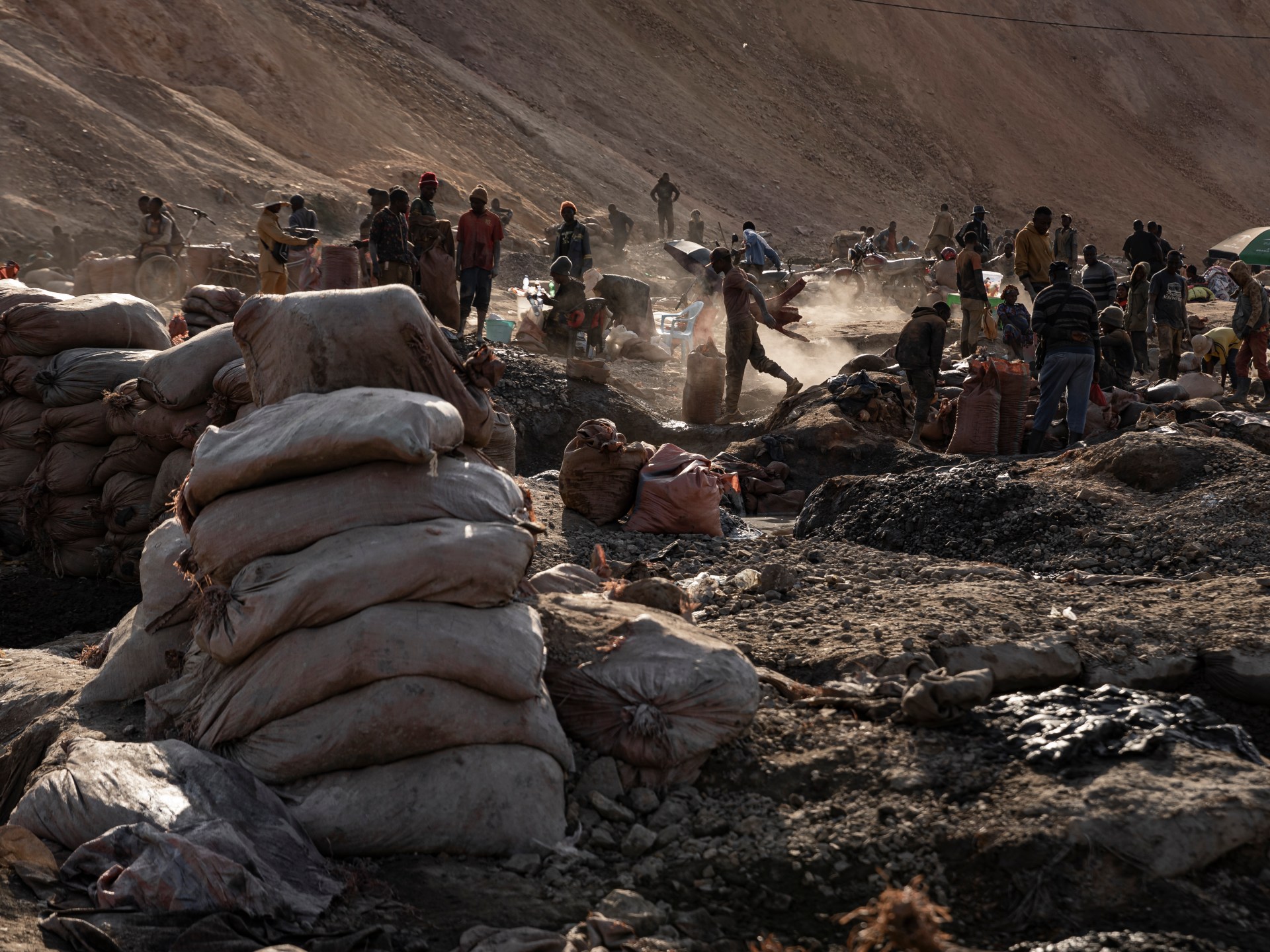
The official formula speaks of transparency, traceability, and combating smuggling. It is accurate but incomplete. A mine is never just a mine in the DRC. It is a focal point for the army, armed groups, traders, local authorities, transporters, community militias, and political networks that thrive on informal taxes.
The operational difficulty begins as soon as one steps outside the fence. Protecting an industrial site in Katanga has nothing to do with securing a secondary road in the east, where a mineral convoy can cross shifting zones of influence. A static unit protects a gate. An effective unit must hold intersections, control cargoes, check documents, escort certain transports, prevent parallel taxation, and above all, avoid becoming a new source of predation itself.
This is where Congolese experience demands caution. The national army, the Republican Guard, and police units have already been deployed around mining sites. The results have been ambiguous. In some areas, the presence of security forces has reduced visible violence. In others, it has shifted the rent in favor of men in uniform.
Cobalt becomes a military objective
The DRC produces about 70% of the world's cobalt and also has significant reserves of copper, coltan, gold, tin, and lithium. These minerals power batteries, electrical grids, electronics, and modern defense chains. Congolese cobalt is therefore no longer just a raw material. It has become a strategic variable for Washington, Beijing, Brussels, Abu Dhabi, and Kinshasa.
Al Jazeera emphasizes that Chinese companies hold a dominant position in the Congolese mining sector, while the United States seeks to reduce this dependency. The American partnership with the DRC and Zambia on electric batteries is only valuable if the minerals can be extracted, traced, and transported without being captured by smuggling or war.
The eastern DRC remains the weak point
The main risk is not just fraud. It is military. In eastern DRC, the M23 and ADF crises overlap with an old war economy. Amnesty International documented in May a campaign of violence by the ADF against civilians in Ituri and North Kivu, with attacks, kidnappings, forced labor, and child recruitment. The report also notes that the focus on M23 has sometimes allowed the ADF to take advantage of the redeployment of forces.
At the same time, the ISS reminds us that the gradual withdrawal of MONUSCO, particularly in South Kivu, leaves entire areas dependent on civil early warning mechanisms, local negotiations, and community networks. The Congolese security map does not resemble a classic staff map. It resembles a mosaic of control pockets, negotiated corridors, and areas where local information circulates faster than official orders.
The danger of a new armed rent
The project's weak point is known in advance: the chain of command. If this mining guard truly depends on a technical authority, receives clear training, has control procedures, and is subject to independent audits, it can improve traceability. If it becomes a hybrid force, half administrative and half military, with local political loyalties, it risks reproducing the problem it claims to solve.
The Congolese government presents this initiative as a way to clean up the sector. The goal is legitimate. But the country's mining history shows that security is never enough if it is not accompanied by transparent contracts, enforceable community rights, sanctions against abuses, and independent traceability. Otherwise, corruption is simply shifted from the office to the checkpoint.
What Washington and Abu Dhabi are really buying
The American and Emirati support should not be read merely as technical assistance. It is an investment in trust. The United States wants to secure part of the access to critical minerals; the Emirates seek to strengthen their role in African flows of gold, copper, and strategic resources. Both need a Congolese state capable of ensuring that the ore entering the official chain does not emerge from a war economy.
But an external partner can finance equipment, not create the discipline of a force. This is built through regular pay, rotations, sanctions, training of leaders, and a clear separation between public mission and private interests. From experience, this is often where African mining security arrangements degrade: not at the moment of announcement, but after six months in the field, when the first local arrangements become habits.
The next friction line
The first phase of the project, if the timeline holds, will begin with recruitment in May, training starting in June, and deployment in December 2026. Armed groups and smuggling networks will therefore have time to adapt. They will seek to infiltrate, buy, circumvent, or intimidate the new force.
The DRC is trying to transform its minerals into a strategic lever. This is understandable. But a guard of 20,000 men does not just secure cobalt; it redraws the relationship between the state, communities, armed groups, and external powers. If Kinshasa fails to control its own controllers, the battle for cobalt will not be demilitarized. It will simply change uniforms.
The Democratic Republic of the Congo is establishing a mining guard of 20,000 personnel to secure cobalt extraction sites and transport routes. The initial deployment of 2,500 to 3,000 recruits is expected by December 2026, with support from the United States and the UAE. This initiative aims to control the mining sector amid ongoing military risks from armed groups in the eastern DRC, where cobalt production is critical for global supply chains.
- The DRC is creating a mining guard of 20,000 personnel to secure cobalt extraction sites.
- The initial contingent will consist of 2,500 to 3,000 recruits, with deployment expected in December 2026.
- The initiative is supported by the United States and the United Arab Emirates.
- The DRC produces about 70% of the world's cobalt, making it strategically important.
- The eastern DRC faces military risks from armed groups like M23 and ADF.