

Summary and Key Points: Republic’s F-105 Thunderchief flew more than 20,000 sorties over Vietnam and more than 75 percent of the bombing sorties against North Vietnam. Of 833 built, 320 were lost in combat, the war’s highest loss rate; it was the only American aircraft pulled from combat for its loss rate. It still shot down 27.5 MiG-17s, earned two pilots the Medal of Honor, and survives in 96 museum airframes in six countries.
The F-105 Thunderchief Explained
In the world of military aviation, two paradoxical truths exist: “Speed is life” and “Speed kills,” and both of these truisms were embodied in the F-105 Thunderchief fighter-bomber embodied both.
The impressive speed of the F-105 undoubtedly saved many of its pilots’ lives, but alas, the plane’s shortcomings all too often got its pilots killed, whether at the hands of the enemy or via self-destruction.
The latter earned it the unfortunate nickname “Thud.”
F-105 Initial History, Premise, and Tech Specs
The now-defunct Republic Aviation built the Thunderchief, as well as famous fighters such as the P-47 Thunderbolt of World War II and the F-84 Thunderjet of the early Cold War era; notice a consistent pattern in the naming conventions there, eh? The F-105 made its maiden flight on 22 October 1955, and made its official operational debut with the U.S. Air Force on 27 May 1958.
The warbird was initially designed for nuclear strike, more specifically for high-speed low-altitude penetration carrying a single thermonuclear device, the flip side to the subsonic B-52 “BUFF” strategic bomber’s high-altitude approach to a would-be nuclear war against the Soviet Empire. Thankfully, World War III and its resultant nuclear Armageddon never happened, so the F-105 soon found itself reassigned to conventional air-to-ground attack duties.
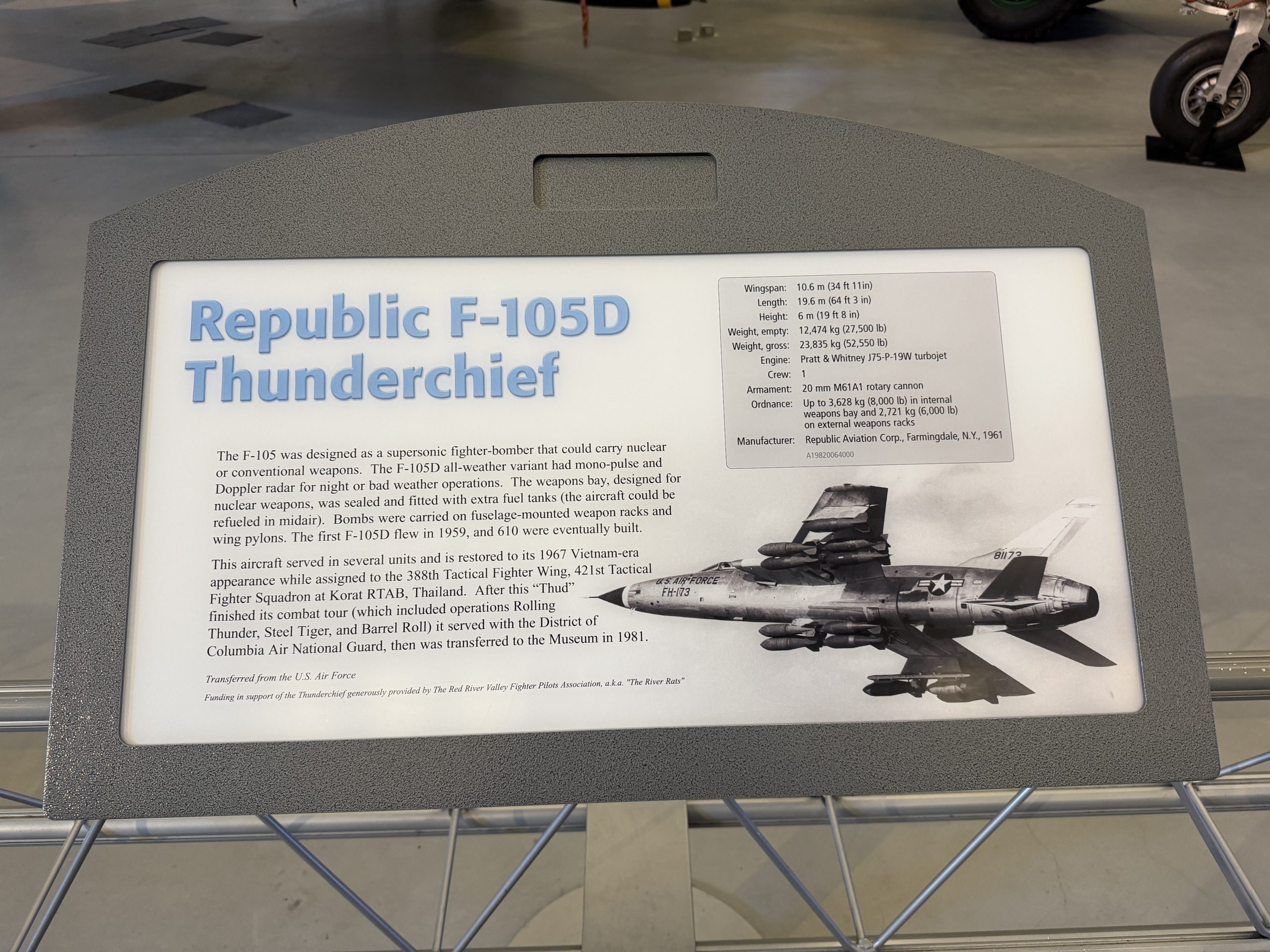
F-105 Thunderchief at the Smithsonian. Photos taken by Christian D. Orr for 19FortyFive.
And when it came to conventional bomb loads, this single-engine fighter-bomber toted a bigger payload than so-called “heavy bombers” of World War II, such as the B-17 Flying Fortress and B-24 Liberator: up to 14,000 lb. of rockets and/or general-purpose bombs and/or missiles; the latter could be air-to-air, air-to-surface, and anti-radiation. As for the “fighter” portion of that “fighter-bomber” designation, the Thud also wielded a 20mm M61A1 Vulcan cannon.
Despite that heavy bomb load, the F-105 could reach a max airspeed of Mach 2.1. Indeed, in December 1959, an F-105B set a world speed record of 1,216 mph over a 62-mile circuit that required the pilot to maintain a precise course while pulling a steady 3.5 G’s for three minutes.
That speed record has long since been broken multiple times over, but given the historical timeframe—two years before Alan B. Shepard, Jr. became the first man in space—it was still pretty goshdarn remarkable.
For the basis of comparison, the SR-71 Blackbird set an official speed record of Mach 3.32 and an *unofficial* record of Mach 3.56. At the same time, the MiG-25 “Foxbat” could theoretically reach Mach 3.2 but was realistically limited to Mach 2.83.
Operational History/Combat Performance
The “Thud” soon became one of the mainstay warplanes of the Vietnam War, with 20,000+ sorties flown during that Southeast Asian conflict.
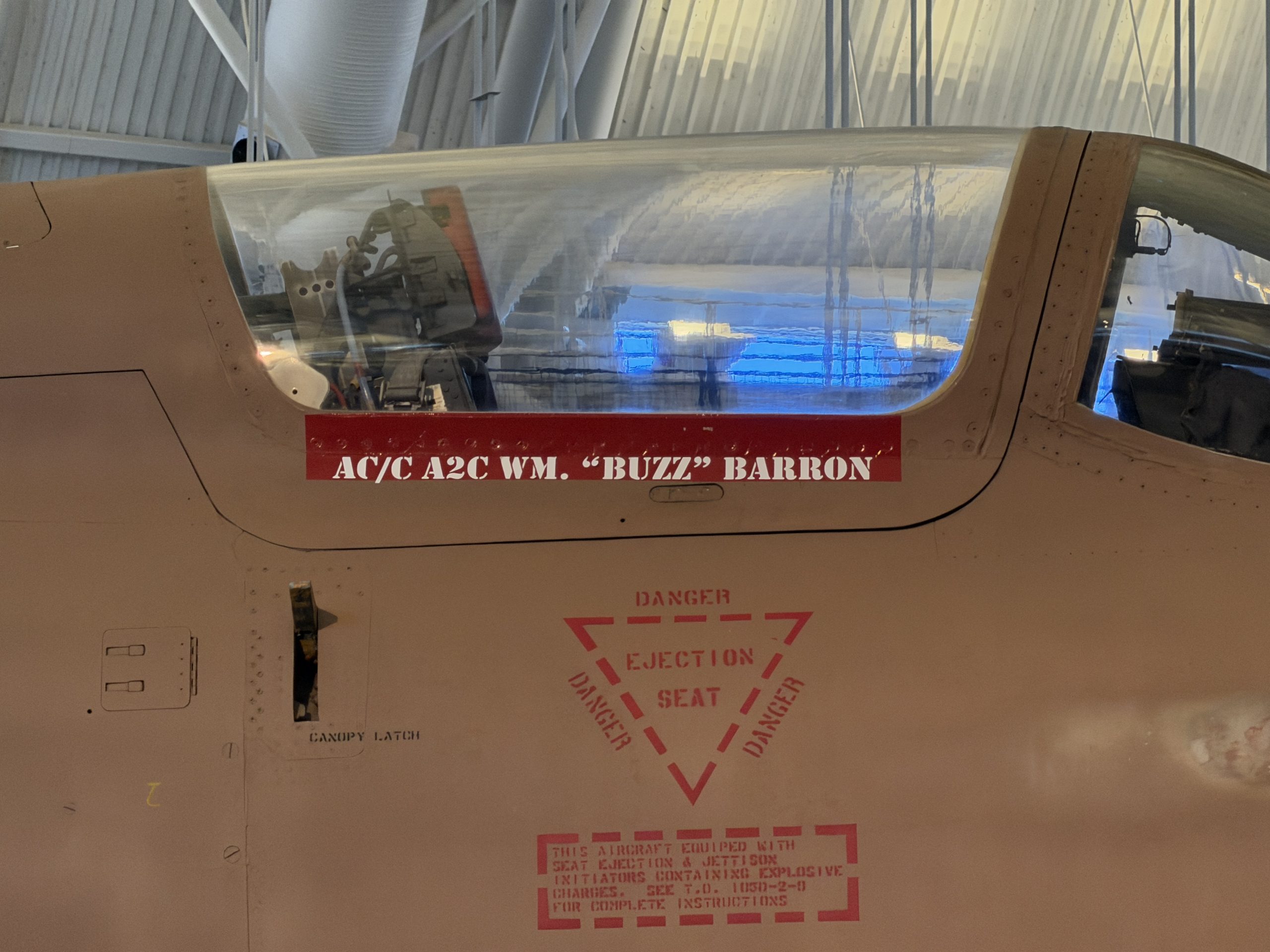
F-105 Thunderchief at the Smithsonian. Photos taken by Christian D. Orr for 19FortyFive.
Indeed, the all-weather F-105D variant was initially the only USAF jet capable of penetrating North Vietnam’s Soviet-supplied air defenses.
Thunderchiefs flew more than 75 percent of all the bombing sorties against North Vietnam, including the hair-raising “Wild Weasel” missions that performed Suppression of Enemy Air Defenses (SEAD) duties. Two of these Wild Weasel Thud fighter jocks, then-Capt. Merlyn H. Dethlefsen and then-Maj. Leo K. Thorsness earned the Medal of Honor.
However, as noted earlier, the nickname of “Thud” had a ring of gallows humor, inspired by the plane’s distressing penchant for blowing up in midair.
Moreover, the Thunderchief was also quite vulnerable to enemy fire.
320 airframes out of 833 total produced were lost in combat over Vietnam, making for the highest loss rate of any U.S. aircraft during the war, which resulted in the F-105 becoming the only American aircraft to be removed from combat operations due to high loss rates; over the course of the Thud’s career, 612 were destroyed by various causes, an unsustainable 75 percent of the entire production run.
However, the long-suffering warbird still performed Wild Weasel duties until the plane was retired in 1984.
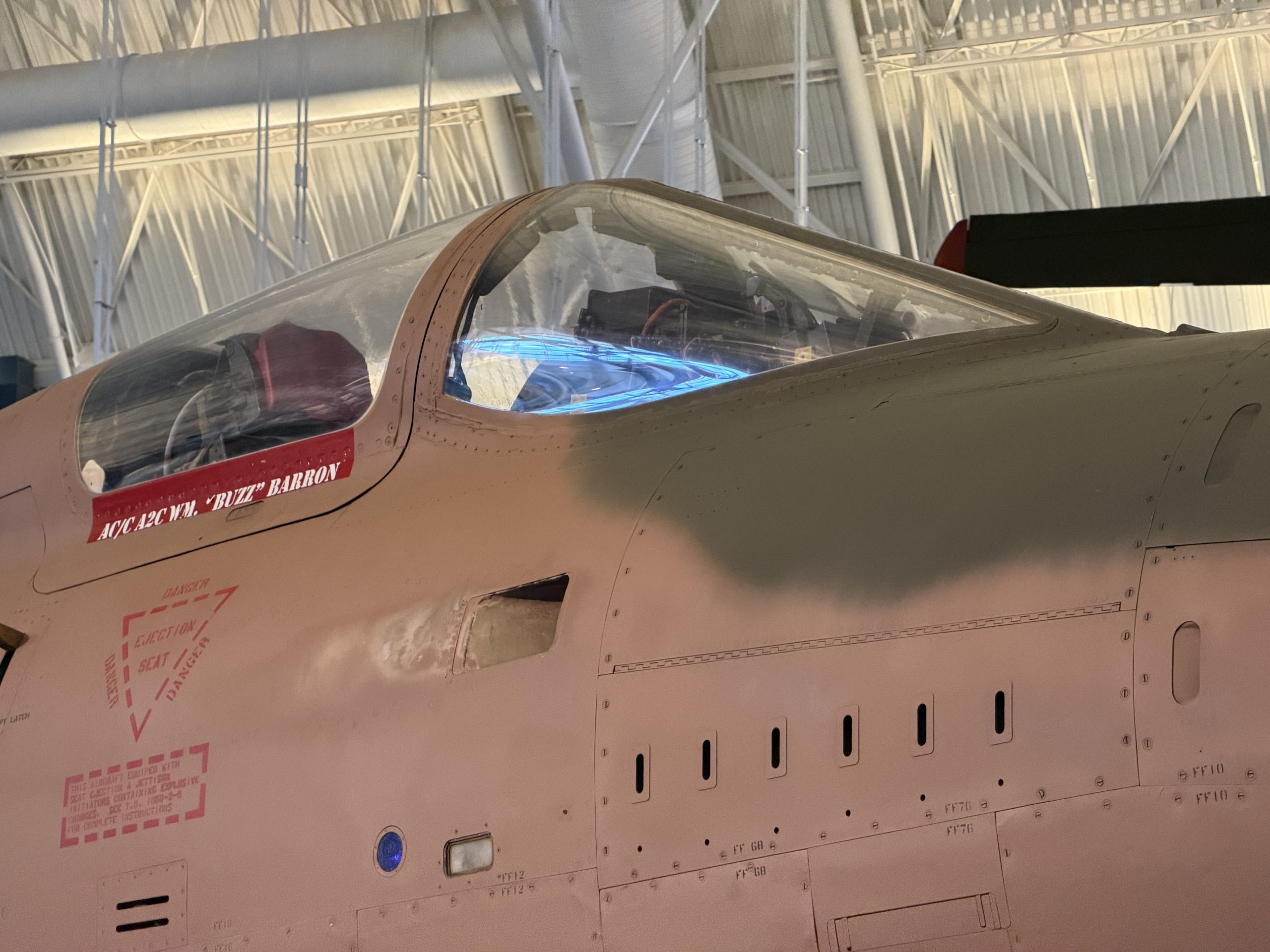
F-105 Thunderchief at the Smithsonian. Photos taken by Christian D. Orr for 19FortyFive.
A morbid moniker of “Thud Ridge,” was later bestowed on a mountainous landmark northwest of Hanoi.
Though the Thunderchief was incredibly fast, it lacked maneuverability and agility, thus leaving the fighter-bomber vulnerable to shootdown by North Vietnam’s nimbler MiG-21 “Fishbed” and MiG-17 “Fresco” fighters, which downed 15 and seven F-105s, respectively.
However, the air-to-air combat picture for the Thud wasn’t entirely one-sided.
Though the Thunderchief drivers didn’t down any of the Fishbeds, they did tally 27.5 air-to-air kills against the Fresco—two with AIM-9 Sidewinder missiles and the rest with the gun —thus making for an overall positive kill ratio of 1.25:1.
The aforementioned Maj. Thorsness nabbed one confirmed MiG-17 kill and one probable on his Medal-winning mission.
One of the war’s most famous air-to-air combat photos came from gun camera footage of Thud driver Major Ralph Kuster Jr. of the 469th Tactical Fighter Squadron blowing away a MiG-17.
Where Are They Now?
No airworthy Thunderchiefs remain.
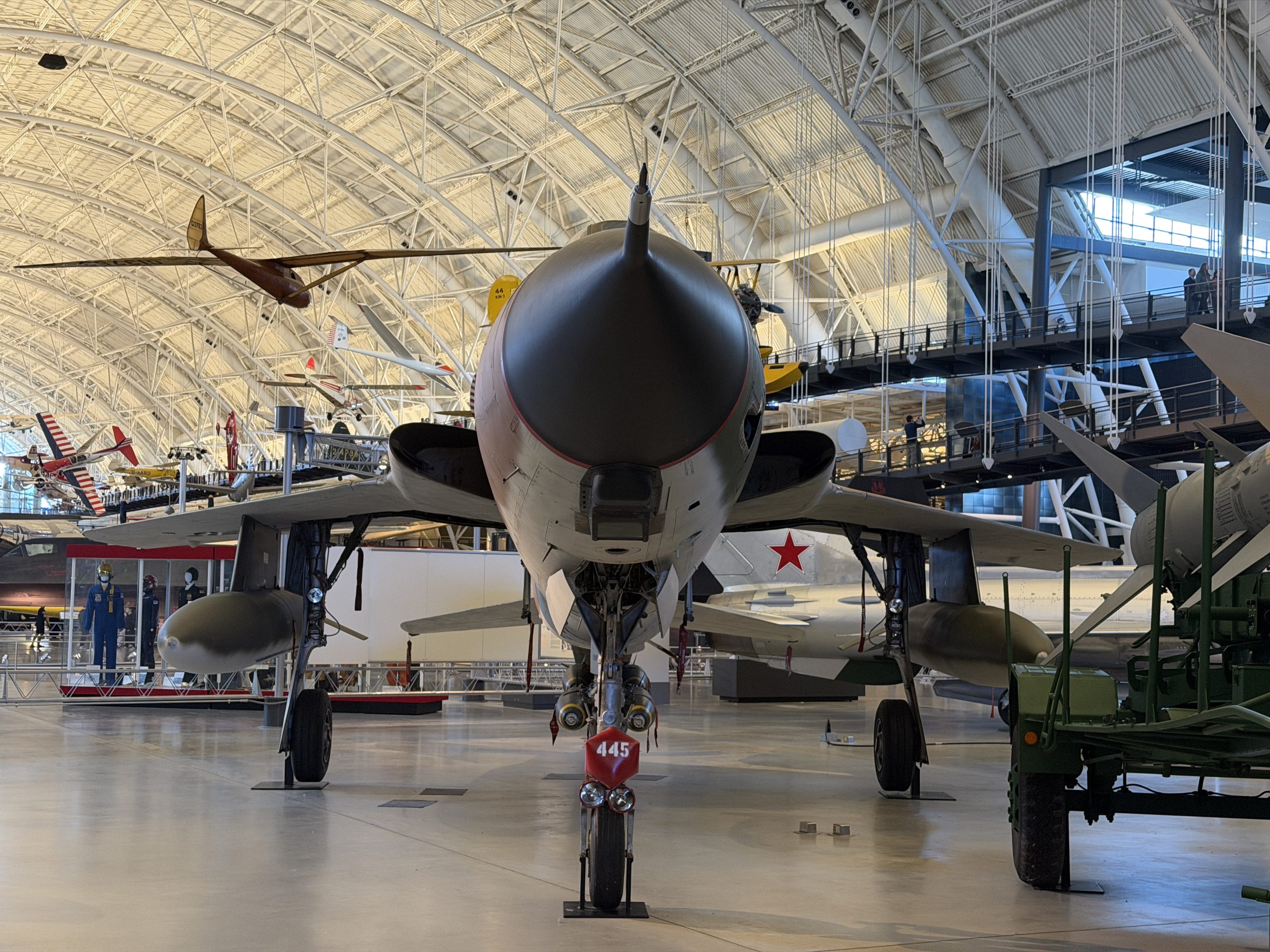
F-105 Thunderchief at the Smithsonian. Photos taken by Christian D. Orr for 19FortyFive.
However, 96 F-105 airframes are preserved for posterity as static displays at multiple museums and airbases spread out across six different countries, including the Smithsonian National Air & Space Museum’s Steven F. Udvar-Hazy Center in Chantilly, Virginia—which this author recently had the honor and pleasure of visiting and photographing in person; some of those pics are published herein—and the National Museum of the United States Air Force at Wright-Patterson AFB in Dayton, Ohio.
Some of the men who flew her have also kept the Thud’s memory alive.
The best example is “Rollin’ In My F-105,” composed and sung by Irv Levine (Maj., USAF, Ret.), a Thud driver during the Vietnam War who later became a professional singer on the Erosonic record label. Methinks it fitting to conclude this article with the refrain from Irv’s song:
“I was rollin’ in my F-105, back rollin’ in my F-105/Out across the Bac-9, I was sure feelin’ fine/I was rollin’ in my F-105…Yeah I was rollin’ in my F-105, back rollin’ in my F-105/Though it’s been quite a while it really made me smile/’Cause I was rollin’ in my F-105.”
About the Author: Christian D. Orr
Christian D. Orr is a Senior Defense Editor. He is a former Air Force Security Forces officer, Federal law enforcement officer, and private military contractor (with assignments worked in Iraq, the United Arab Emirates, Kosovo, Japan, Germany, and the Pentagon). Chris holds a B.A. in International Relations from the University of Southern California (USC) and an M.A. in Intelligence Studies (with a concentration in Terrorism Studies) from American Military University (AMU). He is also the author of “Five Decades of a Fabulous Firearm: Celebrating the 50th Anniversary of the Beretta 92 Pistol Series,” the second edition of which was recently published.