
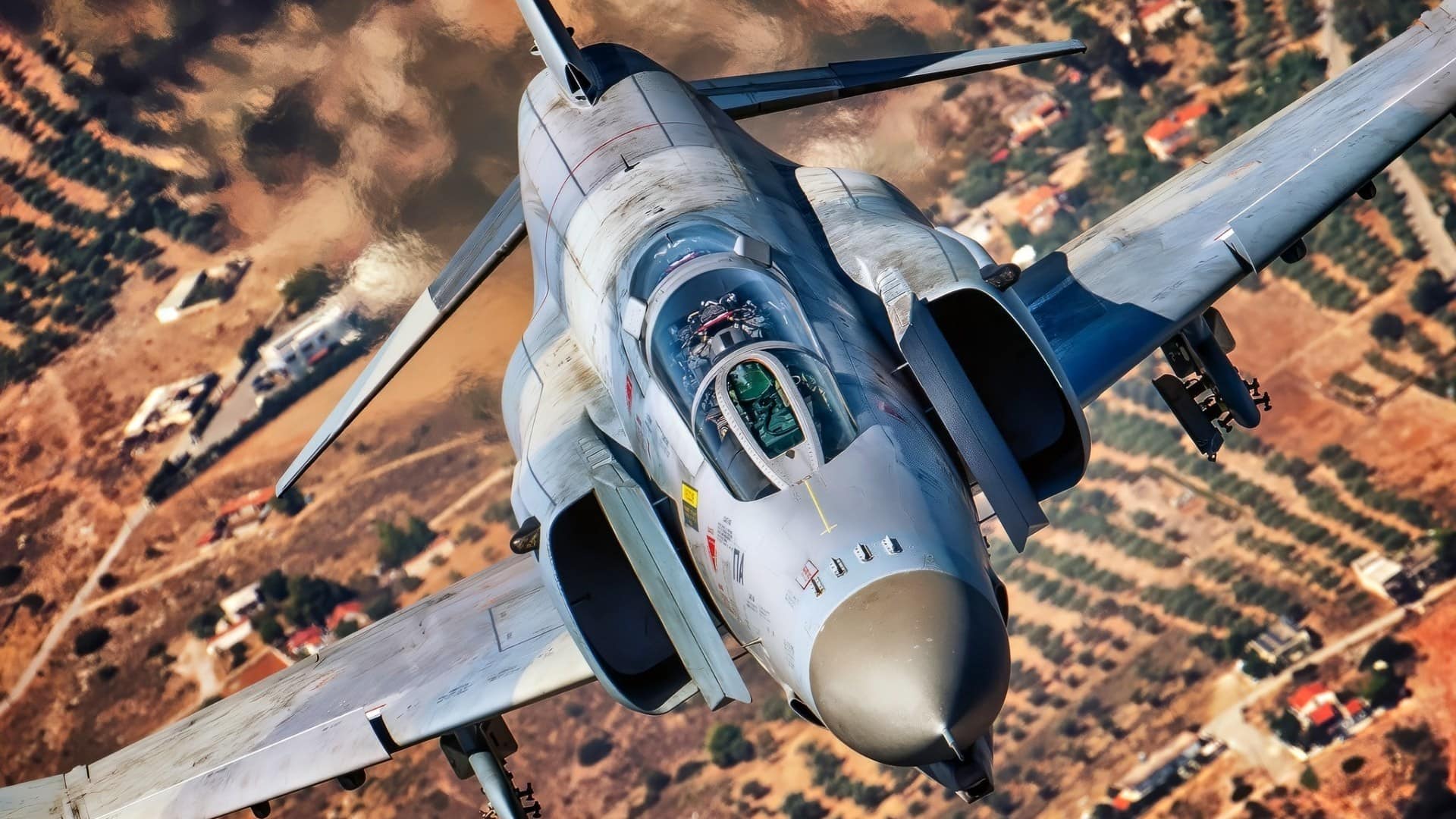
 F-4 Phantom Fighter Flying High
When Israeli aircraft hit Tabriz airport on March 1, 2026, Iran lost an American-designed F-4 Phantom that was preparing to take off.
We know because there’s footage of the attack, which was shared by the Israeli military.
The same footage showed an Iranian F-5 being destroyed, too.
The aircraft were old, having been obtained before the current regime took power, when Tehran was a close ally of Washington and Iran was buying American military aircraft in huge numbers.
The destroyed F-4 was one of dozens believed to be left over from that period.
FlightGlobal’s World Air Forces directory listed 65 Iranian F-4D, F-4E, and RF-4E aircraft before the conflict began, though those figures are only the world’s best estimate of what was there.
On paper, it meant that Iran had a substantially larger fleet of these aircraft than it did F-14 Tomcats – but nobody can really be sure how many there were.
And, even if those 65 were technically operational – and they’re not – they’re also old.
Iran’s Phantoms were more than half a century old, and spare parts have been difficult or impossible to obtain for decades.
Aircraft in that inventory aren’t necessarily capable of flying combat missions, and even those that might be could still be on the verge of being decommissioned because they lack of access to parts.
And with Iranian air bases subjected to repeated U.S. and Israeli attacks over the last year, it’s hard to say exactly how many Phantoms remain operational today — if there are indeed any left.
The Shah Bought Hundreds of Phantoms
Like Iran’s F-14s, the Phantoms are a remnant of a military designed to support Washington — not fight it.
Iran ordered 16 F-4Ds in 1967 and purchased another 16 afterward.
The first of the aircraft arrived in September 1968, giving the Imperial Iranian Air Force one of the most capable fighters available at the time.
Throughout the 1970s, that purchase expanded dramatically, with 32 F-4Ds arriving in the country, and later 177 improved F-4Es and 16 RF-4E reconnaissance aircraft.
Those hugely valuable, high-spec aircraft arrived right before the Islamic Revolution, and the remaining 31 F-4Es and 16 RF-4Es that had been ordered were never delivered after the collapse of the Shah’s government.
By 1979, Iran had received 225 Phantoms in total.
The F-4
The F-4 was designed as a two-seat, twin-engine supersonic fighter.
It was one of the defining American combat aircraft of the Vietnam era and, while it is no longer in U.S. service, it is still seen as one of America’s best.
The F-4E could carry air-to-air missiles and thousands of pounds of weapons in external stores. It also featured an internal 20mm cannon.
It was a big aircraft, and it was fast.
Its two General Electric J79 turbojet engines produced more than 17,000 pounds of thrust, each with afterburner.
This meant the F-4 could reach around Mach 2.2 at altitude and a maximum speed of more than 1,400 mph.
It had a service ceiling of roughly 60,000 feet and could carry more than 18,000 pounds of weapons on nine external stations.
Its weapons capacity made it useful for substantially more than air-to-air combat, too.
It could carry everything from conventional bombs to rockets and air-to-ground weapons, allowing the same basic aircraft to perform both strike and interception missions.
The F-4E also incorporated the AN/APQ-120 radar and, unlike earlier Phantom variants, had the M61A1 Vulcan 20mm cannon built into its nose.
The specialized RF-4E version Iran obtained included reconnaissance equipment and cameras that were advanced at the time but have since become outdated and less useful.
How Many Are Left?
It’s impossible to say how many remain without access to Iran’s own numbers.
GlobalMilitary still puts the inventory number at 63, but that figure is hard to trust given the sheer scale of the strikes that have been launched against Iranian military sites, including its air bases.
Israel destroyed at least one F-4 at Tabriz on March 1, and Iranian air bases suffered further attacks after that.
Ten of Iran’s 18 tactical air bases had been struck by March 8 alone.
That means those estimates could be way off.
Evidence suggests that at least some of Iran’s Phantoms remained operational shortly before the current conflict began, with three Iranian F-4Es flying in public at the Kish Air Show in late 2024.
But after more than five decades of use, sanctions making repairs and maintenance difficult, and cannibalization further degrading Iran’s fleet, it’s hard to imagine very many being left at all — let alone in flyable condition.
For now, only Iran knows the true number of F-4s remaining — and even then, the regime may not fully understand how many are ready to fly.
About the Author: Jack Buckby
Jack Buckby is a British researcher and analyst specializing in defense and national security, based in New York. His work focuses on military capability, procurement, and strategic competition, producing and editing analysis for policy and defense audiences. He brings extensive editorial experience, with a career output spanning over 1,000 articles at 19FortyFive and National Security Journal, and has previously authored books and papers on extremism and deradicalization.