F-14D

🇺🇸United States
Grumman
1991 – 2006
Spotlight

The last Tomcat: APG-71 digital radar, F110 engines and a second life as a Bombcat

F-14D Last NAVY Power DEMO at Oceana 2006 (Burner IRST Air show videos)

Watch on YouTube
Overview
F-14D
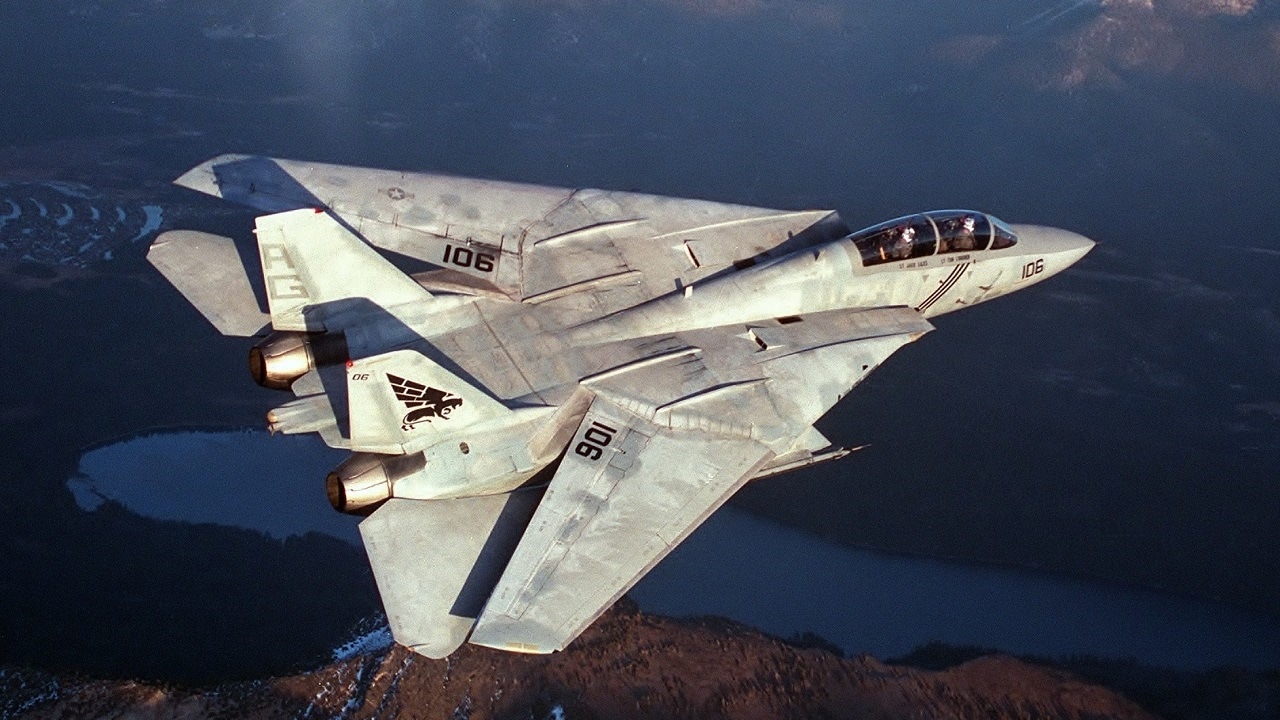
The F-14D is a variant of the F-14 Tomcat, featuring advanced avionics, electronic countermeasures, and improved engines. It is equipped with a variety of air-to-air and air-to-ground weapons, including the M61 Vulcan cannon, AIM-54 Phoenix, AIM-7 Sparrow, AIM-9 Sidewinder, and JDAM precision-guided munitions. The aircraft has a maximum speed of Mach 2.34 and a service ceiling of 53,000 feet. It is operated by a crew of two, consisting of a pilot and a radar intercept officer.
Specifications

General

Crew2
RadarAN/APG-71
Engines2 × F110-GE-400
StealthNone
Thrust Kn240 kN
Air To AirAIM-54, AIM-7, AIM-9
Hardpoints10
Internal GunM61A1 20mm
Air To GroundJDAM, GBU-10/12/16, Mk-80
Ferry Range Km3,000 km
Max Payload Kg6,600 kg
Max Speed Mach2.34 Mach
Combat Radius Km900 km
Service Ceiling M17,000 m

Other

Length M19.13
Ir SensorAN/AAS-42 IRST + AN/AXX-1 TCS (dual chin pod)
Wingspan M19.55 unswept / 11.65 swept
Units Built37 new-build + 18 F-14A conversions (F-14D(R))
Targeting PodAN/AAQ-14 LANTIRN targeting system (LTS)
Empty Weight Kg19,840
Internal Fuel Kg7,348
Max Takeoff Weight Kg33,725
Latest Developments
Oct 17, 2026weak signal
The US Navy Mach 2.34 Grumman F-14E Super Tomcat 21 Fighter Summed Up in 1 Word

the mission the F-14D mastered no longer existed, or was expected to return

Oct 11, 2026strong signal
Iran Flew US Military Grumman F-14 Tomcat Fighters to War and Fired a Mach 4 Missile ‘Made in the USA’ To Destroy 78 Aircraft

Iranian F-14 Tomcats were credited with 78 Phoenix victories in the Iran-Iraq War.

Oct 4, 2026strong signal
The US Military Destroyed $600,000,000 in SR-71 Blackbird Parts After Retirement, the Jet Needs 300 Hours of Maintenance per Flight Hour, and NASA Still Wants to Fly One

the bill would transfer three F-14Ds to the U.S. Space and Rocket Center (USSRC) in Huntsville, Alabama

Oct 1, 2026strong signal
Forget the SR-71 Blackbird: The US Navy’s F-14D Tomcat Fighter Might Make a Comeback and Fly Again

For the past two decades, the Navy’s retired F-14Ds have sat in the Boneyard at Davis-Monthan Air Force Base in Arizona.

Sep 29, 2026strong signal
The US Navy Just Might Have Second Thoughts on the F/A-XX Aircraft Carrier Fighter

Entity 'F-14 Tomcat' mentioned in report

Featured Coverage
Research Notes

Fleet Defense Fighter Evolution

medium

The F-14 Tomcat was developed for the U.S. Navy’s fleet-defense requirement after the F-111B program failed to meet carrier needs. The F-14D represents the most advanced Tomcat variant, updating the aircraft’s sensors and systems while preserving the variable-sweep wing and two-seat fighter concept. Its design was shaped by carrier operations and long-range interception.

Variable-Sweep Naval Fighter

medium

The Tomcat’s variable-sweep wing allowed it to adapt between low-speed carrier handling and high-speed interception. In service, the aircraft combined long-range radar, two-crew workload sharing, and heavy air-to-air weapons for fleet defense, later adding strike capability in some roles. The F-14D page should explain why the aircraft was a system of fighter, radar, weapons, and crew coordination.

Legacy in Naval Aviation

medium

The F-14D remains important because it symbolizes a specific era of U.S. carrier aviation: defending the fleet at long range against bombers and cruise-missile threats. Its retirement and replacement by Super Hornets marked a shift toward multirole deck efficiency. For readers, the Tomcat is most valuable when placed in this doctrinal transition rather than treated as a pop-culture icon only.

Key parameters at a glance

high

Figures describe the F-14D specifically; where they differ from earlier Tomcat variants the difference is noted.

Role
Carrier-based fleet air defence interceptor with added precision-strike role
Crew
2 (pilot and radar intercept officer)
Powerplant
2 × General Electric F110-GE-400; 26,950lbf (119.9 kN) each with afterburner
Radar
AN/APG-71 digital multimode pulse-Doppler (AWG-9 replacement, APG-70 modules)
Passive sensors
AN/AAS-42 IRST and AN/AXX-1 TCS in a dual chin pod; AN/ALR-67 RWR
Cockpit
Digital glass cockpit, dual mission computers, Link 16 compatibility, NACES ejection seats
Air-to-air load
Up to 6 × AIM-54C Phoenix, or AIM-7M Sparrow / AIM-9M Sidewinder mixes
Strike fit (Bombcat)
LANTIRN pod with Paveway GBU-10/12/16 and GBU-31/38 JDAM
Length / wingspan
19.13 m / 19.55 m unswept (11.65 m swept)
Max takeoff weight
33,725kg

Program milestones

high

Publicly documented milestones specific to the F-14D line.

1987-11F-14D prototype first flight

A converted F-14A (BuNo 161865) flew as the F-14D aerodynamic and systems prototype, combining F110-GE-400 engines with the new digital avionics suite.

1990-02First production F-14D flies

The first newly built F-14D flew on 9 February 1990, the first Tomcat delivered with the AN/APG-71 radar and glass cockpit from the factory.

1990-11First fleet delivery

VF-124, the West Coast fleet readiness squadron at NAS Miramar, received the first F-14D in November 1990 and began aircrew conversion training.

1992Production capped; first deployable squadron

Defense budget cuts ended the line at 37 new-build aircraft plus 18 F-14A rebuilds designated F-14D(R). VF-11 became the first deployable F-14D squadron, followed by VF-31.

1996LANTIRN turns the Tomcat into a Bombcat

Integration of the AN/AAQ-14 LANTIRN targeting pod gave the fleet a self-designating laser strike capability; the F-14D's digital architecture made it the most capable host for the fit.

2003-03First combat JDAM release from an F-14

During Operation Iraqi Freedom the type dropped its first GPS-guided JDAM in combat, completing the shift from pure interceptor to strike-fighter.

2005-10Final combat deployment

VF-31 and VF-213 deployed aboard USS Theodore Roosevelt, flying 1,163 combat sorties over Iraq and dropping roughly 61,000 lb of ordnance. ROVER video downlink was added to the F-14D in December 2005 for close air support.

2006-09Retirement from U.S. Navy service

The last carrier catapult launch took place on 28 July 2006 from USS Theodore Roosevelt; a farewell ceremony was held at NAS Oceana on 22 September 2006, and the final ferry flight followed on 4 October 2006.

Strategic significance

high

The F-14D was the point at which the Tomcat's airframe finally matched its mission. Replacing the troublesome TF30 with the F110-GE-400 removed the throttle-handling restrictions that had constrained F-14A crews in the high-alpha regime, while the AN/APG-71 swapped the AWG-9's analogue processing for digital signal processing borrowed from the F-15E's APG-70. The practical gain was less in raw detection range than in clutter rejection, jamming resistance, mode flexibility and non-cooperative target recognition — the qualities that matter when an interceptor has to sort a raid rather than simply see it.

The variant nevertheless arrived at the worst possible moment. Its capability was sized against a Soviet regimental anti-ship missile threat that disappeared as the type entered squadron service, and Pentagon budget decisions capped the line at 37 new-build aircraft and 18 rebuilds rather than the several hundred once envisaged. The Navy chose to consolidate on the cheaper, more maintainable F/A-18 family, and Grumman's proposed further developments such as Super Tomcat 21 were never funded. Fewer than sixty airframes could not sustain a separate logistics and training pipeline against that argument.

What the F-14D did prove, in its final decade, was the value of a large, two-seat, sensor-rich carrier aircraft in the strike and forward air control roles. With LANTIRN, JDAM and finally the ROVER downlink, the D-model flew as a precision strike and airborne FAC platform over Iraq until 2006 — a mission profile its designers never intended and one the Navy has arguably been rebuilding toward ever since with two-seat and long-range unmanned tanking and sensing programmes.

Videos

Final U.S. Navy F-14 Tomcat Landing - October 4, 2006 (ZINGER AVIATION MEDIA)

Watch on YouTube

The Insane Engineering of the F-14 Tomcat (Real Engineering)

Watch on YouTube

The last catapult launch of the final F-14 Tomcat (Bilibili)

Watch on Bilibili
Sources & References
Related Discussions

No discussions about F-14D yet

Start the first discussion