F-14 Tomcat

🇺🇸United States
Grumman
1974 – 2006
Spotlight

Swing-wing fleet defender: the AIM-54 Phoenix carrier interceptor, 1974-2006

F-14 Tomcat & AIM-54 Phoenix - The Ultimate Fleet Defence (Mach Two Aviation)

Watch on YouTube
Overview
F-14 Tomcat
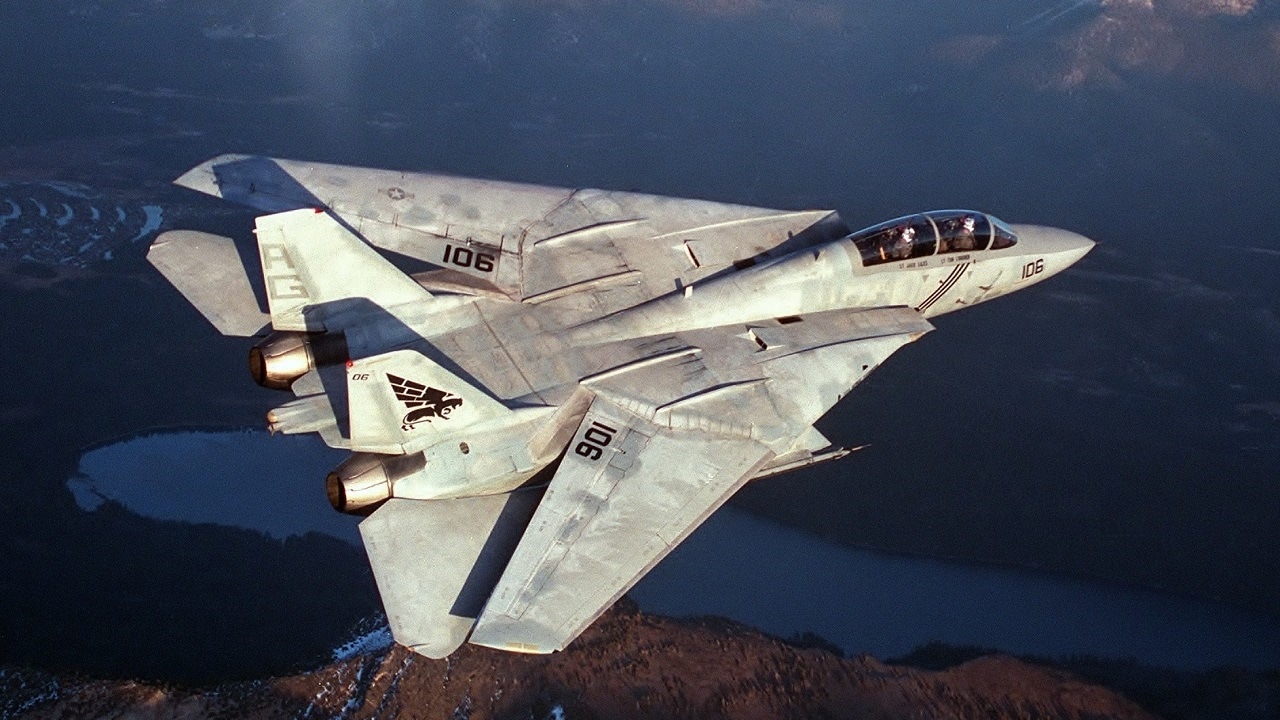
The F-14 Tomcat is an American carrier-capable supersonic, twin-engine, tandem two-seat, twin-tail, all-weather-capable variable-sweep wing fighter aircraft developed for the United States Navy.
Specifications

General

Crew2
RadarAN/AWG-9 pulse-Doppler (F-14A/B); AN/APG-71 (F-14D)
Engines2
StealthNo
Generation4th
Internal Gun20 mm M61 Vulcan rotary cannon
Combat Radius Km~926 km (500 nmi, fleet air defence profile)

Other

Length19.1 m
Wingspan19.55 m unswept / 11.58 m fully swept (20°-68° variable geometry)
Max SpeedMach 2.34 (~2,485 km/h at altitude)
PowerplantF-14A: 2 x Pratt & Whitney TF30-P-414A; F-14B/D: 2 x General Electric F110-GE-400
Max Takeoff Weight~33,720 kg
Primary Air To Air MissileAIM-54 Phoenix (up to 6), with AIM-7 Sparrow and AIM-9 Sidewinder
Latest Developments
Oct 17, 2026weak signal
The US Navy Mach 2.34 Grumman F-14E Super Tomcat 21 Fighter Summed Up in 1 Word

the Tomcat was already heavy on takeoff, so it had landing-weight restrictions to keep the landing gear from collapsing

Oct 11, 2026strong signal
Iran Flew US Military Grumman F-14 Tomcat Fighters to War and Fired a Mach 4 Missile ‘Made in the USA’ To Destroy 78 Aircraft

Iranian F-14 Tomcats were credited with 78 Phoenix victories in the Iran-Iraq War.

Oct 1, 2026strong signal
Forget the SR-71 Blackbird: The US Navy’s F-14D Tomcat Fighter Might Make a Comeback and Fly Again

In September 2006, the U.S. retired the F-14 Tomcat.

Sep 29, 2026strong signal
The US Navy Just Might Have Second Thoughts on the F/A-XX Aircraft Carrier Fighter

Entity 'F-14 Tomcat' mentioned in report

Featured Coverage
Research Notes

Carrier interceptor built around fleet air defense

medium-high

The F-14 was designed to defend carrier groups against long-range bomber and missile threats.

The F-14 Tomcat was created for a specific naval problem: defending U.S. carrier battle groups at long range. Its two-seat cockpit, variable-sweep wings, powerful radar and Phoenix missile integration gave the Navy an interceptor optimized for detecting and engaging threats before they reached the fleet. That role explains the aircraft better than pop-culture fame alone.

Long-range radar and missile engagement

medium-high

The Tomcat’s key Cold War advantage was pairing AWG-9 radar with AIM-54 Phoenix missiles for outer-air-battle defense.

F-14 capability centered on long-range detection and engagement. The aircraft could patrol far from the carrier and act as a missile-armed shield against Soviet bombers and anti-ship missile carriers. Later strike upgrades expanded its usefulness, but the aircraft’s original identity remained tied to the outer air battle around the carrier force.

Retired by the U.S., still historically influential

medium-high

The Tomcat shaped carrier aviation doctrine even though maintenance burden and changing missions led to its replacement.

The F-14 left U.S. Navy service because it was expensive to maintain and the Navy moved toward the more versatile Super Hornet. Yet its historical influence remains large: it defined a generation of carrier air defense, and Iranian operation keeps the type visible in strategic discussions. A rich page should capture both the technical achievement and the sustainment burden.

Key parameters at a glance

high

Programme-level figures for the F-14 family, drawn from published US Navy and Grumman data. The F-14D Super Tomcat is covered on its own page.

Role
Carrier-based fleet air defence interceptor, later multirole fighter
Origin
Grumman VFX programme, launched after the F-111B failed carrier suitability
First flight
21 December 1970
US Navy service
1974-2006 (32 years of fleet service)
Airframes built
712aircraft (632 US Navy, 80 Iran)
Wing geometry
Variable sweep, 20°-68°, scheduled automatically by the air data computer
Sensor-weapon pairing
AN/AWG-9 tracked up to 24 targets and engaged 6 simultaneously with AIM-54
AIM-54 Phoenix reach
over 100nmi (~185 km, reported)
Strike role
LANTIRN targeting pod from 1996 gave the 'Bombcat' laser-guided strike capability
Remaining operator
Iran, the only export customer; IRIAF airframes reported struck in 2025-2026

Program milestones

high

Documented milestones across the Tomcat's development, service and export history.

1968VFX requirement issued

After the swing-wing F-111B proved too heavy for carrier operations, the US Navy issued the VFX requirement for a dedicated fleet air defence fighter; Grumman was selected in January 1969.

1970-12First flight

The first F-14A prototype flew on 21 December 1970 at Calverton, New York. It was lost on its second flight nine days later after a hydraulic failure; both crew ejected safely.

1974-09First operational deployment

VF-1 'Wolfpack' and VF-2 'Bounty Hunters' took the Tomcat on its first combat cruise aboard USS Enterprise, covering the final evacuation flights from Southeast Asia in 1975.

1976Iranian deliveries begin

Imperial Iran ordered 80 F-14As with AIM-54s; 79 were delivered from January 1976 before the 1979 revolution ended support, making Iran the type's only export operator.

1981-08Gulf of Sidra engagement

Two VF-41 F-14As shot down a pair of Libyan Su-22s over the Gulf of Sidra, the type's first US air-to-air kills; a second Libyan engagement followed in January 1989.

1996'Bombcat' precision strike

LANTIRN targeting pod integration turned the interceptor into a long-range precision strike platform, extending the airframe's usefulness as the AIM-54 mission receded.

2006-09US Navy retirement

The final US Navy Tomcat flight ceremony was held at NAS Oceana on 22 September 2006; the last airframe ferry flight followed on 4 October. The F/A-18E/F Super Hornet assumed the mission.

2026-03Iranian fleet reported struck

The Israeli Air Force stated it had struck the 8th Tactical Fighter Base at Isfahan, believed to host all remaining IRIAF F-14s, following earlier strikes in 2025. Independent verification of the surviving airframe count is limited.

Strategic significance

medium

The Tomcat was built for one specific strategic problem: keeping Soviet naval aviation regiments armed with long-range anti-ship missiles away from a carrier battle group. The answer Grumman produced was less an agile dogfighter than a mobile radar and missile battery. The AN/AWG-9 could hold two dozen tracks while the AIM-54 Phoenix reached beyond 100 nautical miles, letting a small number of aircraft screen an enormous volume of ocean. That pairing shaped US carrier air wing structure for three decades and had no true equivalent in any other navy.

The same specialisation became the type's constraint. The variable-sweep wing and the early TF30 engines made the F-14A maintenance-intensive and, in the A model, prone to compressor stalls at high angle of attack; the F110 re-engining of the F-14B and F-14D fixed much of that but arrived late in the programme. When the Soviet bomber threat receded, the Navy chose a cheaper, more supportable multirole airframe over a smaller fleet of specialised interceptors, and the F/A-18E/F displaced the Tomcat in 2006 even though the newer aircraft offered less unrefuelled reach.

Iran remains the postscript. Cut off from US spares after 1979, the IRIAF sustained a Tomcat force for over four decades through reverse engineering, cannibalisation and locally substituted avionics - an unusual case study in long-term sustainment under sanctions. Israeli strikes in 2025 and March 2026 are reported to have destroyed the bulk of that fleet; the practical result is that the F-14's operational history is likely closing, while the design's influence on carrier air defence doctrine outlasts the airframe.

Videos

Secrets of the F-14 Tomcat: Carrier Ops (Ward Carroll, former F-14 RIO)

Watch on YouTube

USS Theodore Roosevelt launches F-14 Tomcat and F/A-18 Hornet (AiirSource Military)

Watch on YouTube

Eagles of the Union: The F-14 Tomcat, Part 1 (Junwu Cidiwei / CRAZY262)

Watch on Bilibili
Variants (1)
Service YearName
1991 – 2006F-14D
Sources & References
Related Discussions

No discussions about F-14 Tomcat yet

Start the first discussion