
The FLA exposes 200 prisoners in Mali — the Northern war escalates
 Marie Dubois
The FLA exposes 200 prisoners in Mali — the Northern war changes threshold
In Anefis, on the axis connecting Gao to Kidal, a video sometimes speaks louder than a victory statement. The Front for the Liberation of Azawad (FLA) made public, on August 1, images showing more than 200 Malian soldiers held alive, according to France 24. The footage arrives at the worst moment for Bamako: just a few days after Amnesty International's accusations regarding the alleged execution of at least 19 Malian soldiers who had surrendered during the attack on a convoy that left Anefis on July 18.
One must remain cautious. We do not have independent access to all the filmed prisoners, nor to the complete verification chain of the images. But the military effect is already visible. The FLA seeks to regain the narrative initiative in a theater where the Malian army, its Russian allies from the Africa Corps, and jihadist groups are competing less for lines on a map than for roads, wells, radio points, and the fear of isolated garrisons.
The Gao-Anefis road becomes an operational test
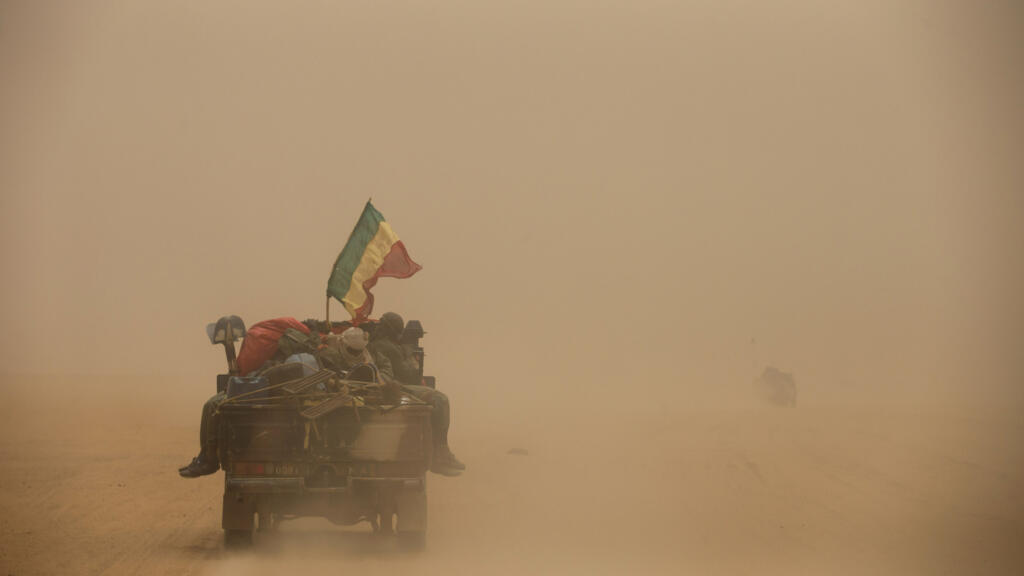
On the ground, the situation is not just about a propaganda video. Anefis is a traffic choke point. From Gao, moving towards Kidal requires crossing an open, dusty area, lacking cover, where vehicles visible from afar become vulnerable to prepared ambushes. A column leaving Gao must carry fuel, water, ammunition, repair means, and medical evacuation. If it loses its rhythm, it becomes a target.
The attack on July 18 illustrates this constraint. Amnesty, cited by Africanews, claims to have analyzed videos showing soldiers out of combat, hands behind their heads, before being shot. The organization speaks of a possible serious violation of international humanitarian law and calls for an independent investigation. The available figures remain fragmentary: at least 19 soldiers are said to have been executed after surrender, while at least 50 military personnel were reportedly killed in the ambush itself. The distinction is important. Dying in combat and being executed after capture do not fall under the same category, either militarily or legally.
The FLA and JNIM exploit a common weakness of Bamako
The FLA is not the Group for Support of Islam and Muslims (JNIM), affiliated with al-Qaeda. The two forces do not share the same political project or social base. However, recent months show a tactical convergence against the Malian state. The UN reported that the FLA and JNIM carried out simultaneous attacks on April 25 against several points, including Bamako, Kati, Gao, Kidal, and Mopti. This is not a specific ideological alliance. It is an addition of operational interests.
For Bamako, this convergence is more dangerous than a classic jihadist offensive. The JNIM provides a capacity for attrition, sabotage, and rural intimidation. The FLA brings detailed knowledge of the North, local networks, and political legitimacy in certain Tuareg communities. Together, even occasionally, they can force the Malian army to disperse its units between convoy protection, city defense, route control, and response to attacks on infrastructure.
From experience, an army that escorts everything controls very little. It becomes predictable. Adversaries no longer need to take Gao or Kidal to win; they just need to make the movement between the two too costly.
The Africa Corps does not solve the control problem
The Malian junta has replaced the French military relationship with a Russian one, first under the shadow of Wagner, then under the label Africa Corps. This choice has given Bamako strike capabilities, instructors, political assurance, and more brutal communication. It has not yet made the roads safe.
Human Rights Watch, cited by Africanews on July 31, accuses Russian paramilitaries from the Africa Corps of killing eight civilians, including three children, during airstrikes in June on the village of Kyrnia, in the Mopti region. The organization claims that a Su-24 dropped at least two munitions, one near the village chief's residence, the other near a small livestock market. Africa Corps presented the area as a terrorist gathering point; HRW emphasizes that no jihadist fighters have been identified among the known victims.
This type of episode has an immediate tactical cost. In central and northern Mali, human intelligence remains crucial. Drones observe, planes strike, but it is the locals who know which path has been mined, which well is monitored, which unit left the camp before dawn. A population that fears the army as much as the insurgents no longer provides information at the right time.
The political trap of prisoners
The video of the 200 prisoners places Bamako in front of a dilemma. Denying too quickly exposes the regime to being contradicted by other images. Acknowledging the capture too broadly weakens the narrative of a security reconquest. Attempting a recovery operation, finally, would require precise intelligence, airlift capabilities, or a rapid column, and an extraction capacity that the Malian army cannot afford to waste.
The FLA knows this. Showing live prisoners serves several objectives: responding to accusations of executions, demonstrating a detention capacity, putting pressure on the families of military personnel, and reminding isolated garrisons that a surrender can become a national political issue. The message is directed as much at Malian soldiers as at Bamako's officers.
In northern Mali, possessing a prisoner is sometimes worth as much as capturing an armored vehicle: it immobilizes a political decision.
What the next week will really reveal
The point to watch is not just the fate of the prisoners. One must look at the Gao-Anefis-Kidal axis, the reinforcement movements from Gao, the attacks on power lines and logistical convoys, as well as the posture of the JNIM around Mopti and Gourma. If the FLA can retain its captives while maintaining pressure on the roads, Bamako will have lost more than a battle: it will have lost the freedom to maneuver in part of the North.
The immediate risk is a punitive response, poorly informed, that would create new civilian casualties and reinforce the cycle of vengeance. The operational risk, more discreet but more serious, is the establishment of a fait accompli: garrisons that still hold their walls but no longer control the paths between them. In the Sahel, this is often how a defeat begins. Not through the spectacular fall of a capital, but through a road that no one dares to take anymore without praying for the sand to remain silent.
Sources: France 24, Africanews citing Amnesty International, Africanews citing Human Rights Watch, United Nations.
The Front de libération de l'Azawad (FLA) publicly displayed a video of 200 captured Malian soldiers on August 1, impacting the military narrative in Mali. This event follows accusations of the execution of soldiers after surrender during an ambush on July 18. The FLA's actions, alongside the JNIM, indicate a tactical convergence against the Malian state, complicating military operations in the Gao-Anefis-Kidal region.
- FLA released a video showing 200 captured Malian soldiers on August 1.
- Amnesty International reported on the execution of at least 19 Malian soldiers after surrender.
- The FLA and JNIM have conducted simultaneous attacks against Malian positions.
- The situation in the Gao-Anefis-Kidal area is critical for military logistics and control.
- The FLA's actions are part of a broader tactical convergence against the Malian state.