
The Gao-Anéfis convoy falls into the ambush of JNIM and FLA — 50 Malian soldiers killed on the Russian axis
 Marie Dubois
The Gao-Anéfis convoy falls into the ambush of JNIM and FLA — 50 Malian soldiers killed on the Russian axis
In Tabankort, or Tabrichat according to local transcriptions, the track between Anéfis and Gao has once again swallowed a military column. On July 18, a convoy of the Malian Armed Forces (FAMa) and their Russian partners was ambushed on this approximately 200-kilometer axis, north of Gao. Initial security sources cited by AFP report at least 50 Malian soldiers killed, along with prisoners and unconfirmed Russian losses. Bamako acknowledges an attack on a convoy of Malian soldiers and "partners," but does not provide a detailed toll.
It is precisely this silence that matters. On the ground, an army that retakes a locality but does not secure its access route has not truly stabilized the area. It has planted a flag, but not secured the theater of operations.
A logistical axis turned shooting range
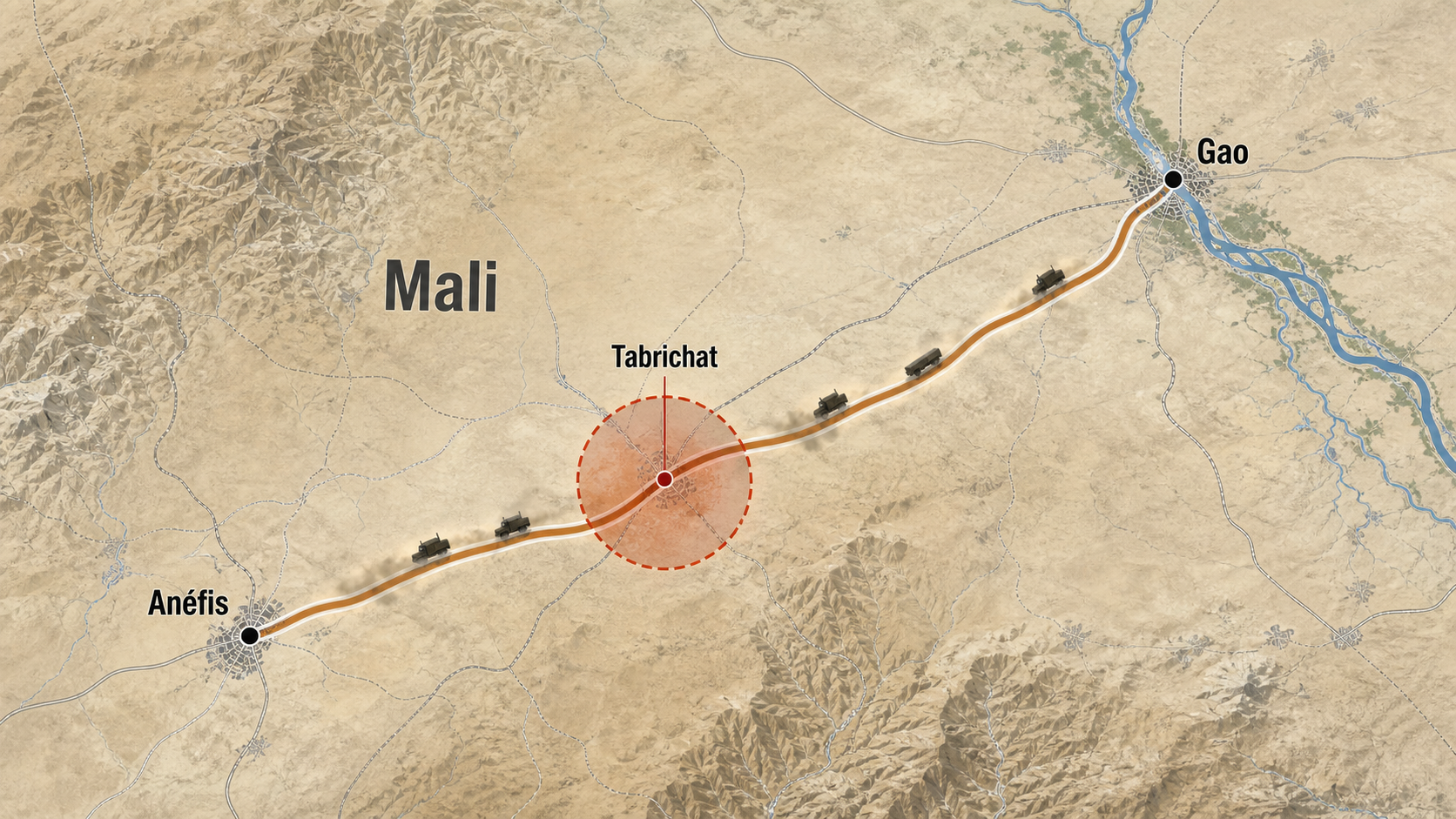
The targeted convoy was leaving Anéfis for Gao, according to a military source cited by Al Jazeera. This road is not just a line on a map. It connects a strategic city in northern Mali, contested since early July, to the main military and administrative center of the Niger loop. In the dry season, it offers quick mobility windows. In the rainy season, the wadis, detours, and soft sand areas become mechanical traps. A loaded column, with armored vehicles, pick-ups, fuel, ammunition, and medical evacuations, moves at the pace of its slowest element.
The Azawad Liberation Front (FLA) and Jama'at Nusrat al-Islam wal-Muslimin (JNIM, affiliated with al-Qaeda) have separately claimed responsibility for the attack, citing heavy human and material losses. Images released by armed groups show, according to several media outlets, prisoners, destroyed vehicles, and bodies. These elements remain to be independently verified. However, the repetition of incidents along the same corridor is less contestable: on July 9, a column of Russian reinforcements heading towards Anéfis had already been struck, and on July 6, the FLA claimed to have shot down a Russian Mi-24 near Gao.
Anéfis retaken, but not controlled
Bamako announced it had retaken Anéfis on July 10, after several days of fighting against the FLA and JNIM. The Malian Chief of Staff acknowledged about 30 dead and 60 wounded in this operation. This is a high cost to retake a point, but the real test came next: holding the outskirts, protecting movements, and preventing the enemy from turning tactical victory into logistical vulnerability.
From experience, regular armies often overestimate this moment. Entering a locality is not the same as holding its periphery. Holding a base is not the same as holding the ten kilometers of tracks leading to it. In northern Mali, this difference is deadly. Armed groups do not need to defeat the FAMa head-on. They only need to make each movement costly, slow, and politically embarrassing.
The analysis published by defenceWeb based on comments from ACLED supports this view. Héni Nsaibia believes that the events around Anéfis show that the FAMa and Africa Corps do not control the surrounding terrain or key transit routes, despite retaking the base. According to him, the reported behavior of Russian partners during the ambush, with Malian soldiers left exposed, illustrates a dangerous operational dependency. This point is sensitive in Bamako, but it can no longer be dismissed as enemy propaganda.
A FLA-JNIM alliance to be handled without illusion
The FLA and JNIM do not pursue the same political project. The former is part of the continuity of Tuareg and Azawadian claims, even if its militant environment has changed. The latter builds rural jihadist governance, with taxation, courts, religious coercion, and control of routes. Their cooperation around Anéfis is therefore less a merger than an operational convergence.
This convergence is nonetheless formidable. The FLA knows the tracks, water points, local networks, clans, and fallback zones. JNIM brings ambush discipline, propaganda capability, and experience in coordinated attacks. Together, they can strike a column and then exploit the psychological effect: prisoners displayed, equipment seized, the narrative of an army abandoned by its allies.
One must remain cautious about the numbers. Reports from armed groups are often inflated, while those from states are often minimized. But when several independent sources converge on a figure greater than 50 dead, and when the army does not quickly publish a contrary toll, the hypothesis of a major loss becomes credible.
The pressure on Malian air power
That same weekend, JNIM reportedly also struck Kouakourou, in central Mali, before a Mi-24 helicopter was destroyed during an air response. ACLED notes that this would be the second helicopter lost in two weeks. For an army like the FAMa, this is not a technical detail. The helicopter is both a fire tool, reconnaissance, evacuation, and moral presence. When it becomes vulnerable, all ground maneuver slows down.
Armed drones can compensate for some of this weakness, but not all. A drone strikes, observes, sometimes deters. It does not retrieve the wounded on a cut-off track. It does not reassure an encircled garrison. It does not replace ground logistics that must continue to roll between Gao, Bourem, Anéfis, and Kidal.
The Russian dimension makes the problem more political. Since the French departure and the rise of Wagner and then Africa Corps, Bamako has sold its opinion a simple promise: less Western dependence, more sovereignty, more efficiency. However, the ambush of July 18 shows the opposite is possible: a displayed sovereignty, but increased dependence on a foreign partner whose own losses remain opaque.
The next operational risk
The immediate risk is not the fall of Gao. The city remains too important, too garrisoned, too visible. The risk is more subtle: the methodical wear of the axes that supply it. If JNIM and FLA can strike three times in two weeks around the same corridor, they can force the FAMa to choose between heavier, thus slower, convoys or rarer, thus less responsive, movements.
This war is played less in press releases than in distances. Gao-Anéfis, about 200 kilometers. Gao-Kouakourou, another theater, but the same logic: isolate, harass, wait for the mistake. The coming days will tell if Bamako launches a real sweeping operation or a series of airstrikes to restore its image. The first option is costly in terms of men. The second often leaves the ground to the adversary as soon as the dust settles.
The signal sent by Tabankort is simple: in northern Mali, the convoy has once again become the strategic target. Whoever controls the road controls the tempo.
The most vulnerable area is therefore not just Anéfis. It is the entire set of intermediate points between Gao and the forward positions to the north, where a column slows down, where radios have poor reception, where vehicles space out, where air support arrives with a few minutes delay. In the Sahel, a few minutes are enough.
On July 18, a Malian military convoy was ambushed near Tabankort, resulting in the deaths of 50 soldiers. The attack was claimed by the Jama'at Nusrat al-Islam wal-Muslimin (JNIM) and the Front for the Liberation of Azawad (FLA). This incident highlights ongoing instability in the region, with previous attacks on Russian reinforcements also reported.
- 50 Malian soldiers killed in an ambush
- The ambush occurred on the road between Anéfis and Gao
- The attack was claimed by JNIM and FLA
- Malian forces were reportedly left exposed during the ambush
- This incident follows previous attacks on Russian reinforcements in the area.