
The JNIM strikes five villages in Mali in 2026 — 20 dead and the Bankass line wavers
 Marie Dubois
JNIM Strikes Five Villages in Mali in 2026 — 20 Dead and the Bankass Line Wavers
On May 21, between 5 PM and 6 PM, five villages around Bankass and Bandiagara were attacked almost simultaneously. Logo, Soulakanda, and Dimbal, in the Dimbal municipality, followed by Ogossagou and Kouroundé, in the Bankass municipality, saw fighters from the Group for the Support of Islam and Muslims, JNIM linked to al-Qaeda, arrive. RFI, relayed by AllAfrica, reports about twenty dead, including civilians and dozo hunters. Studio Tamani, citing local sources, mentions six affected localities, injuries, livestock taken, and material damage. The exact toll remains incomplete. This is precisely the problem.
In this part of central Mali, information arrives via paths, through cut-off phones, and from local elected officials who speak cautiously. But the operational pattern is quite clear. JNIM did not just want to kill. It wanted to demonstrate that the rural bank around Bankass can be struck at the time when residents return from the fields, just a few kilometers from the centers where the displaced are already seeking refuge.
A Close Attack, Not an Isolated Raid
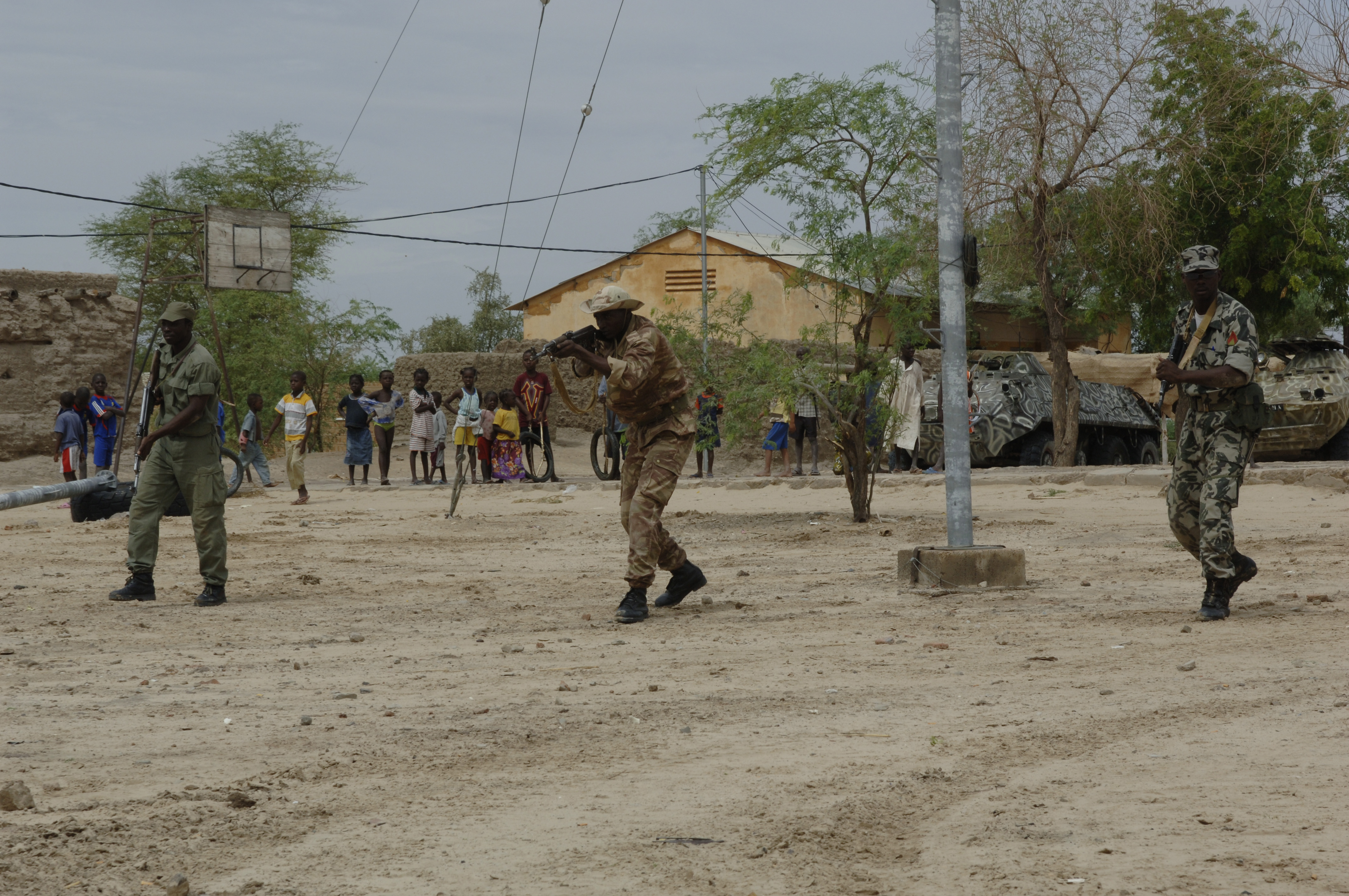
Bankass is not a vague periphery on a map. It is a hub of the Dogon country, southeast of Mopti, in an area where villages are connected by short paths, weekly markets, and family networks. Studio Tamani specifies that some of the attacked localities are less than ten kilometers from Bankass. In a regular war, ten kilometers can be covered quickly. In central Mali, with poor roads, a slow chain of command, and units that fear ambush, ten kilometers can become a border.
The choice to strike between 5 PM and 6 PM is not trivial. At this hour, improvised posts lower their vigilance, civilians are still moving about, and night approaches quickly to cover the retreat. From experience, this is the time frame for attacks that seek less durable occupation than the effect of terror and the capture of initiative. They enter, fix the dozos, burn or loot what serves the local economy, and then disappear into the wooded corridors and complicit or submissive hamlets.
The Dozos Replace the State and Become the Target
The fighting reportedly pitted the assailants against traditional dozo hunters. This is the most important detail. In many villages in the center, dozos are no longer just a social or ritual institution. They hold checkpoints, warn of attacks, sometimes accompany the Malian Armed Forces, and, above all, remain on site when the army departs.
This substitution comes at a cost. JNIM can present villages that host dozo bases as military targets, then impose a brutal choice on the communities: accept local arrangements with the jihadists, pay, remain silent, or be considered allies of Bamako. RFI reports that a JNIM spokesperson had already threatened villages refusing to submit to these local agreements. The attack on May 21 thus resembles an execution rather than a spontaneous outbreak.
The dozos also have their own past. Africanews and AFP reminded us, after the attacks in Korikori and Gomossogou earlier this month, that Dogon self-defense militias are accused of past abuses, particularly around Ogossagou. JNIM exploits this memory methodically. It does not only win by the Kalashnikov; it wins when it transforms a community rivalry into an argument of legitimacy.
The Silence of Bamako Becomes a Military Factor
According to RFI, a dozo chief lamented the lack of response from the army, and the Malian Armed Forces did not respond to requests. No clear official statement accompanied the attacks. In a capital already under pressure from the jihadist blockade of roads and the JNIM-FLA offensive in April, this silence is not just political. It has tactical implications.
When an army does not speak, villages compare this silence to the words of the adversary. JNIM claims responsibility, threatens, names places, imposes its narrative. The state, on the other hand, sometimes arrives after the burials. This does not mean that the FAMa are absent everywhere or that they do not fight. But at the level of a village chief or a displaced person who must decide whether to return to sleep at home, the effect is simple: the one who promises punishment seems more present than the one who promises protection.
Chatham House recently reminded us that the stabilization of the Sahel cannot be delivered by military means alone. In the case of Bankass, this statement is verified at ground level. Even if Bamako were to send a detachment tomorrow, it would have to hold scattered villages, control paths, protect markets, arbitrate tensions between communities, and prevent local auxiliaries from becoming a cause of reprisals themselves. This is a complete counter-insurgency mission, not a flag patrol.
Pressure Rises from the Village to Bamako
Since April 25, Mali has been living under the shadow of a strategic rupture. The joint offensive of JNIM and the Azawad Liberation Front has hit Kidal, Kati, and the heart of the political-military apparatus. The death of Defense Minister Sadio Camara showed that the alliance with Russia and Africa Corps was not enough to sanctify power. The massacres in early May in Korikori and Gomossogou, followed by the attacks on May 21, now show that the rural center remains open.
One must not confuse the two levels. The April offensive targeted the regime's credibility. Bankass targets the fabric of local control. Yet the two converge. If the villages around Bandiagara empty, Bankass receives more displaced persons. If Bankass saturates, Mopti and Sévaré become the next points of humanitarian pressure. If secondary roads close, military convoys concentrate on a few predictable routes. On the ground, this is how an armed movement transforms a series of village attacks into a strategic effect.
What to Watch Now
The first indicator will be the movement of residents. If families stay in Bankass or move further towards Mopti, it will indicate that fear is no longer sporadic but structural. The second will be the reaction of the dozos. An uncontrolled revenge against villages suspected of agreements with JNIM would play exactly into the hands of the jihadists. The third will be the capacity of the Malian army to hold at night, not just to appear during the day.
The next fragile area lies between Bankass, Bandiagara, and the paths leading down to Koro. JNIM does not need to take Bankass to win. It is enough to make it a refuge city surrounded by villages too dangerous to be normally inhabited. In the Sahel, losing the countryside often begins like this: one evening, five villages burn, and then the official map continues to say that the state still controls the area.
Sources Used
- RFI via AllAfrica, May 23, 2026, attack on five villages near Bandiagara.
- Studio Tamani, May 22, 2026, simultaneous attacks in the Bankass circle.
- Africanews with AFP, May 8, 2026, attacks in Korikori and Gomossogou in central Mali.
- Chatham House, April 2026, analysis of the Malian crisis after the JNIM-FLA offensive.
JNIM launched an attack on five villages near Bankass and Bandiagara on May 21, 2026, resulting in approximately 20 casualties, including civilians and dozo hunters. The assault occurred between 5 PM and 6 PM, targeting areas close to Bankass, demonstrating the group's operational capability. Local dozo hunters attempted to defend against the attackers, but the Malian army did not respond to the incident, raising concerns about security in the region.
- JNIM attacked five villages near Bankass and Bandiagara on May 21, 2026.
- Approximately 20 people were killed, including civilians and dozo hunters.
- The attack was coordinated and aimed to instill fear in the local population.
- Local dozo hunters engaged in combat with the attackers.
- The Malian army did not respond to the attacks.