
The Navy's 1,000 Mile Drone Fighter Is a Carrier Survival Test
 Marcus Chen
The Navy's 1,000 Mile Drone Fighter Is a Carrier Survival Test
A 1,000 nautical mile combat radius is the number that matters in the Navy's July 14 request for carrier-based unmanned aircraft. Not the phrase “Air Wing of the Future,” not the familiar promise of manned-unmanned teaming, and not the usual acquisition language about affordability. One thousand nautical miles, without refueling, is the Navy admitting that the current carrier air wing does not have enough reach for the Western Pacific fight it keeps describing.
Defense News reported that the Naval Air Systems Command request asks industry for autonomous aircraft able to operate from Ford-class and Nimitz-class nuclear carriers, with responses due Aug. 13. The mission list is wide: surface strike, land attack, anti-submarine warfare, air-to-air combat, electronic warfare, intelligence collection, aerial refueling and resupply. That breadth matters less than the radius. A drone that can strike 1,000 nautical miles from the deck changes where a carrier can stand. A drone that cannot is just another aircraft competing for scarce deck space.
The Range Problem Is Not Abstract
The F/A-18E/F Super Hornet remains the workhorse of the carrier air wing, but its unrefueled combat radius is not built for a fight where the ship may need to stay outside dense missile threat rings. Even with external tanks and careful mission planning, a carrier commander trying to generate sorties from east of the first island chain is doing arithmetic under pressure: distance to target, tanker availability, weapons load, deck cycle, recovery fuel, and how many aircraft must be held back for defense of the force.
China's DF-21D anti-ship ballistic missile is commonly assessed in the 1,450 to 1,550 kilometer range band, according to CSIS Missile Threat. That is roughly 780 to 837 nautical miles. The larger DF-26 family extends the problem further, but the DF-21D alone explains why the Navy is asking for more than a marginal improvement. A 700 nautical mile aircraft does not solve the carrier's problem if the carrier has to remain outside the threat envelope and still hold targets at risk inland or at sea.
Anyone who has served on a destroyer knows that sea control is not a slogan. It is geometry, fuel, radar horizon, magazine depth and time on station. The carrier air wing has been living off aerial refueling and exquisite deck choreography for decades. In the Western Pacific, that model still works for presence missions. It is much less convincing for a high-tempo campaign against a peer force with long-range sensors and missiles.
MQ-25 Is the Gateway, Not the Answer
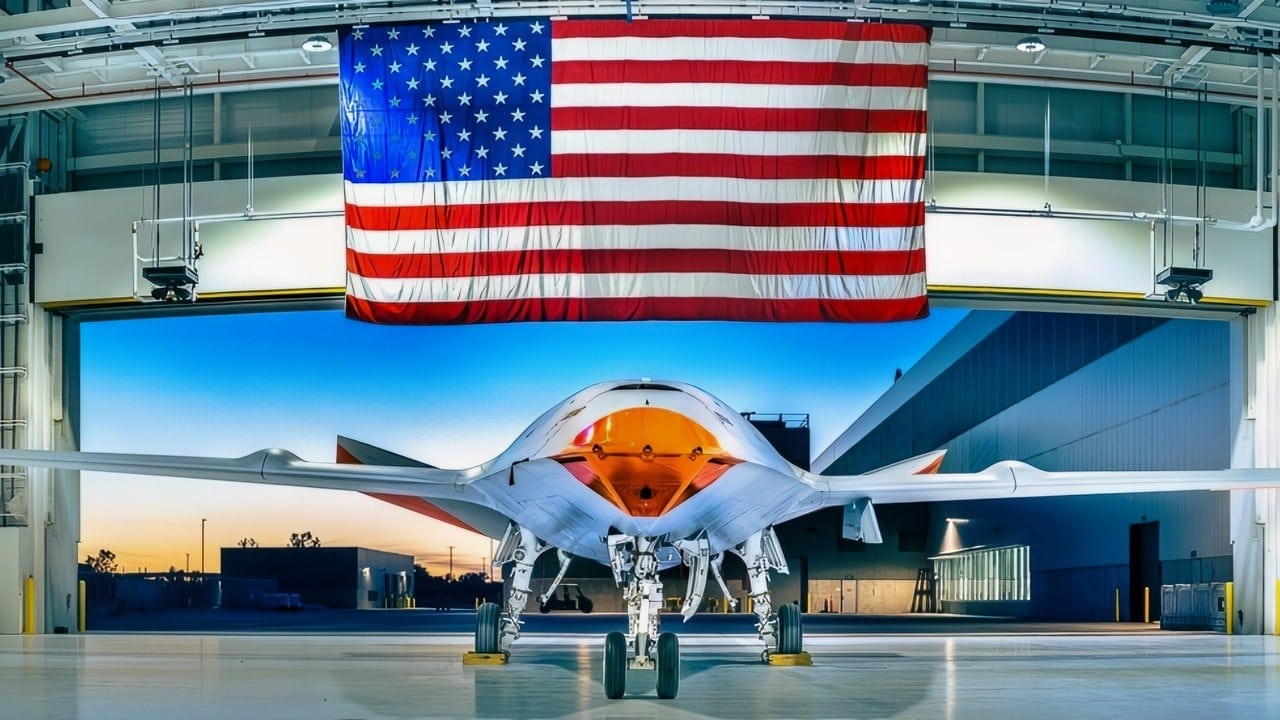
The Navy already has one unmanned carrier aircraft moving toward the fleet. Stars and Stripes reported in April that Boeing's MQ-25A Stingray made its first flight from MidAmerica St. Louis Airport, a two-hour event tied to the Navy's first carrier-based unmanned refueling aircraft. The numbers are useful: MQ-25 is designed to fly up to 500 nautical miles and offload more than 14,000 pounds of fuel to Super Hornets.
That is important, but it is not the same thing as a 1,000 nautical mile strike aircraft. MQ-25 buys back range for crewed fighters and frees some Super Hornets from the tanker role. It teaches the fleet how to move an unmanned aircraft through the carrier pattern, around deck crews, through maintenance routines and into command-and-control systems built around human aviators. It does not, by itself, give a carrier commander a disposable penetrating shooter.
The July RFI appears to build from that lesson. The Navy wants the new aircraft to plug into existing Unmanned Carrier Aviation control systems rather than create a separate control architecture for every new drone. That is the right instinct. The flight deck cannot become a museum of incompatible ground stations, contractor laptops and one-off data links. If unmanned aviation is going to matter at sea, it has to fit into the carrier as a system, not arrive as a science project.
Deck Space Is the Hidden Constraint
The RFI's reference to “spot factor” is one of the most revealing details. A carrier does not have infinite room because it is large. The flight deck is a moving industrial plant with aircraft parked, fueled, armed, launched, recovered and repaired in a rhythm that leaves little margin for platforms that take up space but do not generate combat effect.
A smaller drone with a 1,000 nautical mile radius and a modest weapons load may be more useful than a larger unmanned aircraft that looks impressive in a rendering but consumes the same deck footprint as a crewed fighter. The Navy is asking industry to show increased combat effectiveness over fourth-generation aircraft at a given spot factor. Translated from acquisition language, that means the service wants more sorties, more reach or more survivable mass per square foot of flight deck.
This is where the cost language matters. The request asks companies to explain unit recurring flyaway cost, sustainment cost, maintenance burden and how production could scale in a surge. That is not decorative. A drone fighter that costs nearly as much as a manned fighter will not be risk-tolerant in a real campaign. A drone that cannot be built quickly will not provide mass. The Navy has spent too long buying small numbers of exquisite platforms and then calling them decisive. In a Pacific air and missile fight, attrition is not a theory. It is the bill arriving early.
The Carrier Needs a Real Unmanned Wing
The most promising part of the request is also the most difficult: the Navy is not asking for a single mission aircraft. It is asking whether industry can produce a family of systems for strike, electronic warfare, sensing, refueling and logistics. That is the right frame because no single drone will fix the carrier air wing. A 1,000 nautical mile shooter without electronic attack support is a target. A sensor drone without weapons nearby is a reporting asset. A tanker without enough protected communications becomes a dependency.
The harder question is whether the Navy can buy and field this family fast enough to matter. The response deadline is in August. A first flight, first trap and initial operational capability are still future milestones. Even if industry answers well, the service must avoid turning this into another decade-long requirements debate. The carrier air wing does not need a perfect unmanned aircraft in 2040. It needs credible range, affordable mass and carrier-deck autonomy before Chinese missile and sensor networks mature another generation.
There is a blunt conclusion here. The 1,000 nautical mile requirement is not ambitious. It is the minimum useful answer to the geography of the Pacific. If the Navy cannot turn that requirement into aircraft that can be built, maintained, controlled and lost in numbers, the carrier remains a powerful ship increasingly dependent on aircraft that cannot reach far enough without a fragile tanker plan. The RFI is a good start. The math is still unforgiving.
Sources
The U.S. Navy requested the development of a carrier-based unmanned aircraft with a 1,000 nautical mile combat radius to enhance operational capabilities in the Western Pacific. This aircraft is intended for various missions, including surface strike and electronic warfare, and aims to address the limitations of current carrier air wing capabilities. Responses from industry are due by August 13, 2026.
- The Navy is seeking unmanned aircraft with a 1,000 nautical mile combat radius.
- The MQ-25A Stingray is currently in development as a refueling aircraft.
- The request includes a wide range of missions for the new aircraft.
- The Navy aims to integrate the new drones into existing control systems.
- The deadline for industry responses is August 13, 2026.