
The Navy's Shipbuilding Capability of the People's Liberation Army Leads 2 to 1: Can China's Fleet Size Advantage Be Transformed into Combat Power in the Taiwan Strait?
 Li Minghui
PLA Navy Shipbuilding Capability Leads 2 to 1: Can China's Fleet Size Advantage Be Transformed into Combat Power in the Taiwan Strait?
On October 23, the South China Morning Post cited analysts' assessments stating that China's shipbuilding capacity is approximately twice that of the United States. This figure is striking, but it does not simply mean that China can trade two warships for one American ship; rather, it indicates that Beijing has a broader industrial base: large shipyards, commercial ship supply chains, and dual-use military-civilian equipment can continuously provide hulls for the navy.
2 to 1 is Primarily a Comparison of Industrial Capability
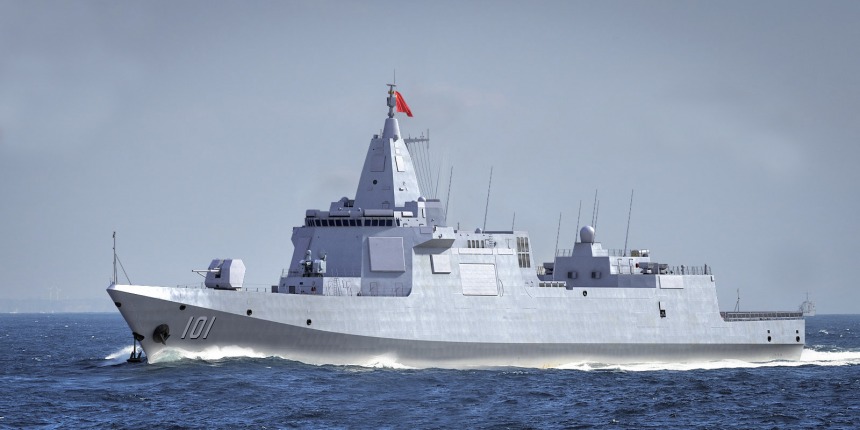
China's advantages are mainly reflected in the number of docks, steel processing, modular construction, and the scale of supporting enterprises. The Type 055 destroyer, a 10,000-ton class vessel, is a product of this systematic capability. Publicly available information generally indicates that the ship has a displacement of over 12,000 tons and is equipped with 112 vertical launch system cells, undertaking tasks such as area air defense, anti-ship operations, and fleet command. More critically, the Type 055 is not an isolated "star equipment," but is part of a continuous construction sequence alongside the Type 052D destroyer, amphibious assault ships, and aircraft carriers.
The U.S. Department of Defense's "China Military Power Report" and recent assessments from the Congressional Research Service have repeatedly emphasized that the growth in the number of Chinese naval vessels relies on a mature commercial shipbuilding foundation. In simple terms, China is not just building warships; it is using a massive shipbuilding industry to provide a buffer for warship production.
Tonnage Advantage Does Not Equal Combat Advantage
However, directly equating commercial shipbuilding capacity to naval combat outcomes is a dangerous simplification. The most challenging aspects of building warships are often not the steel hulls, but rather the gas turbines, phased array radars, onboard software, missile inventories, and long-term maintenance systems. The South China Morning Post also reminds us that technological level and maritime combat experience remain important.
Take aircraft carriers as an example; the Fujian ship employs electromagnetic catapults, representing China's advancements in hull design and large-scale assembly. However, the operational readiness of carrier-based aircraft, deck management, long-range replenishment, and fleet coordination require years of intensive training to stabilize. The U.S. Navy's advantages are precisely concentrated in these areas that are not easily visible from satellite images. China may launch vessels more quickly, but it still needs to prove that these vessels can sustain operations in high-pressure environments.
The Taiwan Strait Scenario Values Resupply Speed More
For the Taiwan Strait, the strategic value of shipbuilding capability lies not in the one-time production of a "decisive fleet," but in providing continuous resupply and damage recovery capabilities. If the PLA wants to maintain a blockade, escort, anti-submarine operations, and long-range fire support around Taiwan, it will need to rotate a large number of platforms of varying levels. The Type 055 is responsible for high-value air defense and command tasks, the Type 052D undertakes larger-scale escort and area air defense, while other frigates, unmanned vessels, and civilian auxiliary ships fill the quantity gap.
This is also why the U.S. and Japan are increasingly emphasizing allied bases, long-range missiles, and unmanned systems in "agile operations" and distributed deployments. They are attempting to shift naval warfare from a competition of vessel numbers to a competition of sensors, munitions, and maintenance nodes. If China's shipbuilding advantage does not have sufficient long-range reconnaissance, maritime replenishment, and ammunition reserves to support it, it may still turn into "tonnage in the harbor."
The Real Weakness Lies in Fleet Generation Rate
The author believes that what is most worth observing next is not how many ships China can launch, but how many complete task forces capable of executing long-range missions can be generated each year. This includes crew training, carrier-based aircraft coordination, missile resupply, maintenance cycles, and command chain resilience against interference. The 2 to 1 shipbuilding gap will increase the PLA's strategic options, but it will not automatically eliminate the gaps in combat experience, joint training, and advanced subsystems.
If China can continue to convert its shipyard advantages into a stable fleet generation rate, the pressure around the Taiwan Strait will shift from "occasional exercises" to a long-term maritime presence. The question is, in high-intensity conflicts, what will truly become the bottleneck: the docks, missiles, or well-trained crew members?
References
China's naval shipbuilding capacity is assessed to be twice that of the United States, with significant implications for military operations in the Taiwan Strait. The People's Liberation Army Navy focuses on continuous ship production and logistical support, emphasizing the need for operational readiness and training. The Type 055 destroyer exemplifies China's advancements in naval technology, but challenges remain in crew training and operational integration.
- China's shipbuilding capacity is approximately twice that of the U.S.
- The Type 055 destroyer has a displacement of over 12,000 tons and is equipped with a vertical launch system.
- China's naval growth relies on a mature commercial shipbuilding base.
- The strategic value of shipbuilding lies in sustained replenishment and damage recovery capabilities.
- China's naval forces need to prove operational effectiveness under high-pressure conditions.