
The original equipment is severely outdated, unmanned systems are still immature, and the Middle East conflict exposes the U.S. military's weakness in mine clearance.
[Global Times Special Correspondent Chen Yang] As the peace talks between the U.S. and Iran are at a stalemate, U.S. Central Command spokesman Hawkins declared on the 25th that U.S. forces conducted "defensive" airstrikes that day against missile launch sites and minesweepers in southern Iran. Iran immediately returned fire. According to Hawkins' statement, the U.S. airstrikes were triggered by Iranian minesweepers attempting to lay mines in the Strait of Hormuz. Several U.S. media outlets have pointed out that the U.S. Navy's insufficient mine-clearing capabilities are currently its greatest weakness.
Are Iranian minesweepers the "trigger"?
According to a report by the BBC on the 26th, the U.S. military launched a new round of airstrikes in southern Iran, targeting Iranian missile launch sites and vessels attempting to lay mines. Hawkins stated that U.S. forces "destroyed" two Islamic Revolutionary Guard Corps vessels found laying mines in the Strait of Hormuz. Additionally, U.S. forces destroyed an air defense missile site in the southern Iranian port city of Abbas. U.S. Central Command claimed in a statement that these airstrikes were "defensive" actions aimed at "protecting our forces from threats posed by Iranian forces."
Qatar's Al Jazeera reported that several members of the Iranian Islamic Revolutionary Guard Corps were casualties in the U.S. airstrikes. Social media reports indicated that two Iranian Revolutionary Guard Navy fast boats were attacked by U.S. aircraft on the evening of the 25th, and in response, Iran fired at U.S. warships in the Gulf of Oman. The U.S. military subsequently conducted airstrikes near Abbas port.
The Iranian Fars News Agency later published a statement from the Iranian Islamic Revolutionary Guard Corps, claiming to have shot down a U.S. MQ-9 "Reaper" drone in Iranian airspace and fired at another drone and an F-35 fighter jet, driving them away. The statement also warned the U.S. military against violating the ceasefire agreement.
After this round of exchanges, both the U.S. and Iran showed restraint, and the regional situation did not escalate further. Sources told Fox News that the U.S. military's "defensive strikes" have now ceased.
The British Independent reported on the 26th that since the U.S. and Israel launched raids on Iran on February 28, Iran has deployed small surface vessels to lay mines in various areas of the Strait of Hormuz, attempting to control the passage of this vital waterway. Approximately one-fifth of the world's oil and liquefied natural gas transport passes through this strait. Previously, U.S. officials stated in an interview with The New York Times that Iran might not be able to reopen the strait because it cannot locate all the mines and lacks the capability to clear them. This situation still poses a threat to about 700 vessels that remain stranded in the Gulf.
Why is the U.S. military anxious about Iranian mine-laying?
The U.S. military's sensitivity to Iranian mine-laying operations has long been evident. In April, U.S. President Trump declared on social media: "I have ordered the U.S. Navy to sink any vessel that lays mines in the waters of the Strait of Hormuz—no matter how small—without hesitation."
The Independent reported that Iran possesses at least 2,000 mines of various types, including traditional anchor mines, bottom mines, and more advanced rocket-propelled rising mines, which may use different detonation modes such as trigger, magnetic fuse, or acoustic signature, increasing the complexity of mine clearance. Commander Gemma Britton of the British Navy's Mine Warfare and Threat Development Group told the Associated Press that a navigable channel would likely need to be cleared in the Strait of Hormuz first to allow trapped vessels to leave; subsequently, a channel would need to be cleared in the opposite direction to allow subsequent vessels to enter the strait. She emphasized that clearing all the mines in the strait could take months or even years.
Even if the mine clearance in the Strait of Hormuz is completed after much effort, Iran can easily lay mines again. According to The Wall Street Journal, most of Iran's larger surface vessels have been destroyed in U.S. airstrikes, and now they primarily rely on soldiers in diving suits using small boats that resemble ordinary fishing vessels to lay mines. These small boats are "difficult to identify and eliminate."
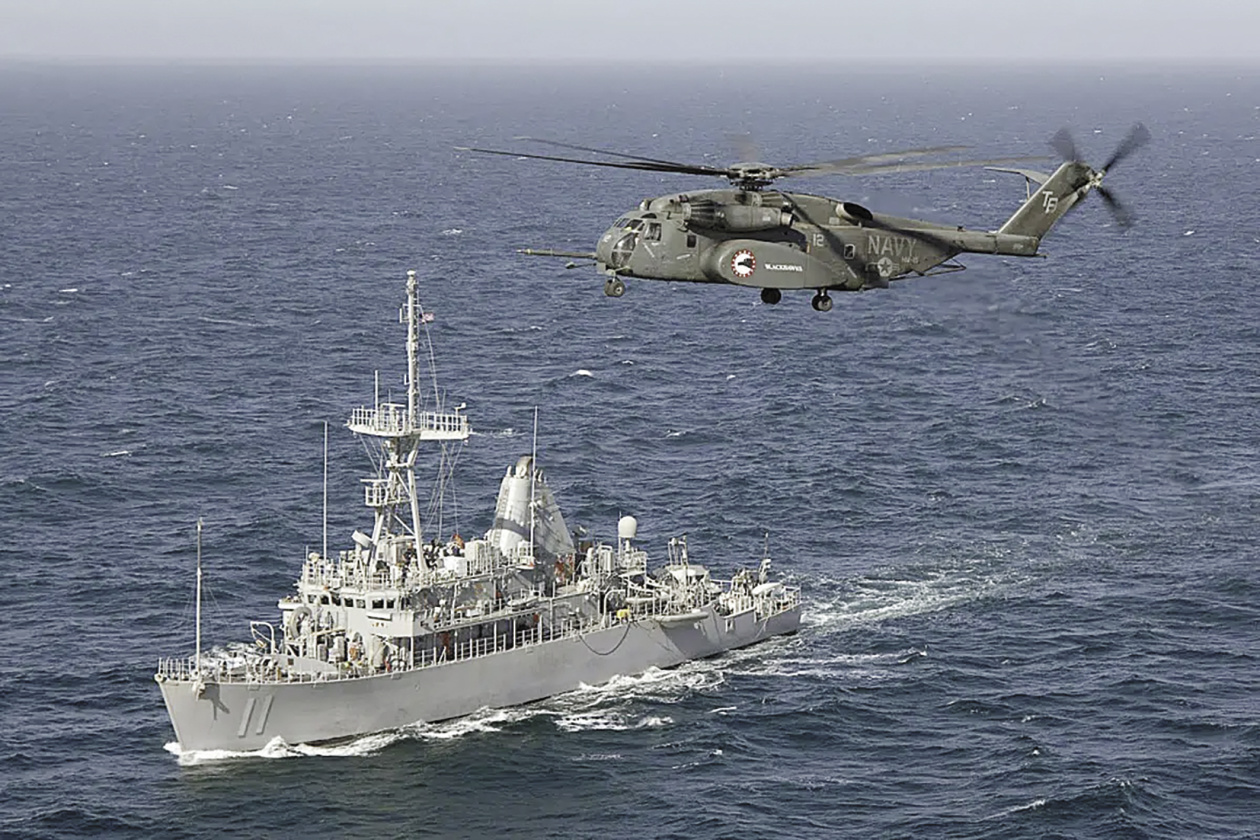
U.S. website Business Insider explained that the Pentagon is very anxious about Iran's mine-laying operations in the Strait of Hormuz due to the severe inadequacy of the U.S. Navy's own mine-clearing capabilities. Reports indicate that the "Avenger" class minesweepers, which were once the mainstay of U.S. mine clearance, successfully cleared over 1,000 various mines during the 1991 Gulf War, but now their average age exceeds 35 years, making them severely outdated. The four "Avenger" class minesweepers previously stationed in Bahrain are set to be retired by 2025, and currently, the U.S. Navy has only four remaining "Avenger" class minesweepers deployed at U.S. bases in Japan, which are planned to be retired by 2027. The MH-53E "Sea Dragon" heavy helicopter used for aerial mine clearance has also gradually been phased out, further weakening the U.S. military's multi-dimensional mine-clearing capabilities.
According to previous Pentagon plans, mine clearance tasks were supposed to be taken over by littoral combat ships equipped with mine clearance modules and various unmanned mine clearance systems, but tests have shown that their technology is far from mature. The "Defense" section of the U.S. website "Power" cited assessments from internal U.S. military reports stating that the mine clearance systems on littoral combat ships require several hours of preparation time, and sonar performs poorly in complex environments. The visual confirmation of mines using the AN/AQS-20 mine detection system equipped on the ship is also quite challenging, "even in relatively calm waters off Southern California, errors are easy to make." The report also highlighted several potential "single points of failure" in the mine clearance systems included in the module and the equipment required for deploying and recovering these systems. "Littoral combat ships are designed as multi-mission platforms... crew members may be distracted by other tasks and unable to devote much time to mine clearance operations. In contrast, the 'Avenger' class is a dedicated minesweeper."
In addition to unreliable performance, the number of littoral combat ships capable of performing mine clearance tasks is also extremely limited; currently, there are only three littoral combat ships in the Middle East suitable for such tasks. Worse still, when performing mine clearance tasks, these vessels must operate very cautiously, lacking maneuverability and self-defense capabilities, making them easy targets for adversaries.
Although the U.S. military is also attempting to use unmanned underwater vehicles like "Knife Fish" and "King Fish" for detection and mine clearance tasks, and these unmanned systems have the advantage of "not worrying about personnel losses," these new technologies have not yet been tested in large-scale combat, and their actual effectiveness and operational speed against the thousands of mines Iran may lay remain unknown.
Allies refuse to directly participate in mine clearance
With its own mine clearance capabilities insufficient, the U.S. military has to seek assistance from allies to clear mines in the Strait of Hormuz. However, so far, no other country has expressed willingness to directly assist the U.S. military in mine clearance while the conflict has not yet subsided.
The BBC reported that hundreds of British sailors are on standby aboard the "Lime Bay" landing ship near Gibraltar, which carries unmanned underwater vehicles equipped with sonar devices. The latter can use sensors to capture underwater images, detect and locate mines, thereby providing guidance for remote mine clearance. The "Lime Bay" can remain outside the relatively safe minefield, reducing the risk of triggering mines. However, British officials stated that any actions aimed at ensuring the safety of the Strait of Hormuz "must begin only after hostilities have ended and a relevant ceasefire agreement has been reached."
The German Navy's "Fulda" minesweeper has set sail from its naval base in the Baltic Sea to the Mediterranean, initially joining a NATO mine countermeasure fleet. The ship is equipped with highly specialized equipment for searching and destroying mines, which can provide important support for mine countermeasure operations. However, Commander von Putkamer of the German Third Minesweeper Squadron clearly stated that dangerous tasks in minefields can only be carried out under conditions of adequate protection. "In other words, mine clearance forces can only be deployed when land and air threats can be eliminated. Just as frigates cannot detect mines, minesweepers cannot engage in air combat." Additionally, the minesweeping mission in the Strait of Hormuz must also be conducted under the conditions stipulated by the German Constitution and the rulings of the German Federal Constitutional Court.
On the 25th, U.S. Central Command conducted airstrikes against Iranian missile launch sites and minesweeping vessels in the Strait of Hormuz in response to Iranian actions. The strikes resulted in casualties among the Iranian Revolutionary Guard Corps. Iran claimed to have downed a U.S. MQ-9 Reaper drone during the conflict. Despite the tensions, both sides have shown restraint, and the situation has not escalated further.
- U.S. conducted airstrikes on Iranian missile launch sites and minesweeping vessels in the Strait of Hormuz.
- Iranian Revolutionary Guard Corps suffered casualties during the airstrikes.
- Iran claimed to have shot down a U.S. MQ-9 Reaper drone during the conflict.
- U.S. airstrikes were described as defensive actions to protect U.S. forces.
- The situation remains tense but has not escalated further after the initial exchanges.