
The People's Liberation Army Emphasizes Unmanned Intelligent Countermeasures on May 21, Calculating Costs for Anti-Drone Systems
 Li Minghui
On May 21, the PLA Emphasized Unmanned Intelligent Countermeasures, and the Counter-Drone System Begins to Calculate Costs
On May 21, China Military Online published an article titled "Analyzing the Internal Logic of Building Unmanned Intelligent Countermeasure Capabilities." This is not an ordinary equipment promotional article; the most interesting aspect is that it does not rush to discuss a specific type of counter-drone weapon but repeatedly emphasizes "low cost and high efficiency," "precise countermeasures and flexible defense," and "counteracting data full-chain feedback." In other words, when the PLA discusses counter-drone issues, it has begun to shift from "what equipment to buy" to "how to sustain long-term operations."
The Real Keyword is Not Countermeasures but Readiness
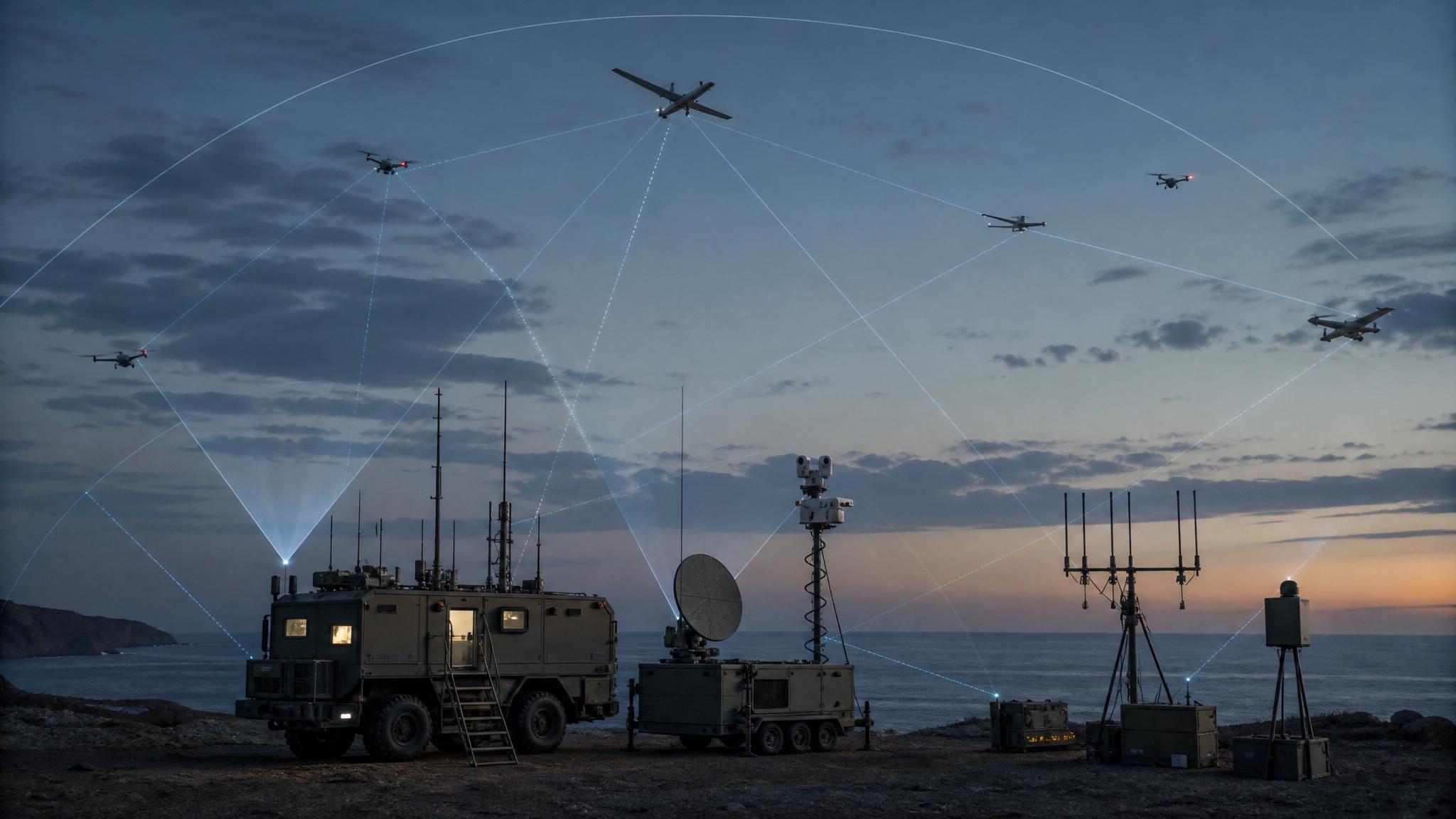
The first judgment made in the article is that the threats posed by unmanned intelligent platforms are characterized by diversification, clustering, and multi-domain distribution. Therefore, countermeasure capabilities can no longer be patched up in response to temporary threats. In today's battlefield environment, this statement is very direct: quadcopters, fixed-wing loitering munitions, low-altitude reconnaissance aircraft, decoy drones, and inexpensive FPVs are not just a model issue but a consumption system that will continuously morph.
Thus, what the PLA truly wants to build is not one or two "counter-drone wonders," but a permanent network composed of all-time monitoring, rapid decision-making, soft and hard coordination, and effect assessment. I believe this is more important than any single piece of equipment's parameters. The difficulty in drone offense and defense does not lie in taking down one drone, but in whether the defense system can maintain identification, allocation, and re-engagement capabilities when facing simultaneous attacks from multiple directions over several hours or days.
Low-Cost Interception is Becoming a Hard Indicator
Recent actions by the United States can serve as a reference. Defense News reported on May 19 that the Pentagon awarded a $500 million counter-drone contract to Perennial Autonomy, with core products including the Merops intercept drone, Bumblebee quadcopter, and Hornet medium-range strike drone. U.S. military officials publicly stated that drones like the Shahed cost about $30,000 to $50,000, while the Merops costs about $15,000. This set of numbers illustrates a problem: counter-drone efforts are not simply about hit rates but about exchange ratios.
This article from China Military Online similarly discusses "being able to defend" and "being able to afford to defend," proposing the establishment of a cost-effectiveness evaluation model based on counteracting data. This suggestion is very technical and pragmatic. If high-value missiles are used to target low-cost drones, it may solve the target issue in the short term but will lead to losses in inventory and finances in the long term. A truly sustainable solution should involve the cost-effective use of radar, electro-optical, radio detection, electronic suppression, kinetic interception, small intercept drones, and close-in firepower.
- Low-threat targets should be prioritized for handling with jamming, decoying, and low-cost interception methods.
- High-value or high-speed targets should only use more expensive hard-kill weapons.
- The command system must assess target value, ammunition costs, and secondary risks in real-time.
For the PLA, the Weakness Lies in Data Feedback Loops
The latter part of the article mentions "full-chain feedback of operational data" and "digital twins and reinforcement learning." This sounds like a technical slogan, but behind it are very specific engineering issues: after a counter-drone exercise, what did the radar miss, where was the electro-optical identification slow, did the electronic suppression mistakenly harm friendly links, and at what distance window is intercepting ammunition most cost-effective? Can this data be fed back into algorithms, equipment modifications, and training outlines?
This is also where I have the most reservations about the current publicly available information. The PLA has made significant investments in radar, electronic warfare, drones, and command information systems, but integrating these systems into a low-latency, reviewable, and iterative feedback loop is much more challenging than procuring individual pieces of equipment. Especially in complex electromagnetic environments, counter-drone systems must detect low, slow, small targets without confusing friendly drones, civilian targets, and decoy targets, which puts pressure on sensor fusion and rule authorization.
The Taiwan Strait Scenario Will Amplify This Issue
If this logic is applied to the Taiwan Strait, the problems will become sharper. Islands, ports, airports, radar stations, fuel and ammunition depots, landing assembly points, and naval formations may all face low-altitude drone reconnaissance and harassment from small attack drones. The PLA has emphasized the offensive capabilities of unmanned equipment in recent years, and now official media are systematically discussing "using unmanned to counter unmanned, using intelligence to counter intelligence," indicating that the defense aspect has been placed on an equal footing.
This does not mean that a new counter-drone equipment will be publicly unveiled immediately. A more likely change is that theater commands, group armies, naval bases, and key air defense units will increase mixed training subjects involving drone saturation attacks, electronic interference, decoy targets, and low-cost interception. One easily overlooked detail is that the strength of future counter-drone capabilities may not depend on the most expensive interceptors but on whether the most ordinary battalion-level units can consistently collect data, modify rules, and control ammunition costs.
In short, the counter-drone system is not a smaller version of air defense systems but a set of new accounts that need to be calculated based on industrial costs, algorithm iterations, and grassroots training.
The real unanswered question is: can the PLA transform this theoretical discussion into counter-drone modules that are mass-producible, maintainable, and can be decentralized to grassroots levels, rather than remaining at the level of a few demonstrations and sample systems?
The People's Liberation Army (PLA) emphasized the development of low-cost and efficient counter-drone systems on May 21. The PLA is shifting its focus from simply acquiring equipment to ensuring sustainable operational costs and effective data feedback loops. This approach is particularly relevant in the context of potential conflicts in the Taiwan Strait, where various drone threats are anticipated.
- PLA emphasizes the need for low-cost and efficient counter-drone systems.
- The focus has shifted from merely acquiring equipment to sustainable operational costs.
- The report discusses the importance of data feedback loops in counter-drone operations.