
The PLA Dali Ship Participates in the 2026 China-Singapore Military Exercise, Exposing New Focus Areas for South China Sea Cooperation in Five Subjects
 Li Minghui
The PLA Dali Ship Participates in the 2026 China-Singapore Military Exercise: Five Key Areas of Focus for South China Sea Cooperation
On September 14, the Ministry of Defense disclosed that the Chinese Navy and the Singapore Navy completed the "Maritime Cooperation - 2026" joint exercise in the maritime and airspace near Zhanjiang, Guangdong, from September 3 to 9. The news itself is not surprising; what is truly informative is the combination of exercise subjects: communication drills, formation maneuvers, live-fire exercises, at-sea replenishment, joint search and rescue, and medical evacuation all took place, with both sides sending observers to participate alongside the ships. This is no longer a simple ship visit, but a set of low-intensity interoperability tests covering everything from communication to logistics, from combat to humanitarian assistance.
What Mission Did a Type 056 Frigate Undertake?
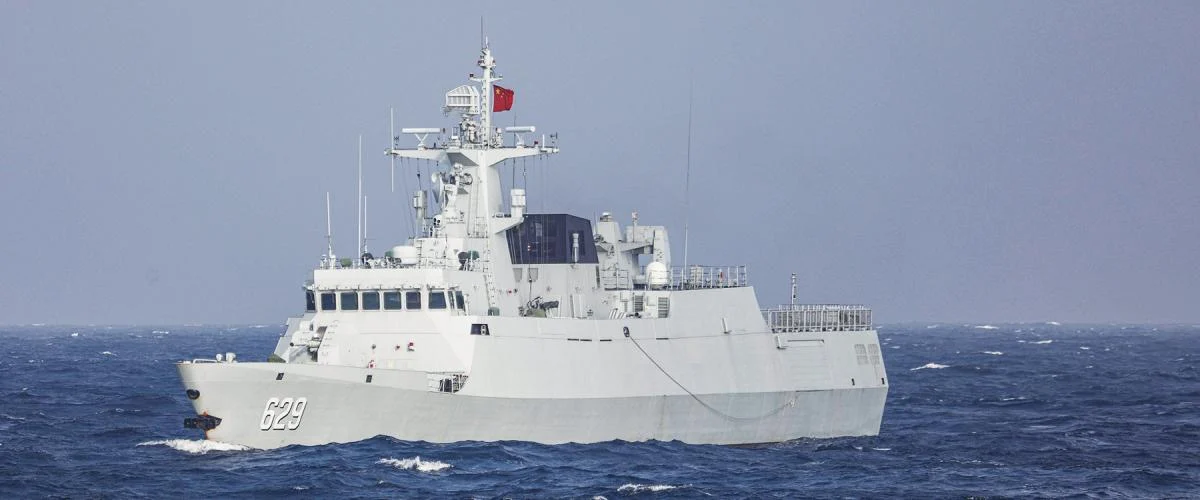
The Chinese participant was the Dali Ship, hull number 629, which belongs to the Type 056 light frigate class. This type of ship has a full-load displacement of about 1,300 to 1,500 tons and is typically equipped with a 76mm naval gun, anti-ship missiles, and short-range air defense weapons. The focus is not on single-ship long-range combat, but rather on near-shore patrol, escort, anti-ship operations, and formation coordination. The Singaporean "Formidable" class frigate, on the other hand, belongs to the main frigate series of the Singapore Navy, with a higher tonnage, sensors, and air defense configuration than the Type 056. Placing these two ships in the same exercise creates functional complementarity rather than an equipment competition.
So what does this mean? The Chinese Navy did not use a Type 055 destroyer or an aircraft carrier to showcase its strength, but instead chose a lower-cost, more numerous near-shore combat vessel. For Southeast Asian countries, this arrangement reduces political pressure and is more aligned with the actual needs for maritime law enforcement support, escort, and disaster relief. For the PLA, the Type 056 ship serves as a suitable platform to test whether grassroots vessels can stably execute communication, replenishment, and rescue processes in a multinational formation.
Exercise Subjects Are More Worth Analyzing Than Ship Tonnage
Live-fire exercises may easily become the focus of reports, but communication drills and at-sea replenishment are the hard thresholds for joint operations. Different navies use different data links, radio procedures, navigation rules, and damage control standards. While formation maneuvers may seem simple, they actually involve speed control, formation maintenance, collision avoidance, and command authority. At-sea replenishment goes a step further, requiring both sides to coordinate course, distance, and personnel safety under relatively stable sea conditions. Public information did not specify which communication protocols were used, nor did it disclose the details of the shooting subjects, target types, and hit results; these capabilities should not be overestimated simply because the exercise was "completed."
The value of joint search and rescue and medical evacuation should not be underestimated either. Singapore has long operated a blue-water navy and a multinational training network, while the Chinese Navy has experience in escorting in the Gulf of Aden and large-scale fleet operations. Integrating search and rescue, medical evacuation, and observer mechanisms into the same process is essentially establishing a minimum cooperative language in times of crisis. I believe this is more practical than a high-profile formation sailing, as the probability of maritime accidents, merchant ship distress, and natural disasters is far higher than the sudden formation of a combat alliance between China and Singapore.
How Much Space Do Beijing and Singapore Each Retain?
This is the fifth time the two navies have held this series of joint exercises in recent years, and the frequency indicates that mutual trust is accumulating, but it is still not a signal of a military alliance. Singapore needs to maintain security ties with the United States, Australia, India, and ASEAN partners simultaneously and will not abandon its strategic autonomy just because it conducts joint exercises with China; China, on the other hand, hopes to partially detach maritime security issues from the narrative of great power competition through professional cooperation, showcasing another side of its role as a regional security participant.
The timing is also intriguing. The exercise was only disclosed by the Ministry of Defense during a routine press conference after its conclusion, indicating that the focus of communication is closer to "stabilizing the periphery" and "pragmatic cooperation," rather than showcasing new weapons. On September 16, Defense Minister Dong Jun stated at the 13th Beijing Xiangshan Forum that China is willing to share experiences in military building and governance, and to carry out joint disaster relief, emergency response, and humanitarian assistance cooperation. When viewed together, these two messages suggest that the PLA is packaging its joint operational capabilities as an exportable public safety product.
Of course, one cannot directly infer a common operational capability in the South China Sea crisis from an exercise conducted from September 3 to 9. The exercise did not publicly disclose complex electromagnetic countermeasures, submarine coordination, long-range air defense, or joint anti-submarine content, and whether the two sides' advanced combat systems can interconnect remains unanswered. What is truly worth tracking is whether the sixth joint exercise will advance from port exchanges and basic subjects to longer-term sustained operations at sea, and whether Singapore is willing to take another step in data sharing and joint command.
Sources
- Ministry of National Defense of the People's Republic of China, Routine Press Release by the Ministry of Defense in Mid-September 2026, September 14, 2026
- China Military Network, Routine Press Release by the Ministry of Defense in Mid-September 2026, September 14, 2026
- Xinhua News Agency, China ready to share military building experience as PLA approaches centenary, September 16, 2026
The People's Liberation Army Navy conducted a joint naval exercise with the Singapore Navy from September 3 to 9, 2026, near Zhanjiang, Guangdong, China. The exercise included various activities such as communication drills, live-fire exercises, and joint search and rescue operations, focusing on operational interoperability. The Dali frigate represented China, highlighting a shift towards lower-cost naval assets for regional cooperation.
- The joint exercise took place from September 3 to 9, 2026, near Zhanjiang, Guangdong, China.
- The exercise involved communication drills, formation maneuvers, live-fire exercises, maritime resupply, joint search and rescue, and casualty evacuation.
- The Chinese side was represented by the Dali frigate (hull number 629), a 056-class light frigate.
- The exercise aimed to test low-intensity interoperability between the two navies.
- This was the fifth joint exercise between the Chinese and Singaporean navies, indicating growing mutual trust.