
The PLA's New Equipment in 2026 is Coming Too Quickly, Revealing Shortcomings in Unmanned System Training
 Li Minghui
The PLA's New Equipment in 2026 is Being Introduced Too Quickly, Exposing Shortcomings in Unmanned System Training
On May 19, the South China Morning Post cited a rare reminder from the PLA Daily: some units are still not solid enough in the integration of personnel and equipment, lacking sufficient trust in new systems, and the synergy between people and technology is relatively weak. This statement is more interesting than the usual propaganda because it does not continue to list the J-20, Type 055 destroyers, DF-17, and various unmanned platforms, but instead brings the issue down to a more fundamental level: after the equipment is in place, who will truly make good use of it.
The Problem is Not the Equipment List
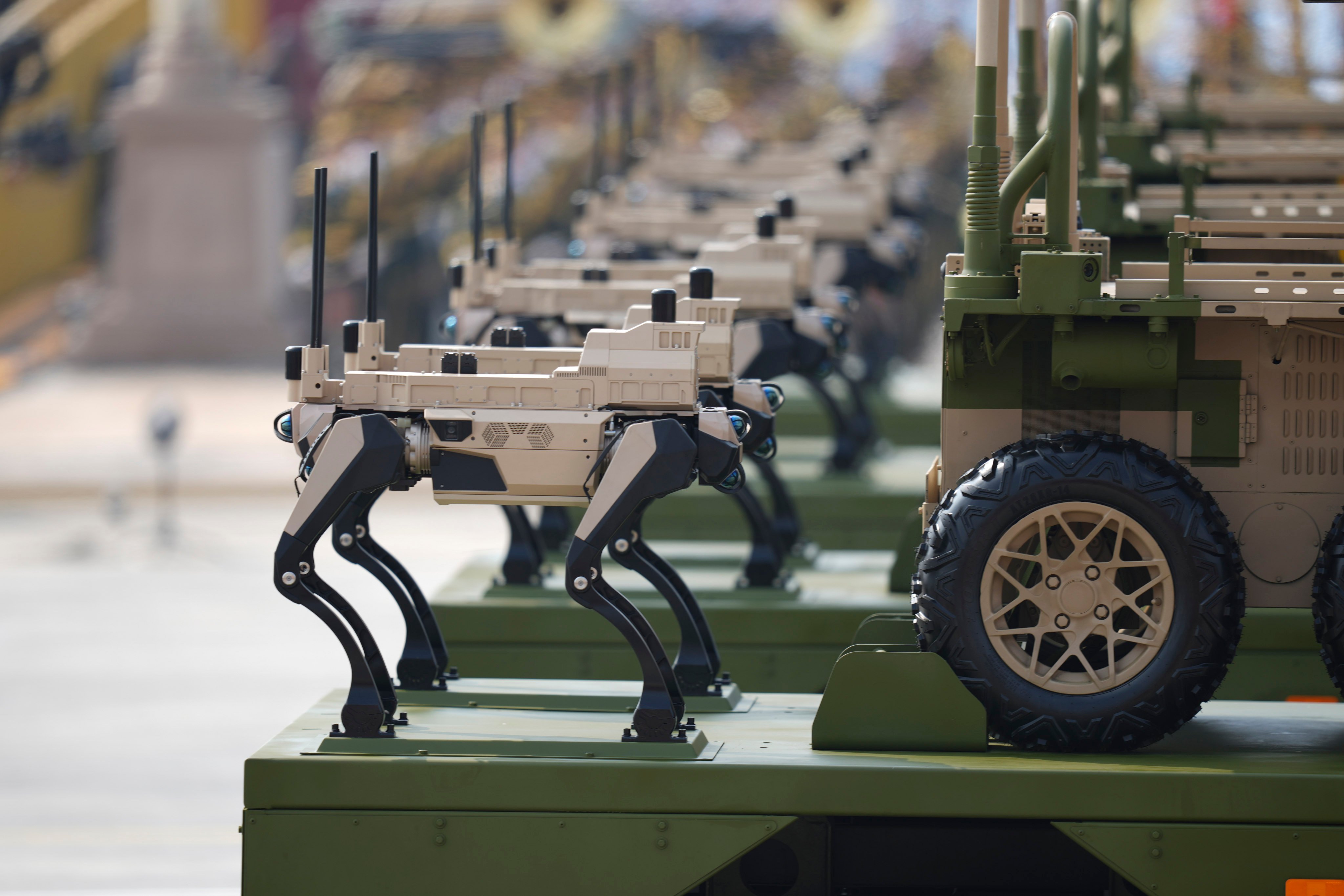
The above image is a schematic of a new unmanned ground system, not from a specific training site. It is suitable for illustrating the core of this discussion: the PLA's fastest catch-up in recent years has not been in traditional artillery or tanks, but in unmanned, intelligent, and long-range precision strike equipment. The SCMP report mentioned that the PLA Daily acknowledged the large-scale distribution of new equipment, especially the widespread entry of unmanned and intelligent systems into the troops, but if personnel technical literacy does not keep up, then there can be no effective human-machine collaboration.
The original intent of the PLA Daily is very straightforward: no matter how advanced the equipment is, if the operators cannot effectively control it, it is just cold steel.
Training Speed is Being Caught Up by Technical Complexity
The annual training commencement of the PLA at the beginning of this year has already demonstrated this trend. Army Recognition, based on CCTV and publicly available footage, reported that training subjects simultaneously featured the J-20, Type 055 destroyer Nanchang, Type 052D Xining, Type 054A Weifang, DF-17, as well as unmanned aerial and ground systems. The 79th Group Army's unit exercises even integrated reconnaissance drones, bombing drones, smoke drones, and first-person perspective cruise missiles into the same squad operational process.
In simple terms, this is not a problem that can be solved by just buying a few more drones. If an infantry squad needs to simultaneously receive drone imagery, assess electromagnetic interference, call for fire support, maintain communication links, and prevent friendly fire, the training burden will increase exponentially. The same applies to fleets and air forces; the Type 055 destroyer has 128 vertical launch system cells, and for the J-20 to operate in distant seas, conduct night refueling, and engage in system confrontations, what they truly consume is the speed of the commander's judgment, data link discipline, and maintenance support rhythm.
The Faster the Unmanned Systems, the More Obvious the Human Shortcomings
There is also a detail that is easily overlooked. The SCMP reported on May 10 during the Chengdu Defense Exhibition that China showcased autonomous underwater vehicles that can be launched from 260mm or 533mm torpedo tubes, with larger models capable of diving to about 3000 meters and also equipped with detection and mine-sweeping modules. Such equipment appears very advanced, but it poses cross-disciplinary requirements for the troops: submarine personnel need to understand underwater robots, mine countermeasure units need to understand autonomous navigation, and the command chain must accept a new process where machines detect first and personnel decide later.
I believe that this reminder from the PLA Daily does not indicate a setback in the PLA's modernization; rather, it precisely illustrates that hardware expansion has entered its second phase. The first phase is "whether there is": Is there a J-20, a Type 055, a DF-17, unmanned platforms? The second phase is "whether stable combat power can be formed": Can different military branches share targets, do grassroots officers dare to rely on algorithms, and can the support system sustain high-intensity training?
The Real Test is the System's Digestive Capacity
From the perspective of the Western Pacific, this issue will directly affect the PLA's operational tempo. Hardware parameters can be showcased at exhibitions and parades, but the system's digestive capacity can only be revealed through continuous training. In the coming year, what is worth watching is not which new unmanned platform has emerged, but whether these platforms begin to be systematically integrated into the daily subjects of brigades, fleets, and air force units. The most critical question remains unanswered: the speed at which the PLA's new equipment is being deployed is very fast, but can the learning curve of grassroots commanders keep pace with the delivery curve of the military-industrial system?
The People's Liberation Army (PLA) is rapidly integrating new unmanned and intelligent systems, but faces significant challenges in personnel training and technology adaptation. A report from PLA Daily emphasizes that without effective training, advanced equipment remains underutilized. The PLA's modernization efforts are now focused on ensuring operational effectiveness and collaboration between personnel and technology.
- The PLA is integrating new unmanned and intelligent systems into its forces.
- There is a noted lack of personnel training to effectively use these new systems.
- The report highlights the need for better human-technology collaboration in military operations.
- The PLA's modernization is entering a second phase focused on operational effectiveness rather than just equipment acquisition.
- The ability of commanders to adapt to new technologies is crucial for maintaining combat readiness.