
The presence of KC-46A and KC-135R in Israel until 2027 makes American fuel a prerequisite for striking Iran.
 Ahmed Al-Rashid
The Presence of KC-46A and KC-135R in Israel Until 2027 Makes American Fuel a Condition for Striking Iran
On May 18, 2026, Israeli Channel 12 revealed that dozens of American refueling aircraft stationed at Ben Gurion and Ramon airports may remain in Israel until at least the end of 2027. The news does not discuss an additional aircraft or new munitions, but rather something more sensitive in any long-range war: fuel in the air. From a military perspective, this is not a side logistical issue, but the dividing line between a symbolic strike against Iran and an air campaign that can be repeated multiple times.
Army Recognition's report linked this infrastructure to the KC-46A Pegasus and KC-135R Stratotanker aircraft, noting that the initial deployment in late February included at least nine KC-46A and five KC-135R, and that the number at Ben Gurion may have exceeded thirty aircraft during peak operations in March. The report also mentioned an immediate aerial refueling capacity exceeding 2.5 million kilograms during a full sortie cycle. These figures explain why the Israeli Civil Aviation Authority was disturbed by the transformation of Ben Gurion, as reported in the Hebrew Mako report, into something resembling a military base rather than a normal civilian airport.
The Civilian Runway That Became a Military Node
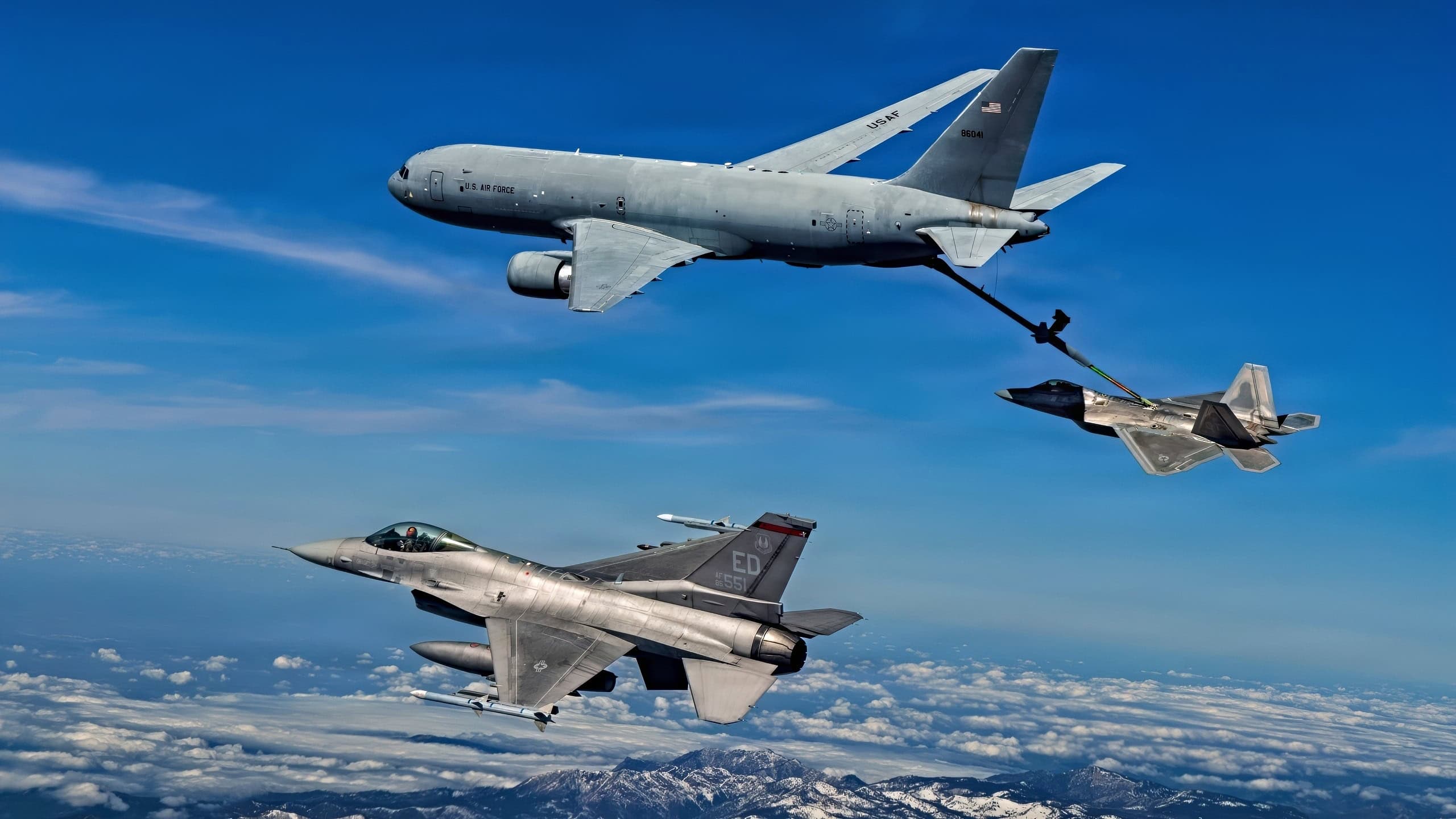
Illustrative image of a US KC-46A aircraft, not a confirmed image from Ben Gurion or Ramon.
The choice of Ben Gurion is not coincidental. Runway 08/26 is about 4,062 meters long, and runway 12/30 is about 3,112 meters long, allowing for the operation of heavy aircraft in the heat of the Eastern Mediterranean and at high takeoff weights. Ramon Airport in the south provides additional depth and opens a less congested route toward the Red Sea or eastern corridors. However, placing large American aircraft in Israeli civilian airports creates a clear paradox: Israel gains additional military capability, but pays a price in civil aviation operations, and in the perception that its airports are no longer distant from war calculations.
Any military personnel who have served in the region know that a base is not just concrete and a runway. A base is fuel, maintenance crews, security, spare parts inventory, communication networks, and airspace management under missile alert. When these elements remain until 2027, the message is not that a strike is coming tomorrow, but that Washington does not want to dismantle the capability that makes the strike possible if the political path fails.
Why Old Israeli Refueling Aircraft Are Not Enough
Israel has about six or seven KC-707 Re'em aircraft built on old Boeing 707 airframes. These aircraft have served for a long time, but they belong to a different generation of air warfare. Their maintenance is more difficult, their operational availability is limited, and their ability to sustain a long campaign against distant Iranian targets is not guaranteed. The distance from Israel to Tehran is about 1,600 kilometers, to Fordow about 1,500 kilometers, and to Bandar Abbas about 2,000 kilometers. These distances do not seem impossible on a map, but they become arduous when an F-15I carries heavy munitions, and an F-35I needs winding routes to reduce exposure, and returning aircraft have to wait due to missile alerts over Israel.
This is where the value of the KC-46A emerges. Boeing data places its fuel capacity at about 212,000 pounds, or approximately 96,000 kilograms, with the ability to use both boom and hose-and-drogue systems, servicing multiple American and allied aircraft. The KC-135R, despite its design age, remains a reliable refueling platform, capable of carrying about 90,000 kilograms of fuel that can be adjusted according to mission conditions. The practical difference is that a network of these American aircraft gives Israel a larger margin for error: longer sorties, heavier payloads, longer air defense patrols, and the ability to recover aircraft returning with near-empty tanks.
The Real Power Is Not Just in the F-35I
The Israeli and Western discourse tends to focus on the F-35I Adir and F-15I Ra'am and bunker-busting munitions. This is understandable from a media perspective, but it is militarily incomplete. A fighter that cannot find fuel at the right point becomes a costly asset with limited range. Therefore, the presence of KC-46A and KC-135R in Israel reveals that the heart of the air campaign is not just the stealth aircraft, but an invisible support chain that connects the runway to the tanker to the fighter to the command center.
In my view, this point puts Gulf countries in front of an uncomfortable lesson. Many Arab capitals have purchased excellent fighters, from F-15 to Rafale and Typhoon, but they have not built to the same extent an aerial refueling system, maintenance, sortie planning, munitions inventory, and alternative bases. Buying the platform is easier than building the institution that enables it to fight for two continuous weeks. This is the triangle of capability that I always return to: equipment, training, and institution. Israel has the equipment and training, but in the long-range file, it still needs the American airborne institution.
Iran Reads Fuel as a Deterrent Signal
For Tehran, the presence of dozens of tankers does not only signify readiness for a new strike. It means that the United States wants to keep the option of escalation executable quickly. The tanker is a relatively soft target if it approaches a threat area, and therefore usually operates outside the range of enemy defenses. However, Iran does not necessarily need to shoot down the tanker to affect calculations; it is enough to threaten the corridors, or pressure the reception bases, or raise the cost of protecting these aircraft. This is why we see increasing American interest in hard protection systems for tankers and transport aircraft, as modern warfare makes rear assets less rear than they used to be.
The political risk is also present. When Israeli civilian airports become part of the structure of an American-Israeli campaign against Iran, the line between civilian and military weakens. This does not give Iran legitimacy to strike civilians, but it provides them with propaganda material and increases pressure on airlines and insurance companies regarding Israel. Hence, the decision to keep the tankers until 2027 is both a deterrent decision and a cost decision at the same time.
Conclusion
The most important lesson from the presence of KC-46A and KC-135R in Israel is that air independence is not measured solely by the number of fighters. Israel is receiving its first KC-46 Gideon after test flights in the United States, and it has a program that may reach six or eight aircraft, but a deep and extended campaign against Iran still requires an American shoulder. As the old military saying goes, amateurs talk about weapons, and professionals talk about logistics. In today's Middle East, logistics is not a truck in the back, but a fuel aircraft over the Mediterranean.
This is the paradox that cannot be hidden: Israel wants the freedom to strike far, the United States wants to control the pace of escalation, and Iran wants to raise the cost for both. Between these three objectives, the American tanker at Ben Gurion becomes a political tool as much as it is a logistical platform.
U.S. Air Force refueling aircraft, including at least 9 KC-46A and 5 KC-135R, will remain stationed in Israel until at least the end of 2027, enhancing military capabilities against Iran. This presence allows for significant aerial refueling capacity, crucial for potential military operations. The use of Ben Gurion Airport as a military base indicates a shift in its operational role, impacting civilian air traffic and regional military dynamics.
- U.S. refueling aircraft KC-46A and KC-135R will remain in Israel until at least 2027.
- The presence of these aircraft enhances Israel's military capabilities against Iran.
- Ben Gurion Airport is being used as a military base rather than a civilian airport.
- The U.S. aims to maintain a rapid escalation option against Iran.
- Israel's older refueling aircraft are less capable for long-range missions.