
The Pressure of the U.S. Navy's $70 Million CHAOS Cruise Missile Contract on Japan's Type 12 and the First Island Chain
 Tanaka Takashi
The Pressure of the U.S. Navy's $70 Million CHAOS Cruise Missile Contract on Japan's Type 12 and the First Island Chain
The $70 million contract announced by the U.S. Navy on July 22 is not merely an order for prototypes of a new type of cruise missile. CHAOS, or Coalition Heterogeneous Affordable Offensive Strike, based on CoAspire's RAACM-ER ground-launched variant, is a plan to provide affordable and easily mass-producible medium-range anti-ship strike capabilities for allied and partner nations. What I find noteworthy is that the U.S. side has designed this weapon with FMS customers in mind from the very beginning, rather than focusing solely on range or warhead weight.
The Concept of Affordable Anti-Ship Firepower
According to Naval News, CHAOS will be delivered to the U.S. Navy's PMX-201 as a ground-launched medium-range cruise missile capable of attacking both moving maritime and land targets. CoAspire has 56 primary suppliers and claims that additive manufacturing will increase the speed of design changes and mass production. While this explanation has a promotional tone, it reflects the U.S. Navy's awareness that conventional, expensive anti-ship missiles alone cannot sustain ammunition consumption in the Western Pacific.
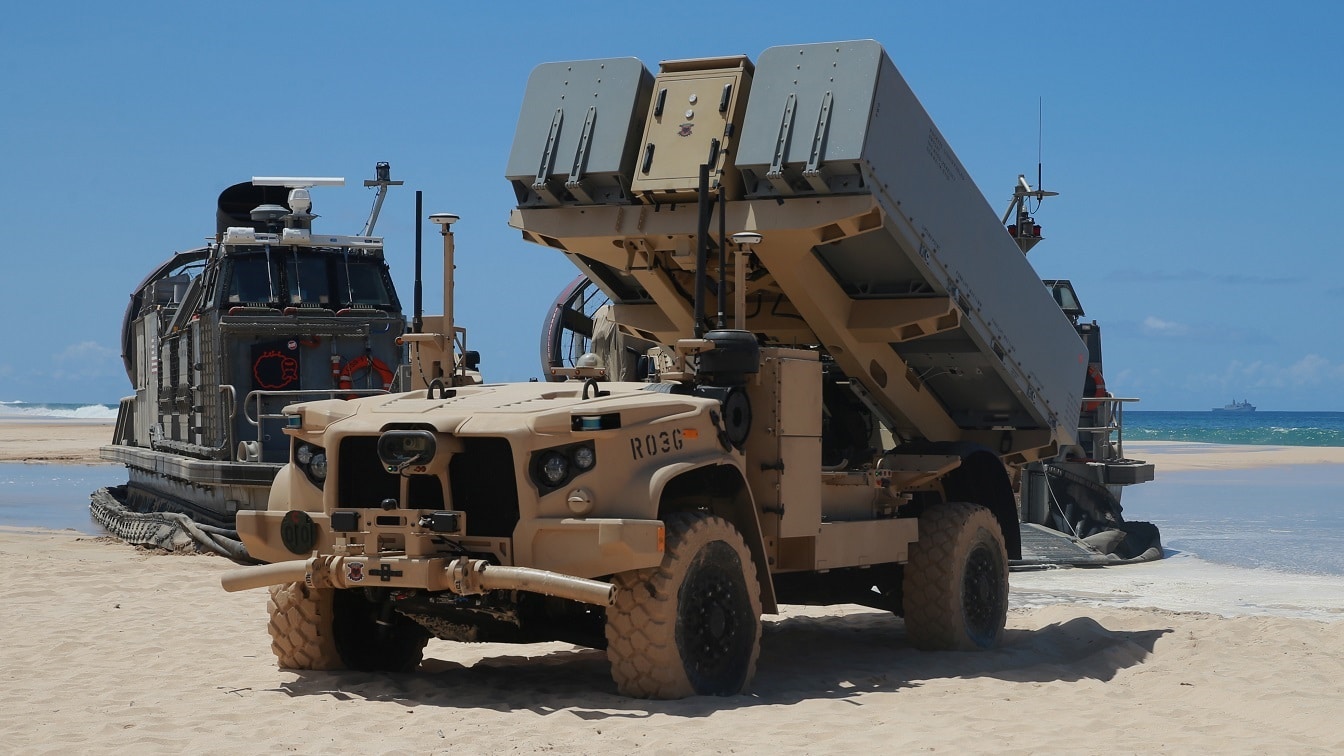
This trend connects with the NMESIS deployed with the 12th Marine Littoral Regiment in Okinawa. Defense News reported in June that the regiment officially received NMESIS and MADIS. NMESIS is a coastal denial weapon that mounts the Naval Strike Missile on JLTV-type vehicles, while MADIS is responsible for air defense against small drones and low-altitude targets. In other words, the U.S. Marine Corps is moving towards combining anti-ship firepower and short-range air defense at small unit levels around the southwestern islands.
Discrepancies with Japan's Type 12 Capability Enhancement
Japan has also indicated a policy to extend the range of its Type 12 anti-ship guided missile capability enhancement from the conventional approximately 200 kilometers to around 1,000 kilometers. This is a core equipment related to Japan's own counterstrike capability and differs in nature from CHAOS. The Type 12 represents domestically produced long-range capabilities, while CHAOS is positioned as a mass-produced fill-in weapon that allied nations can acquire relatively quickly.
However, in practical terms along the First Island Chain, the two do not compete. Rather, the issue is where to place which launchers and how many rounds of ammunition on which islands. Considering Miyako, Ishigaki, Yonaguni, and further rear bases in Kyushu and Okinawa, the constraints on operations will be more about transport, concealment, reloading, and maintaining communications than the missiles themselves. From the Japan Maritime Self-Defense Force's experience, vulnerabilities in ports and ammunition supply points can more quickly constrain operational continuity than visible vessels at sea.
Allied Options Increase, but Political Burdens Also Rise
The significance of CHAOS lies in the fact that the U.S. has begun to seek not only "high-performance elite forces" from its allies but also "numerous firepower that can be replaced if lost." Whether Japan will adopt this remains uncertain, and there is currently no procurement plan in place. However, when considering the coastal defense networks of partner nations including the Philippines, Australia, and Japan, the likelihood that the U.S. will present affordable anti-ship weapons that are easy to standardize has increased.
This is not just a convenient situation for Japan. Accepting affordable U.S.-made missiles would deepen cooperation on ammunition sharing, target information, and rules of engagement. Conversely, relying solely on the domestically produced Type 12 would mean Japan would bear the issues of production speed and cost alone. Both choices have their advantages and constraints.
Affordable anti-ship missiles for allied nations represent not only an inexpensive deterrent but also a political commitment that is not inexpensive.
In my view, the greatest implication of CHAOS is not that "new missiles will increase." In the defense of the southwestern islands, the questions will be about who stores the ammunition, who provides target information, and who bears the delays in launch decisions, rather than the number of launchers. If weapons are increased without clarifying these points, the firepower network along the First Island Chain may appear robust, but in reality, it will be suspended by a thin thread of political judgment.
The U.S. Navy awarded a $70 million contract for the development of CHAOS cruise missiles, intended to enhance anti-ship capabilities for allied nations. This initiative connects with the 12th Marine Regiment's recent acquisition of NMESIS and MADIS systems in Okinawa. Japan is also working to extend its 12-type anti-ship missile range to 1000 km, indicating a shift in regional defense strategies. The introduction of affordable missile systems like CHAOS may influence Japan's military procurement decisions.
- U.S. Navy awarded a $70 million contract for CHAOS cruise missiles.
- CHAOS missiles are designed for both land and sea targets.
- The 12th Marine Regiment in Okinawa received NMESIS and MADIS systems.
- Japan plans to enhance its 12-type anti-ship missile range to 1000 km.
- The introduction of CHAOS may affect Japan's defense procurement strategy.