
The Qi Jiguang Ship and Kunlun Mountain Ship Conduct Long-Distance Training in 2026, Transforming the PLA Navy's Amphibious Platforms into Mobile Classrooms
 Li Minghui
The Qi Jiguang and Kunlun Mountain Ships Conduct Far-Sea Training in 2026: The PLA Navy Transforms Amphibious Platforms into Mobile Classrooms
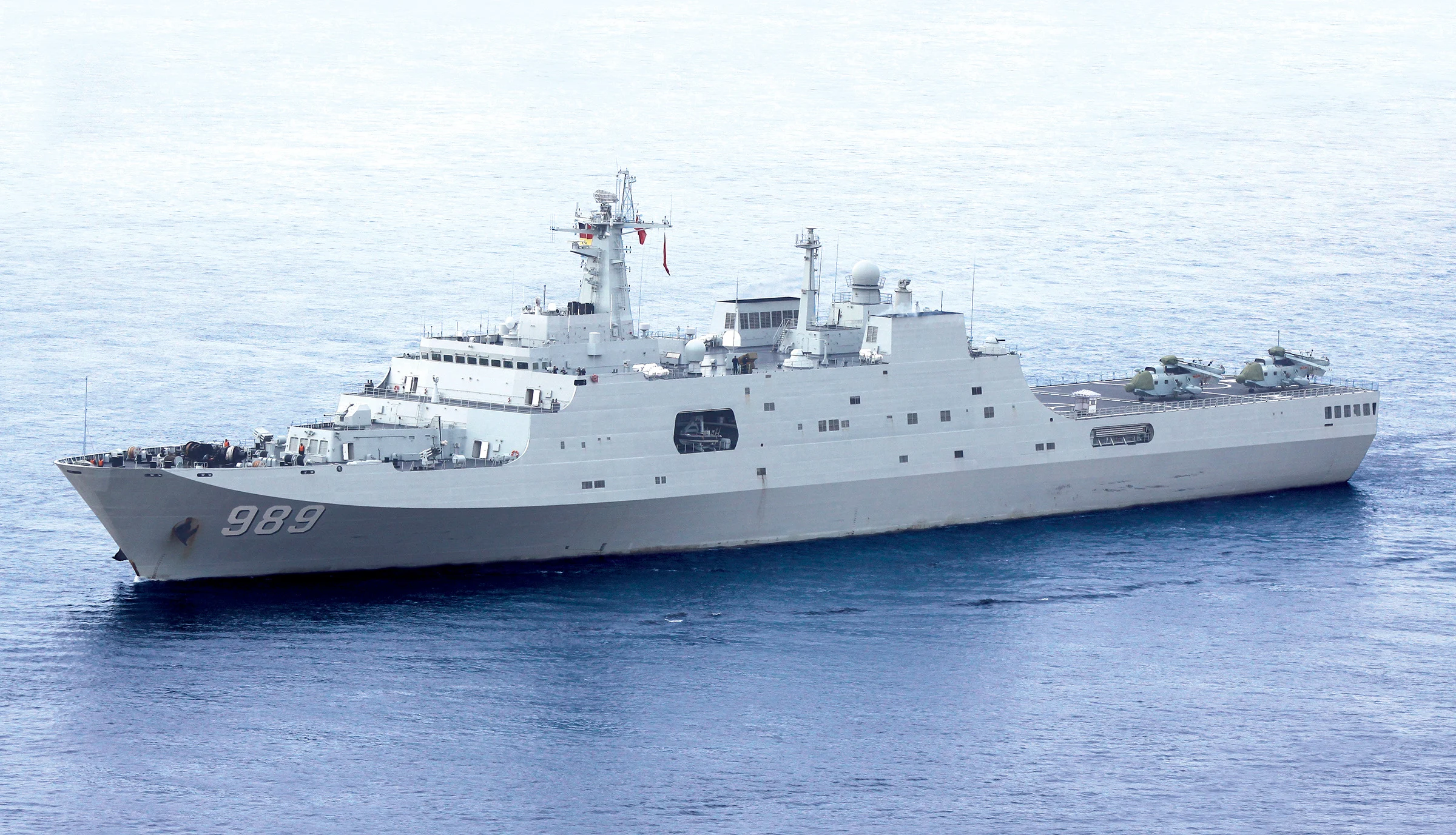
The small task force that set sail from Qingdao on June 15 appears to be just a routine far-sea training and visit mission. However, there is a more interesting detail in the official report: the task force is not solely composed of the training ship Qi Jiguang, but rather consists of the Qi Jiguang (No. 83) and the Type 071 amphibious transport dock Kunlun Mountain (No. 998), carrying over 400 instructors and trainees, as well as more than 20 foreign military trainees from 10 countries, including Myanmar and Brazil.
This is not a news story that can be summarized with the phrase "the navy of a great power ventures into the deep blue." I prefer to view it as a small change in the training methods of the PLA Navy academies: classrooms are being moved to real far-sea routes and large operational platforms.
Why Does a Training Ship Need to Bring Along a Type 071?
The Qi Jiguang is a dedicated training ship, with public information indicating a full displacement of about 9,000 tons, a length of approximately 163 meters, and a range of about 10,000 nautical miles. It is designed to serve far-sea navigation, ship handling, and provide living and teaching space for trainees. It functions like a school floating on the sea, suitable for astronomical navigation, terrestrial navigation, engine room training, and job internships.
The Kunlun Mountain, on the other hand, is a different type of platform. The Type 071 amphibious transport dock typically has a full displacement of over 20,000 tons, equipped with a dock chamber, flight deck, vehicle deck, and strong personnel loading capacity. It is originally intended for amphibious deployment, troop transport, maritime support, and non-combat military operations. Including such a ship in the training task force means that it is not just about teaching trainees "how to operate a ship," but also about helping them understand how far-sea task forces are organized on large integrated platforms.
In simple terms, the training ship can teach basic navigation, while the Type 071 can teach maritime task systems. Together, trainees see a complete process from navigation to deck scheduling, from personnel management to organizing temporary port visits.
The Training Subjects Reveal Not Showmanship but Remedial Education
The official list of subjects includes terrestrial navigation, astronomical navigation, and practical training, and will incorporate on-site teaching and specialized lectures based on the navigated sea areas. Many readers may find these topics quite basic, but what the navy truly fears in far-sea operations is precisely the lack of solid foundational training.
Modern vessels certainly rely heavily on satellite navigation, data links, and automated systems, but once they enter an environment of electromagnetic suppression, limited communication, or complex weather conditions, traditional navigation skills, damage control awareness, and inter-departmental coordination become crucial again. The Russia-Ukraine conflict and the Red Sea escort missions repeatedly highlight one issue: advanced equipment does not equate to a mature system; a mature system first depends on whether personnel can maintain procedures under pressure.
This is also why I believe this task force is worth writing about. It does not have the same visibility as an aircraft carrier venturing into far seas, but it holds more foundational significance for the navy's long-term combat capability. The Chinese navy has launched ships rapidly over the past decade, with the 052D, 055, 075, 901 supply ships, and a batch of new auxiliary vessels continuously entering service, leading hardware expansion. The problem is that the training cycles for far-sea ship captains, department heads, aviation support officers, and amphibious operation staff cannot be compressed like shipbuilding.
Foreign Military Trainees Serve as Diplomacy and Standard Display
This mission carries over 20 foreign military trainees from 10 countries. While the number is not large, the choice to include them in a far-sea training mission rather than onshore visits or short-term studies indicates that the navy aims to showcase not just equipment photos, but also its training organization methods.
This arrangement serves two purposes. First, it can facilitate military diplomacy, especially in cooperation with naval academies in the Global South. Second, it also subtly promotes the training standards and platform ecosystem of the Chinese navy. A trainee from a small or medium-sized country's navy who has completed courses in navigation, deck operations, damage control, and port organization on the Qi Jiguang and Type 071 will have a much lower threshold for understanding Chinese vessels, equipment, and training language in the future.
However, it is important to maintain a level of caution here. The participation of foreign military trainees does not equate to forming military alliances, nor should it be simply understood as some form of bloc expansion. It is more akin to long-term relationship building; a single training voyage will not immediately alter the regional balance of power, but it will increase the Chinese navy's presence in professional networks.
The Real Highlight Lies in Talent Production Capacity
From a production capacity perspective, the number of vessels is just the first layer of accounting. The real challenge is calculating the output speed of qualified officers and non-commissioned officers. Large amphibious platforms like the Type 071 require not just single-role personnel, but also composite personnel who can organize boat-machine coordination, vehicle loading, casualty evacuation, temporary resupply, and port coordination. The combination of the Qi Jiguang and Kunlun Mountain ships perfectly connects academy teaching with real task platforms.
This is significant for the PLA Navy's future two types of missions. One type involves amphibious operations, blockade, and transport support in the Taiwan Strait and coastal areas; the other involves more distant missions such as evacuation, disaster relief, escort, and port visits. While these two types may seem quite different, their underlying capabilities are inseparable from far-sea navigation, personnel organization, and platform scheduling.
My question is: will this "training ship plus task ship" model evolve from individual voyages into a fixed system? If in the future there are multiple batches of trainees completing modular training on Type 071, 075, comprehensive supply ships, or even aircraft carrier task forces each year, then the Chinese navy will not just be filling in navigation courses, but addressing the production capacity shortfall of far-sea officers.
On June 15, 2026, the People's Liberation Army Navy (PLAN) launched a training exercise from Qingdao involving the Qijiang-class training ship and Type 071 amphibious transport dock. The exercise included over 400 personnel, including foreign military students from 10 countries, focusing on naval operations and education on large operational platforms. This initiative aims to improve the operational capabilities of naval officers.
- The Qijiang-class training ship and Type 071 amphibious transport dock participated in a training exercise.
- Over 400 personnel, including foreign military students from 10 countries, were involved.
- The exercise took place off the coast of Qingdao on June 15, 2026.
- The training focused on navigation, deck operations, and emergency management.
- The exercise aims to enhance the operational capabilities of naval officers.