
The Reality of Japan-U.S. Island Defense Demonstrated by NMESIS and the Improved Type 12 on Yonaguni Island on October 19, 2026
 Tanaka Takashi
The Reality of Japan-U.S. Island Defense Demonstrated by NMESIS and the Improved Type 12 on Yonaguni Island on October 19, 2026
From October 19 to 29, the Japan-U.S. joint integrated exercise "Keen Sword" will take place, where the U.S. Marine Corps' NMESIS (Naval Mobile Launchers for Anti-Ship Missiles) and MADIS (Mobile Air Defense Integrated System) will be deployed for the first time on Yonaguni Island. It is noteworthy that, rather than large vessels of the Japan Maritime Self-Defense Force, mobile missile units will take center stage in the exercise on an island located about 110 kilometers from Taiwan.
Equipment Brought to the Island
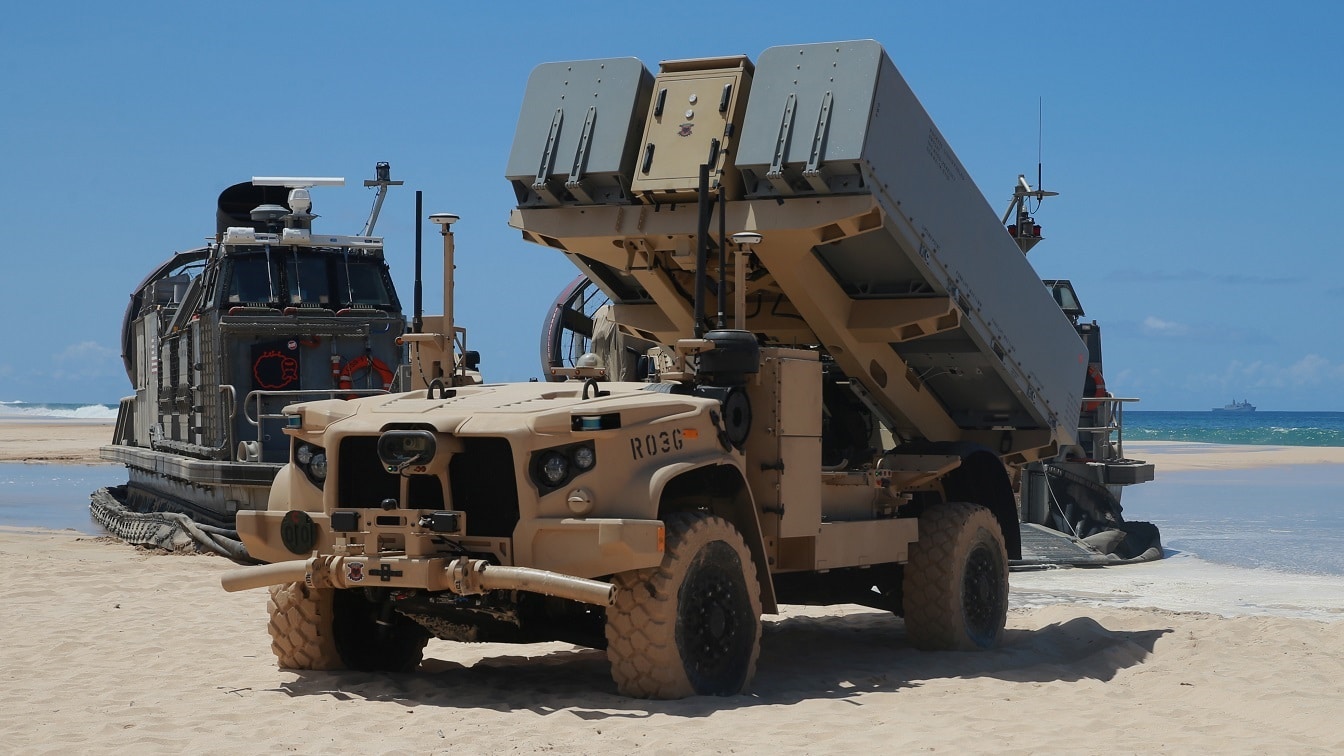
- NMESIS: An anti-ship system based on the Marine Corps' unmanned launch vehicle, with a range of approximately 185 kilometers.
- MADIS: Accompanies small units and is responsible for close air defense against low-altitude threats such as drones.
- Japan Ground Self-Defense Force: Operates the improved Type 12 anti-ship guided missile (Type-25 SSM mentioned in the article) with a range of about 1,000 kilometers, the Type 88 anti-ship missile, and the Type 03 medium-range surface-to-air missile (SAM).
- U.S. Army: Plans to deploy HIMARS on Ishigaki Island, with the movement of Typhon launchers to Okinawa also scheduled.
According to the Ministry of Defense, this is a large-scale exercise involving approximately 45,000 Self-Defense Force personnel from nine countries. However, the key feature of this exercise is not the number of participants, but the distribution of firepower and air defense across multiple islands, while sharing sensor information to deny access to the maritime area.
From "Fleet-Centric" to SLOC Defense
In traditional island defense exercises, escort ships and aircraft have taken the lead, with islands often treated as forward bases. In this case, however, mobile launchers will move using roads, ports, and temporary positions. Even if subjected to initial attacks from enemy satellites, drones, and missiles, the design minimizes the direct correlation between the loss of a single base and the overall loss of firepower.
This operation differs from the notion of viewing the southwestern islands merely as a "buffer." The dispersed units on Yonaguni, Ishigaki, and Miyako create multiple firing options for the SLOC (Sea Lines of Communication) around Taiwan and the East China Sea. Although the range of NMESIS is shorter than that of the improved Type 12, the ability of small U.S. Marine Corps units to change positions quickly is valuable. Conversely, Japan's long-range missiles will not demonstrate the deterrent effect indicated by their numbers without target information and rules of engagement.
Practical Challenges of the Alliance Beyond Capability
This exercise, which does not feature aircraft carrier strike groups prominently, indicates that Japan and the U.S. are transitioning from a defense strategy of "waiting for vessels to arrive" to one that places continuous denial capabilities on the islands. However, this dispersed configuration creates additional burdens related to supply, maintenance, communication, and the use of civilian ports. In Yonaguni, the use of Kubura Port and local roads for transporting large equipment has raised concerns among local authorities about training that exceeds the island's handling capacity.
Rationality in defense alone does not automatically secure the agreement of the island's residents. The weakness of the Japan-U.S. alliance lies not in the range of missiles, but in the ability to maintain necessary fuel, parts, and communication lines before an attack occurs, and whether political decisions can be made regarding the use of ports and roads. What will truly be tested in this Keen Sword exercise is not the mobility of the launchers, but the support of the islands' rear areas that sustain that mobility.
References
The U.S. Marine Corps deployed NMESIS and MADIS systems on Yonaguni Island for the first time during the joint military exercise 'Keen Sword' from October 19 to 29, 2026. Approximately 45,000 personnel from 9 countries participated, focusing on distributed firepower and air defense across multiple islands. Logistical concerns were raised regarding the transport of large equipment on the island.
- The U.S. Marine Corps is deploying NMESIS and MADIS systems for the first time in a joint exercise.
- The exercise involves approximately 45,000 personnel from 9 countries.
- The focus is on distributed firepower and air defense across multiple islands.
- The exercise runs from October 19 to 29, 2026.
- Logistical challenges are raised regarding the transport of large equipment on Yonaguni Island.